A ballot fight over corporate money in Michigan politics is coming to voters
Aug 11, 2026 | 4:00 am ET
Description
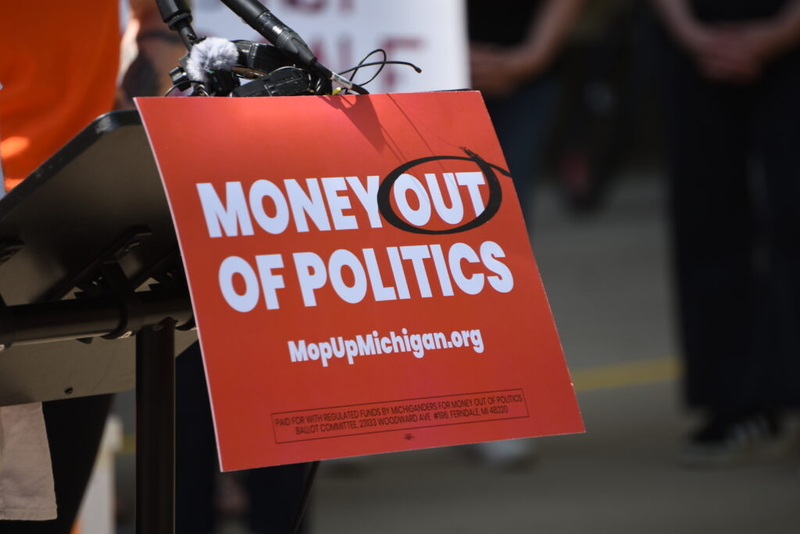
Michiganders for Money Out of Politics submitted its signatures in Lansing to make the November 2026 ballot. May 27, 2026. | Photo by Katherine Dailey/Michigan Advance.
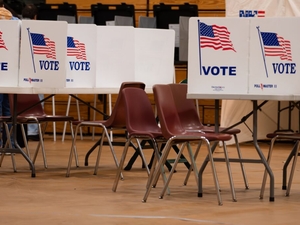
Voters will decide whether to upend campaign finance in Michigan when they head to the polls in November as outrage over money in politics intensifies pressure for reform.
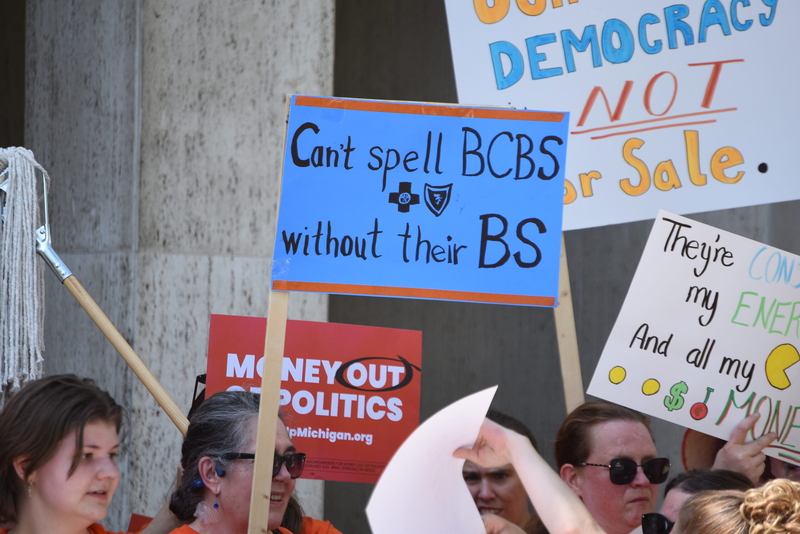
The ballot proposal is one of the most significant efforts to curb outside spending in state politics after a years-long stalemate in Lansing. If it passes, some of the largest political donors — including PACs tied to Blue Cross Blue Shield of Michigan, Comcast, DTE Energy, CMS Energy, and others — will no longer be allowed to spend millions of dollars on Michigan elections.
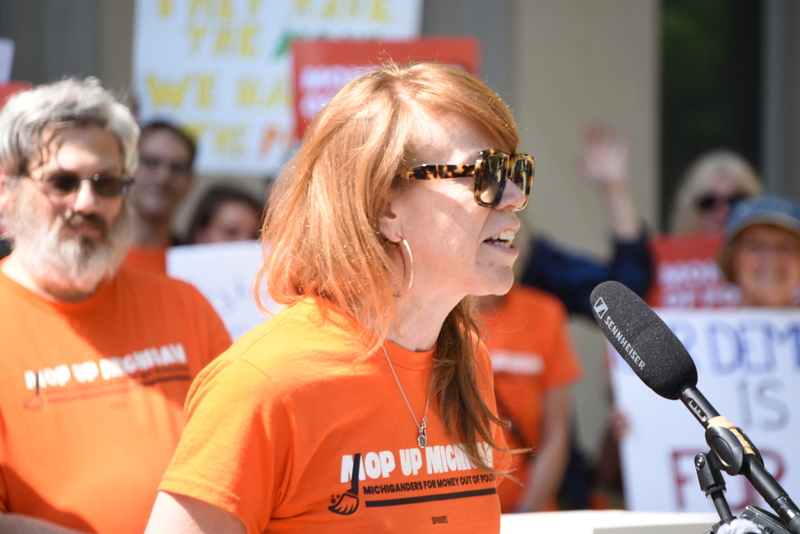
Christy McGillivray, co-chair of the Michiganders for Money out of Politics coalition and executive director of Voters Not Politicians, said the ballot initiative is just one step in a broader campaign aimed at “saving our democracy by attacking the actual rot at the heart of it,” and making government deliver for the people.
Corporate PAC money dominates Michigan elections
The ballot initiative would ban companies with over $250,000 in annual state government contracts, as well as regulated gas and electric utilities, from political spending in Michigan elections. The proposal would also prohibit people and organizations with “substantial connections” to the utilities and contractors from political spending, such as lobbyists or the immediate family members of executives. According to the coalition, it would impact at least 900 companies.
The campaign finance ballot proposal originated out of a coalition in 2022 aimed at securing voting rights and access for Black people, said Sean McBrearty, co-chair of the MMOP coalition. The coalition came together in 2023 to support the Taking Back Our Power bills – which sought to ban major government contractors and utilities from political spending – and coordinated with some lawmakers to introduce them in Lansing during the Democratic trifecta, but the bills were held up in the Government Operations Committee, or as McBrearty called it, “the place we call where good legislation goes to die.” The bill was reintroduced in early 2025 and still went nowhere, so the coalition abandoned the legislative route and pivoted to drafting the ballot proposal.
Corporate PAC cash is a dominant bipartisan force in Lansing. A 2025 Bridge Michigan analysis found that of all 110 members of the state House, an average of just 14% of their campaign funds came directly from constituents, while they were mostly funded by political action committees. And in 2023, the Energy and Policy Institute found that 119 out of 148 legislators accepted funds from utility PACs.
While the proposal targets corporations, utilities and certain connected individuals, it would not prohibit spending by unions, such as the United Auto Workers, nor by advocacy groups including the DeVos family-funded Michigan Freedom Network, and Michigan League of Conservation Voters.
DTE Energy and Consumers have been the subject of ire amid recent massive rate hikes – which McBrearty points to as a sign of “their influence in our political process.” He said the coalition decided to focus on utilities because of the “pattern of corruption” from their political spending influence in Lansing.
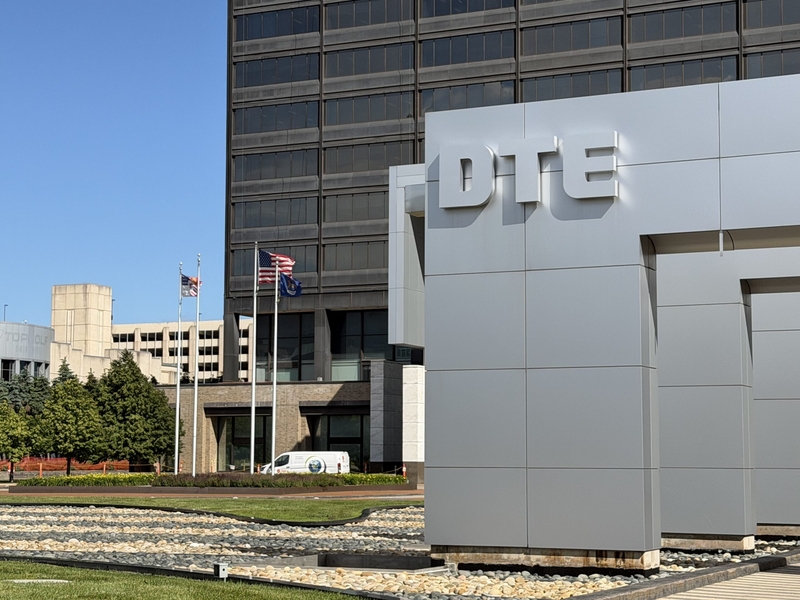
According to a 2025 report by the Citizens Utility Board of Michigan watchdog group, Michigan had longer power outages in 2023 than any other state. Even though its reliability ranks among the worst in the country, Michigan also has the 14th-highest residential electricity prices, about 3.50 cents higher than the national average.
One of the top recipients of DTE and CMS PAC cash is Gov. Gretchen Whitmer. According to campaign finance records, the major utilities’ PACs have together given more than $140,000 to her campaigns over the years. Some within her party have recently criticized the governor for decisions they say have prioritized corporate interests.
In July 2025, Whitmer replaced a member of the Michigan Public Service Commission with Shaquila Myers, who environmental advocates feared would be soft on regulators, prompting calls for a review of the appointment. And this year, the MPSC has approved massive rate hikes: a $242 million increase for DTE and $276 million for CMS. The panel is currently considering additional increases that would increase customers’ bills by roughly 10%.
“I think that’s a really concerning dynamic when there’s sort of this appearance of utility influence showing up a few different places in that process, both in the money that Governor Whitmer has taken and in the questions that many folks raised about the choice for that appointment,” said Karlee Weinmann, a researcher at the Energy and Policy Institute.
Weinmann also noted that while political spending is just one part of utility influence, it is the “kernel in the middle of all of it.”
“The utilities aren’t spending money on political influence for no reason. They’re doing it because it buys them access and influence in the halls of power,” she said.
Other top donors to Whitmer’s campaigns have included PACs affiliated with Blue Cross Blue Shield of Michigan and General Motors, as well as the Michigan League of Conservation Voters and unions.
Whitmer has pushed through major business subsidies, but a recent analysis by the Mackinac Center for Public Policy found that the contracts only brought in 3% of the jobs that the governor had touted. And last month, she came under fire for vetoing a package of Democratic bills after a drawn-out legal battle to push them forward in what some labor groups decried as a “betrayal.”
The governor’s office did not respond to multiple emails seeking comment.
The MMOP ballot initiative would not affect federal races, so PACs tied to government contractors and utilities could still contribute to presidential and U.S. congressional campaigns. So far in this election cycle, DTE’s PAC has contributed $79,500 to 11 Michigan candidates running for Congress, including U.S. Rep. Haley Stevens (D-Birmingham), who ended up losing the Democratic primary for U.S. Senate to Abdul El-Sayed. El-Sayed has made ridding corporate funding in politics the cornerstone of his campaign.
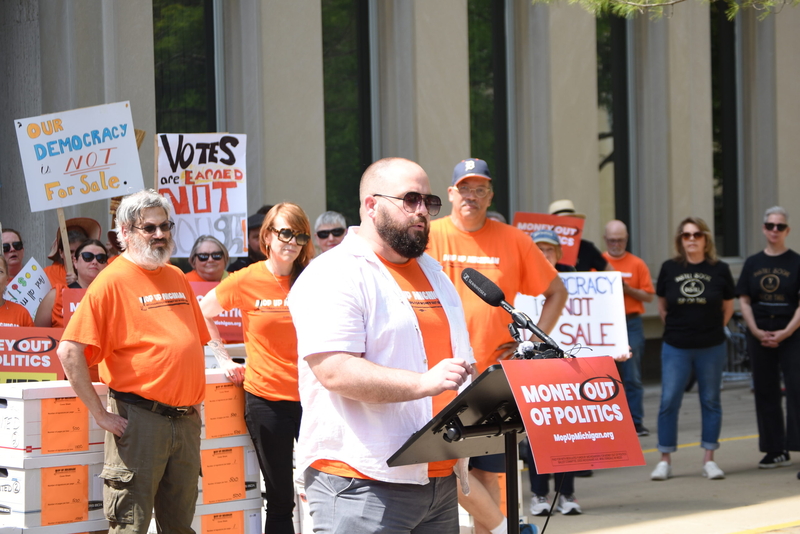
Proposal targets dark money
The initiative also targets so-called dark money. McGillivray called political spending by 501(c)(4) nonprofits “the most corrosive” form of campaign financing because those organizations generally are not required to publicly disclose their donors.
The proposal would expand regulations on political advertising, including donor disclosure requirements so that voters can more clearly identify who’s paying for ads. Advertisers would also be required to disclose whether an ad was authorized by a candidate.
It would mandate disclosures of independent expenditures over $500 within 10 days, and the disclosure would have to state which candidate the ad was supporting or opposing. The proposal calls for fines up to $50 for each day a report is not filed, and if it is overdue by more than 30 days, the violator could be found guilty of a misdemeanor punishable by up to 90 days in prison and $1,000 fine.
Everybody understands that you don’t necessarily want your government to be a government of folks who have been bought by wealthy special interests.
Attorney General Dana Nessel has criticized dark money networks for holding undue influence in Lansing. This year at a Mackinac conference roundtable, Nessel called the relationship between utility political spending and state politics “the worst corruption imaginable.” Utility dark money previously came under the spotlight in 2018, when a Republican state legislator who chaired the Energy Committee blamed that kind of spending for his loss.
But utilities are not the only ones accused of obscuring their political funds through backdoors. In 2024, Nessel charged two government operatives allegedly involved in a right-wing dark money scheme to influence COVID-era health policies.
“I came into this job thinking that the influence of dark money was substantial and corrosive to government,” Nessel said in a 2023 interview with MLive. “My opinion of that now is perhaps tenfold of what it was when I came into office.”
The MMOP committee itself has faced criticism for its fundraising tactics, as records show that the vast majority of its money has come from dark money nonprofits that shield the individual donors from public disclosure, while a sliver of its funds come directly from small-dollar donors. All Hands on Deck Network, a progressive advocacy nonprofit, accounts for 43% of the $7.3 million the MMOP committee has raised.
“We’re fighting to change the rules in our broken campaign finance system so the voices of everyday Michiganders aren’t drowned out by big corporations,” McGillivray told the Advance when asked about the donors. “Until our proposal passes and those rules change, we’re operating under the same laws as everyone else while working to reform them.”
On the other side of the proposal, corporations are bankrolling opposition to the initiative. The anti-MMOP committee, called Protect MI Free Speech, has collected $579,000 so far, all from just 16 donors. Contributors include MITA Inc, Michigan Citizens for Better Health, Comcast, CMS Energy, Blue Cross Blue Shield of Michigan, and Delta Dental of Michigan.
John Sellek, a spokesperson for the Protect MI Free Speech committee, told the Advance in an email that banning corporate PACs and relatives from political spending will “silence thousands of everyday Michiganders.”
“Meanwhile, out-of-state billionaires will still be able to spend like crazy to influence our politics,” Sellek said. “Sadly, it is doubtful that anyone walking into a grocery store or festival understood they were signing away their own right to participate in the political process when a petition was placed in front of them.”
McGillivray called the opposing committee’s message an “Orwellian lie,” asserting that it is money in politics that “drowns out the free speech of voters.”
State canvassers finds Michigan’s ‘Money out of Politics’ effort has sufficient valid signatures
“What really hampers free speech is the fact that these corporations can spend extreme amounts of money to buy our lawmakers,” McBrearty said.
The Board of State Canvassers certified the MMOP proposal July 24, greenlighting it to appear on the November ballot. Less than two weeks later, the Protect MI Free Speech committee announced it had filed a lawsuit challenging the certification, arguing that the board had miscalculated the number of required signatures and that 12 of the approved signatures should have been invalidated.
“The petition failed to meet the threshold required under its own methodology. It’s sloppy math and a failure to follow its own standards,” Sellek said in an Aug. 5 press release.
The lawsuit is asking the Michigan Supreme Court to reverse the certification, which would prevent the proposal from appearing on the ballot, and to fast-track its decision before Aug. 20.
McGillivray called the lawsuit the “opposition’s easiest and cheapest path” to try to stop the proposal before it reaches the ballot box.
“We won’t allow those defending massive, billion-dollar corporations to undermine the voices of more than half a million Michigan voters who signed our petition to rein in pay-to-play politics in Lansing,” McGillivray said in a statement.
Broad support for campaign finance reform
Outside political spending has skyrocketed in recent years even as polls show strong bipartisan support for reforms.
The U.S. Supreme Court’s landmark 2010 decision in Citizens United v Federal Election Commission overhauled campaign finance rules by allowing essentially unlimited political spending by corporations and special interest groups. In addition to rewriting federal campaign finance norms, several of the 24 states that restricted corporate and union political spending repealed or rolled back their rules to avoid legal challenges under the Supreme Court’s reversal.
Meanwhile, surveys show that most Americans are unhappy with the state of campaign finance. Nationally, more than 7 in 10 Americans agree there is too much money in politics, according to a Politico poll in April, including 77% of Donald Trump voters and 80% of Kamala Harris voters. And a poll by Progress Michigan, a liberal advocacy group, found that 8 in 10 Michiganders support the ballot initiative.
The public frustration with campaign finance has even been shared by some political leaders. The Detroit News reported that all four Michigan Democrats running for statewide office this year have expressed support for the proposal. And in a significant turnaround last month, Michigan Republican Party chair Jim Runestad wrote on social media that he was previously unsure about the initiative but is now “leaning toward” supporting it.
But others are skeptical. Macomb County Clerk Anthony Forlini, the Republican candidate for Secretary of State, told the Advance that he supports getting money out of politics but opposes the ballot proposal because it does not target all of the major political spenders such as special interest groups and “California billionaires.”
“We’re restricting the voice in Michigan, but we’re not restricting the voice from outside interests,” Forlini said.
Instead of the ballot question, Forlini said he wants to see the Legislature pass laws to eliminate dark money and tighten disclosure rules.
A Michigan Democratic Party spokesperson told the Advance that the state central committee has not voted on the MMOP proposal, noting that Chair Curtis Hertel and the MDP do not take a position before that panel.
“The MDP does believe that the U.S. Supreme Court’s Citizens United decision was unhealthy for our democracy and we support campaign finance reform,” the MDP spokesperson said.
Other states
Reforms in other states have informed the MMOP coalition’s own drafting process to ensure the initiative can withstand legal challenges.
McBrearty told the Advance that an earlier draft of the MMOP text restricted a broader group of family members of company executives from making political contributions but trimmed it down after a similar restriction in Connecticut suffered legal setbacks.
According to the National Conference of State Legislatures, about two dozen states ban corporate political spending, which include for-profit utilities. Nine states have specifically targeted utilities, in some cases restricting them from using ratepayer money on campaign contributions. But the Michigan proposal would go further than other utility-specific restrictions in the country.
“I think there are a lot of eyes on this Michigan proposal because it’s appealing to folks in other states that are feeling the same frustrations with their utilities,” Weinmann said.
Other states have targeted political spending from other sectors where advocates say corruption is most prevalent. Louisiana, for example, bans casinos and their executives from making political contributions.
Aaron McKean, senior legal counsel at the Campaign Legal Center, said it’s not a “one-size-fits-all” approach because the political environment and dominating forces vary from state to state. He also noted that campaign finance reform is not a “red state or blue state” issue.
“Everybody understands that you don’t necessarily want your government to be a government of folks who have been bought by wealthy special interests,” McKean said. “We want our government to represent all of us.”
In addition to industry-specific efforts, about 20 states have passed “pay-to-play” laws, or campaign finance restrictions on government contractors, including Connecticut and Hawaii. McBrearty noted that reforms were upheld in federal courts.
David Dulio, a political science professor at Oakland University, said that the ballot proposal appears to have a “persuasive message,” which will help its chances in November. But he noted that getting money out of politics appears “almost an impossible task” outside of a reversal from the Supreme Court or constitutional amendment, even though the goal itself is politically popular.
“Every election cycle, we see gnashing of teeth and handwringing about this, and nothing stops the seemingly continual rise of the cost of elections,” Dulio said.
The leaders of the Michigan effort agree that the current proposal is one step in a larger fight.
“I think that while MMOP isn’t going to solve all of this alone, it’s a huge step in the right direction,” McBrearty said.
If voters approve the ballot proposal, the coalition anticipates that its next hurdle will be defending against lawsuits. McKean of the Campaign Legal Center notes that restrictions in other states have withstood the courts.
“There’s good legal precedent for these types of measures and upholding them against legal challenges,” he said. “I think that these laws are typically more successful because courts have recognized over and over again that they play an important role in preserving our democracy and upholding our confidence in our elections.”
Lansing, MI