New Hampshire home prices set a record, bucking a national trend
Aug 10, 2026 | 5:00 am ET
Description
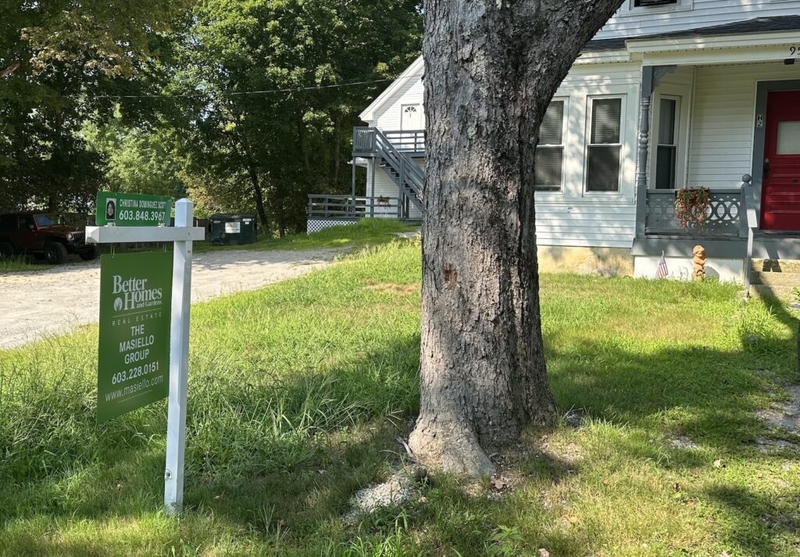
New Hampshire, like other New England states, has not yet benefited from the same factors cooling other housing markets. (Photo by Dana Wormald/New Hampshire Bulletin)
In Punta Gorda, Fla., a harbor town on the Gulf of Mexico crisscrossed by canals and cycling infrastructure, home values have dropped 8.3% in the past year, according to the Zillow Home Values Index.
Home values in Austin, Texas, have fallen by 5% and in Denver, Colo., by 3.4%.
Not so in New Hampshire. The Granite State’s housing market surged to new heights in July, reaching a record-breaking median sales price of $580,000 for a single-family home, the New Hampshire Association of Realtors announced Thursday.
That median is a 5.5% increase over June 2025, and a 36% increase over May 2021, when the median New Hampshire home first passed the $400,000 mark in the wake of the pandemic, a milestone at the time.
Nationally, housing prices have begun to stabilize, fueled by rapid construction, falling values in states such as Florida and Texas, and persistently high mortgage rates.
Asking prices across the country have been steadily dropping for nine straight months, according to data from Realtor.com. The national average this July was 2.4% less than July 2025, the website reported.
According to Redfin, national median sales prices were just 2.2% higher in June 2026 than in June 2025 — one of the lowest year-over-year increases since May 2021.
But New Hampshire, like other New England states, has not yet benefited from the same factors cooling other housing markets.
“Inventory continues to improve, but New Hampshire is still far from a balanced housing market,” said Josh Greenwald, the president of the New Hampshire Association of Realtors, in a statement.
Joanie McIntire, a real estate agent with Coldwell Banker and a previous president of the association, agreed. Even if the buying frenzy is no longer at its mid-pandemic peak, it is still high, she said in an interview.
“What we were seeing, and we’re still seeing to some extent, are multiple buyers for a house,” McIntire said. “If you have 13, or five, or even two buyers for a property, that means at least one person goes away that weekend without a property, and they’re out there still looking.”
Here are some of the takeaways from the latest housing numbers.
New Hampshire home sales are up
Summer is always the strongest season for home sales, which is why economists assess monthly sales data using year-over-year comparisons.
But even when comparing July 2026 to July 2025, the number of sales in New Hampshire is up 10.4%, the New Hampshire Association of Realtors data shows, while pending sales increased 7.2%.
And June’s numbers are even stronger: Sales in that month grew 12.3%, and pending sales were 24.5% higher from the year before.
That increased sales volume came despite July seeing the highest national mortgage rates of 2026 — 6.66% — driven in part by the Federal Reserve decision not to lower rates and in part by the resumption of the Iran war, which caused Treasury yields to rise.
Once again, New Hampshire is defying a broader trend. Nationally, the number of pending sales has grown steadily for eight straight months, the first time since 2021, according to Realtor.com. But those year-over-year increases are slowly shrinking month after month, down to 1.3% in July, potentially reflecting the effects of global economic uncertainty.
Still, the additional homes that are selling in New Hampshire are far more expensive than in the past, McIntire said.
“In 15 years, I had two million-dollar properties that went under contract,” she said, referring to her career before the pandemic. Today, she said, “I’m showing million-dollar properties on the regular.”
Buyer and seller power still imbalanced
The recent state and national sales data is full of contradictions that would appear to defy supply and demand. There are more homes for sale in New Hampshire than in past years, there are more sales being made, but prices are still increasing.
That’s because even though more homes are being sold, demand is far outweighing supply, competition is still fierce, and sellers continue to wield more power than buyers, the data suggests.
One metric captures that especially well, real estate experts say: the “months’ supply of inventory.” That number represents the number of months it would hypothetically take to sell all homes currently listed on the market in New Hampshire — if no new homes were added.
If it would take less than four months to sell, it is generally a seller’s market, economists say. More than six is a buyer’s market; the sweet spot for a healthy balance is between four and six.
New Hampshire’s months’ supply in July was 2.7 months, according to the association. That is barely a change from July 2025’s supply of 2.5 months. The last time the state had a months’ supply greater than four months was 2018.
Sales surging around lakes and mountains
Overall, the sales volume of single-family homes in New Hampshire — measured by dollars exchanged — is up 20.6% since July 2025, representing an increase from $891 million of monthly sales to $1.075 billion.
And the usual suspects are driving that buying surge: lake towns and ski towns. Belknap County, home of Lake Winnipesaukee communities like Meredith, Laconia, and Alton, saw its sales volume increase by 45% last month, while the median price hit $615,000, a 33% jump. The volume of sales in Grafton County, which includes Franconia, Hanover, Lincoln, and Waterville Valley, increased 41.9%, and 90.3% in Sullivan, home to Sunapee and Newport.
Even in Coös County, with the lowest median home price of $269,000, sales increased 36.4%, and that median is up from $225,000 last year.
Central counties like Merrimack and Hillsborough saw lower increases, and while sales volumes in Seacoast counties like Strafford and Rockingham have increased, the median sales prices have risen by smaller percentages.
The rising prices distort other metrics, like a reasonable price for a starter home. “I have to like get over that mindset of: ‘That’s a half a million dollars,’” McIntire said. “It’s a first-time homebuyer house.”
Inventory growing, but far from pre-pandemic levels
Once again, New Hampshire’s housing problems largely come down to supply.
There are indicators that supply is increasing. In July, 1,917 single-family homes were listed across the state, up 9.7% from July 2025. And overall inventory is much higher than before: 2,992 single-family homes, an increase of 15.6% from last year. That’s the highest number of homes on the market since 2021, the first year after the pandemic buying frenzy.
But 3,000 homes is far from what is necessary – or even what has been historically possible. In summer 2015, the number of homes on the market was north of 10,000, according to the NHAR. The recent gains might show momentum relative to recent stagnation, but it is far from what is needed to balance the market.
The surging prices and supply problems explain the decline of another number in New Hampshire: the affordability index. Under the current interest rates, the state’s median household income is 47% less than what is necessary to qualify for the median New Hampshire home. The last time the median home price matched the median income was 2021.
Greenwald noted that the type of housing coming on the market is as big a factor as the volume. He called for “continued efforts to expand New Hampshire’s housing supply through policies that encourage the construction of homes across all price points.”
“While recent increases in housing inventory are a positive sign, the persistent shortage of available homes, especially starter homes, continues to place upward pressure on prices,” Greenwald said.
McIntire argued the focus must lie with zoning — and building — modest houses on smaller lots for younger families.
“I believe those young buyers would like a small house, you know: 1,600 square feet on a half an acre,” she said. “Because they have very busy lives. They don’t have time to go out mow for three hours on the weekend.
Concord, NH