Alabama Department of Corrections could pay private attorney additional $38 million
Aug 07, 2026 | 5:59 am ET
Description
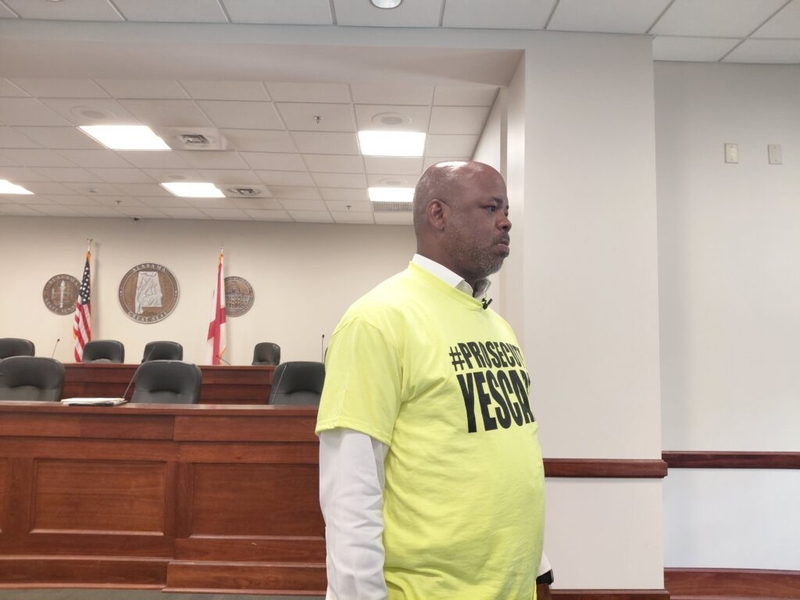
Rep. Chris England, D-Tuscaloosa, speaks with reporters on Thursday, Aug. 8, 2026, after a meeting of the Alabama Legislature’s Contract Review Committee. England voted to delay two contracts to pay Bill Lunsford, a private attorney, an additional $33 million to defend the Alabama Department of Corrections. (Ralph Chapoco/Alabama Reflector)
A state representative Thursday blocked two contracts between the Alabama Department of Corrections and a private attorney that would pay the attorney an additional $33 million, saying ADOC needed to provide answers on how it plans to resolve lawsuits in the future.
Rep. Chris England, D-Tuscaloosa, put holds on a $30 million increase in one contract defending the department in a lawsuit brought by the U.S. Department of Justice over violence in the state’s prisons, and a $3 million increase in another lawsuit alleging DOC provides inadequate mental health care to those in its custody.
Both went to Bill Lunsford, an attorney with Montgomery-based Butler Snow who received millions of dollars in legal contracts with the state, including one worth $4.68 million in Dec. 2024 and a $7.68 million one in June 2023. Lunsford stands to receive an additional $38 million from ADOC, according to Thursday’s Contract Review Committee agenda.
“There is a direct correlation between how much you pay your lawyers and how bad of a client you are,” England said. “And the Department of Corrections is an awful client.”
A message was sent to Lunsford on Thursday seeking comment.
The contract with the $3 million increase — from $1.65 million to $4.65 million – involves the Braggs v. Dunn litigation, alleging the state does not provide adequate mental health services to people who are incarcerated.
To date, the state has spent $17 million on the legal services contracts up for review on Thursday, according to England.
The DOJ contract rose from $3.6 million to $36.6 million, a $30 million increase. DOJ sued the state in 2020 after several reports finding widespread physical and sexual assault in Alabama’s men’s prisons. DOJ said the conditions violated inmates’ Eighth Amendment protections against cruel and unusual punishment.
No reason was given for either of the increases.
England decided to delay the contract awards for a maximum of 45 days until the agency gives him information about its plans for the lawsuits from this point forward.
“Has there been any sort of discussion about conflict, conflict resolution, and … I would be interested to also know if there were any settlement discussions in this case, what they looked like, and if we were ever offered a settlement in the Braggs case?” England said during the committee. “I want to get to a point where we analyze this from a position of trying the case and how much it costs us, and settling the case and how much it costs us.”
U.S. District Judge Myron Thompson, overseeing the Braggs case, has issued several directives to DOC to improve mental health treatment, including hiring additional corrections officers to adequately staff the prison so that people in custody can receive adequate mental health treatment; having third-party experts monitor the condition of people suffering from mental illness within the prison facilities, and ordering that staff adequately screen and appropriately classify people with mental health conditions.
A three-judge panel of the U.S. 11th Circuit Court of Appeals in June upheld Thompson’s ruling but reversed him on some remedies, including one order for ADOC configure all its cells so that people in them do not have the means to commit suicide. A second is that the agency fills “all mandatory and essential posts” at all levels, and the panel exempted Julia Tutweiler Prison for Women from the relief ordered by Thompson.
England did allow two contracts awarded to Lunsford. One was for an increase of $4.5 million over the recently concluded litigation over physical and sexual abuse of women incarcerated at the Julia Tutwiler Prison for Women in Wetumpka.
A second contract that was also changed that will pay an additional $1.5 million for Lunsford to defend the agency in a lawsuit filed by people housed in St. Clair Correctional Facility in Springville alleging “mismanagement, poor leadership, overcrowding, inadequate security, and unsafe conditions, including broken and nonfunctioning locks on the majority of cell doors, have led to an extraordinarily high homicide rate, weekly stabbings and assaults, and a culture where violence is tolerated, creating conditions of confinement that violate the Eighth and Fourteenth Amendments to the United States Constitution.”
In August 2025, a district court judge in Birmingham removed Lunsford and two other attorneys from a DOC case after one of Lunsford’s colleagues filed an AI-generated court brief that fabricated imaginary court citations.
Lawmakers on the committee said the state is trying to address the issues plaguing prisons.
“We are building one new facility, anticipating building another facility,” said Sen. Dan Roberts, R-Mountain Brook during the meeting. “Those are 4,000-bed, definitely state of the art. They are a little behind schedule, but we are working as a state on a plan.”
Montgomery