‘I wanted the pregnancy. It was just so scary.’
Aug 07, 2026 | 5:00 am ET
Description
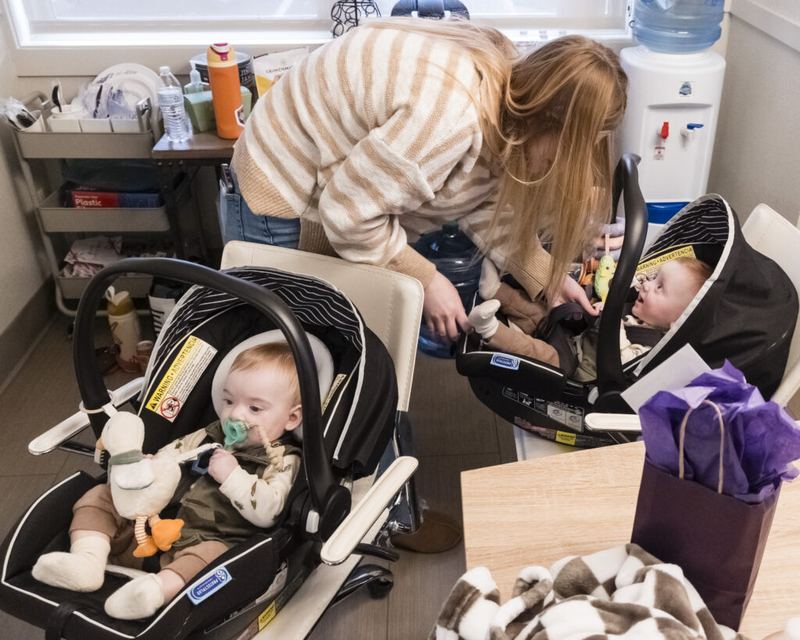
Hailey Allred buckles up her twins in preparation to leave Stanton Healthcare in Meridian, Idaho on January 16, 2026. (Otto Kitsinger for States Newsroom)
Hailey Allred and Jessica Perigo don’t know each other, but last year they were both financially insecure and living in abortion-ban states, where reproductive health clinics and maternity wards have closed in recent years, when they unexpectedly became pregnant.
Both found a local crisis pregnancy center offering free ultrasounds to confirm they were pregnant and to learn how far along they were. Both were comforted by the cardiac activity they heard.
For Allred, who would endure a painful and complicated pregnancy of twins, the center, which provided more medical services than many traditional crisis pregnancy centers, was a godsend.
“They gave me all the resources and the comfort I could find,” she said.
But for Perigo, who also continued her pregnancy, the center she visited made her feel judged and unheard.
“I just remember being very conflicted, because I’d always wanted to be a mom. I’d always wanted to experience pregnancy. I just didn’t know if then was the right time,” she said. “And I remember bringing all that up to them, and … they asked me if I was religious.”
Crisis pregnancy centers have received hundreds of millions of taxpayer dollars just in the past few years. But there’s been little government oversight of how that money is being used and whether such centers are meeting high standards of medical care when they offer free ultrasounds and other services.
These centers, also called pregnancy resource centers or pregnancy help centers, often operate near other abortion clinics, and some have been criticized for using deceptive tactics to dissuade or delay women seeking abortion. As part of our ongoing series, Billion Dollar Baby Bump, States Newsroom spoke with former pregnancy center staffers and with clients who sought care at crisis pregnancy centers. These are some of their stories.
Florida
When Jessica Perigo got pregnant last year, she and her husband were living in a one-bedroom apartment in Orlando, Florida, that they could barely afford. She was on anti-depressants and would have had to stop them to carry the child. Because Florida already had a six-week abortion ban, she didn’t have a lot of time to make a decision on whether to terminate the pregnancy, she said. She also wanted to know whether she could be at risk for a medical emergency, such as an ectopic pregnancy.
Her doctor’s office wasn’t scheduling an ultrasound fast enough to calm her anxiety, she said. So, she went to a crisis pregnancy center advertising free ultrasounds, which informed her when she arrived that it wasn’t a medical clinic but could confirm pregnancy via ultrasound.
But before the procedure, Perigo recalled, she spent some 90 minutes waiting and was asked repeatedly whether she would join a church. And once she was scanned, Perigo recalled, staff told her they couldn’t offer any real medical information.
“I just wanted the ultrasound because I wanted to ease my own anxieties of, is this an ectopic pregnancy or not,” Perigo said. “They gave me so much of a runaround because they wanted to know … whether I was religious or not. That’s what their primary focus was, was I going to have an abortion?”
Perigo was relieved to see her baby’s heartbeat. But staff told her they couldn’t do more than verify that she was pregnant. And she didn’t like feeling judged for being unsure about her pregnancy. And in the weeks after her visit, she didn’t like that the center kept calling her.
“They kept calling me, and they asked me four questions: Was I still pregnant? Was I feeling better about being pregnant? Had I considered joining a church for the spiritual welfare of my pregnancy? And if I wasn’t feeling better about my pregnancy, would I like to be put in contact with adoption resources?”
She said the center continued calling even after she had given birth.
“I told them, ‘I already gave birth. Yes, I’m keeping my baby. Stop calling me.’”
Idaho
Last year Hailey Allred learned she had polycystic ovary syndrome, known as PCOS or PMOS, and likely would never get pregnant without an intervention. So she was surprised when a few months later, in August 2025, she did.
“I didn’t think that any of my pregnancy tests were real,” Allred said.
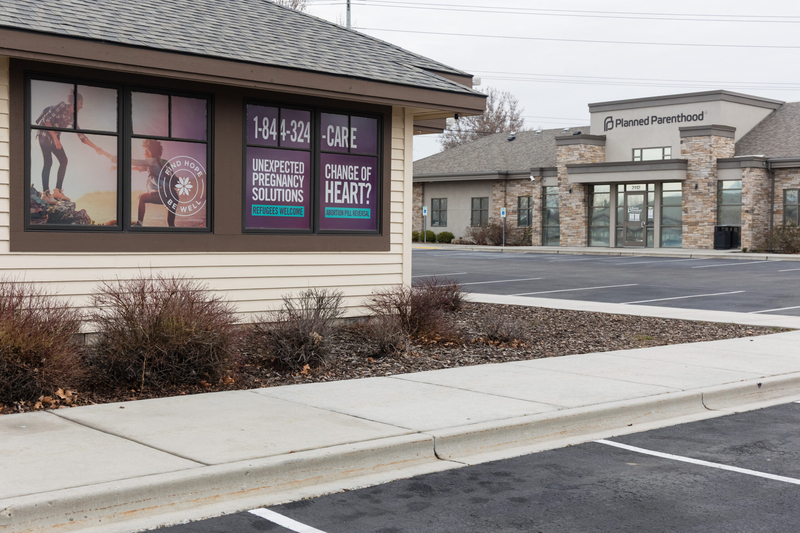
To find out for sure, the 19-year-old newlywed, who did not have good health insurance, went to Stanton Healthcare in Meridian, Idaho. The pregnancy center shares a parking lot with the last standing Planned Parenthood in the state. Like most pregnancy centers that encourage women and girls facing challenges to continue their pregnancies, Stanton’s services are free. And for Allred they were nothing but positive. The Meridian center is accredited with the Accreditation Association for Ambulatory Health Care and faces a level of oversight not required for most crisis pregnancy centers.
Allred said Stanton’s director of client care, Angela Dwyer, confirmed she was pregnant, and at an estimated four weeks’ gestation, and sent her home with a goodie bag that included prenatal vitamins and a baby blanket. When Allred came back two weeks later, the ultrasound revealed she was carrying twins. This time, Dwyer sent Allred home with the book “What to Do When You’re Having Two,” along with ginger and tea for increasing nausea and vomiting. Her nausea developed into full-blown hyperemesis gravidarum, and she lost more than 40 pounds.
The challenges kept mounting — concerning prognoses for the twins, Allred’s shortening cervix and issues with her liver. Her husband had just gotten a new job without any health insurance.
“Genuinely, like, I was so scared,” Allred recalled. “I think I cried, I want to say, maybe three times a day. I wanted the babies so bad. I wanted the pregnancy. It was just so scary of what I was to expect.”
She said Stanton referred her for mental health counseling for prenatal depression and recommended the OB-GYN who ended up delivering her babies. The twins were born preterm at 29 weeks via emergency Cesarean section and had to stay in the hospital for more than two months.
“Without them, we wouldn’t even have a nursery set up. They took me to a storage unit, and they offered to give me a dresser and a crib for our nursery. They have always been here with diapers and clothes,” Allred said. “Yes, they provided medical care, but it was also like they provided more of that emotional care as well.”
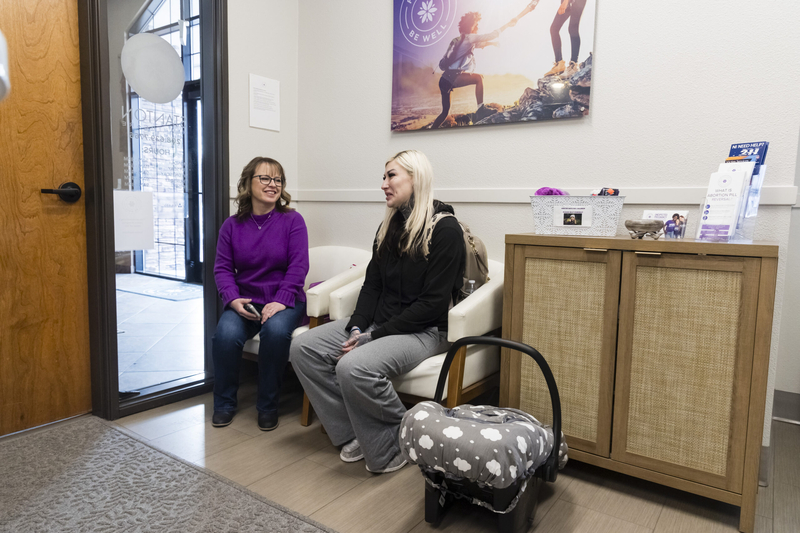
She said last year the Stanton pregnancy center gave Allred’s family a Christmas tree and gifts to wrap for the kids.
“I had called about some resources that I needed after my boys came home from the NICU, and they were like, ‘We’d like to put you down on a Christmas list,’” Allred said. “I think it’s just crazy to think that I came in here looking for pregnancy support, and I built a family.”
Haley Martinez, 21 and pregnant with her second child back in 2017, said she was drawn to Stanton Healthcare’s crisis pregnancy center because it does not provide abortions or refer patients to abortion providers. .
“I wouldn’t want to go to a place that wasn’t pro-life,” Martinez recalled.
The Idaho center gave her free prenatal checkups and ultrasounds along with parenting classes and referrals for services and free baby supplies, she said. But it was the emotional support Martinez received when the baby was stillborn that helped her grieve and eventually have four more children, she said. Her sixth was born in December 2025, two days after Christmas.
Martinez said that she was simultaneously seeing an OB-GYN during those pregnancies but would go to Stanton when she wanted an ultrasound to give her peace of mind.
“They relieved my stress immediately. I see a heartbeat, I see a moving baby, and I know that it’s going to be OK,” Martinez said. “They have changed my life. If it wasn’t for them, I probably wouldn’t have had more kids. With their support and comfort, I knew I really wasn’t walking alone.”
Illinois
When Angela Weszely became president of a Christian pregnancy center in Chicago in 2006, she learned center staff were guided by two main missions: to dissuade clients from abortion and to communicate with them the Christian faith. As she read in the center’s historical materials, these missions applied to medical services such as ultrasounds, and to advising clients.
When Weszely moved to a professional counseling model, she said some staff were resistant, including a nurse, whom she reprimanded for writing “‘Hi, Mommy, Hi, Daddy,’” on the ultrasound screen. She declined to name the center, which she said is still operating, to protect its privacy.

“I said, ‘Oh no, that is not what we’re doing. You know, a woman deserves to see this (the ultrasound) if she wants to. I also don’t agree with the practice where women don’t see it, but the woman needs to be in control, and that felt really undignifying and violating. We treat them as human beings with dignity and agency, and what we want them to do is not going to be part of their medical care here.’”
That set the center apart in a movement where targeting abortion-minded women and changing their minds is the ultimate mission.
Weszely said she was also disturbed during some of the client sessions she sat in on. During one session, she recalled, a pregnant client who was already a mom was explaining all of the obstacles she was facing and why she was considering abortion.
“And the counselor decided to talk to her about why she should place for adoption, and I was just like, ‘Wow, if I was this woman, I would not have felt seen,’” Weszely said. “She’d actually disclosed things that were very hard about raising the child she had. But I felt that’s where we should be supporting her, you know, if according to the website, you’re really coming to get unbiased help and support.”
She said her philosophy was not welcomed by the other Chicago pregnancy centers or the national network Care Net with which she said the center organization ended its affiliation by 2010.
“I went to one or two Care Net conferences and a Heartbeat conference, and I thought that the way the problem was being framed at those conferences was not actually what was happening,” Weszely said.
“No one wanted to have the same conversation that my team and I was having, which is, ‘Hey, are we all on the same page about listening to women and asking questions rather than giving information? Are we all on the same page about disclosing on our website that we are faith based, so no one feels a bait-and-switch when they come in?’” she recalled. “People didn’t want to talk about that.”
In 2016, Weszely founded the organization ProGrace, which provides guidance to churches and some independent pregnancy centers on a Jesus-centered approach that includes interacting with pregnant women without overtly proselytizing or forcing a viewpoint.
Kentucky
When retired nurse Susan Rames was training to provide ultrasounds at a crisis pregnancy center near Louisville, Kentucky, in 2020, she said she found the program to be rigorous and was required to complete at least 75 scans on volunteers before she could serve clients.
But she left the center before meeting that threshold, after discovering the center had been using disinfectant that Rames said was both expired and the wrong kind for cleaning transvaginal probes because it didn’t kill strains of a high-risk sexually transmitted infection, human papilloma virus, or HPV. She said her concerns went unheard by directors and staff both at the center and at the major pregnancy center networks.
Crisis pregnancy centers fight for ultrasound use in clinics without government oversight
“When you’re dealing with someone’s health, you just don’t go around those rules,” Rames said. “That’s just the way I think every nurse gets trained.”
Rames started filing whistleblower complaints with the state of Kentucky in 2021 but learned the center was not regulated by the health department. She said she subsequently filed a complaint with the state board of nursing, which was dismissed, as Reveal reported in 2023.
“When I contacted (the pregnancy networks), they all just fall all over themselves to try and say, ‘Well, this is not how we expect our centers to run,’ and I’m like, ‘But you put out that information as though they all are being held accountable, and they’re not,’” Rames said. “ I contacted the health department, ‘Well, that’s not on us. We don’t regulate them.’ So they’re just freewheeling out here expecting people with their good morals to do what they’re supposed to do.”
This story is part of a reporting fellowship sponsored by the Association of Health Care Journalists and supported by the Commonwealth Fund.
States Newsroom’s investigation is ongoing. If you have had an experience with a crisis pregnancy center, please get in touch at [email protected]. Stateline reporters Sofia Resnick and Shalina Chatlani can be reached at [email protected] and [email protected].