Democratic wins put Medicaid expansion back in play in holdout states
Nov 06, 2026 | 4:21 pm ET

Description
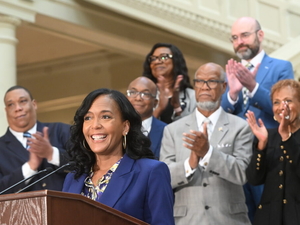
Georgia Democratic Gov.-elect Keisha Lance Bottoms celebrates her victory on Nov. 3 in Atlanta. Bottoms made full Medicaid expansion central to her campaign and has called it “a day one priority.” Democratic victories could bring Medicaid expansion to a handful of other states. (Photo by Ross Williams/Georgia Recorder)
In a handful of holdout states, Democrats appear ready to use their newly won statehouse dominance to expand Medicaid under the Affordable Care Act.
In at least four states — Georgia, Kansas, Texas and Wisconsin — the midterm election results have tilted the political calculus toward expansion, though lawmakers have yet to lay out details. Medicaid is the joint federal-state insurance program for people with low incomes.
Georgia and Wisconsin have limited expansion programs, but neither has approved the broader expansion allowed under the Affordable Care Act.
“Before Tuesday, I wouldn’t have expected much activity in the 10 remaining states that have not expanded Medicaid” to more adults under the Affordable Care Act, said Larry Levitt, executive vice president for health policy at the health research and policy nonprofit KFF, on a media call after the election.
“But I think that dynamic has changed.”
Under the Affordable Care Act, better known as Obamacare, states can expand Medicaid to cover adults earning up to 138% of the federal poverty line — about $22,000 a year for a single person — and the federal government will pick up 90% of the costs for those newly eligible enrollees.
Forty states took the deal, adding nearly 20 million people with low incomes to the rolls. In the remaining 10 states, which have been mostly controlled by Republicans, expansion has been blocked by GOP opponents who think it is too expensive or who are ideologically opposed to growing government programs.
Georgia Democratic Gov.-elect Keisha Lance Bottoms made full Medicaid expansion central to her campaign and has called it “a day one priority.”
“This is thrilling for me because this is the reason I ran for office in the first place,” said Dr. Michelle Au, a Democratic Georgia state representative and physician.
In Georgia, Democrats won every statewide office that was on the ballot and appear poised to take control of the state House, though Republicans will still control the state Senate. Democrats would need bipartisan support to get expansion passed.
“We are going to see a bill and it’s going to be an interesting process in the newly divided government,” said Au.
She said a 2024 Medicaid expansion bill had bipartisan support among state legislators, including from Republicans representing rural districts facing hospital closures and higher rates of uninsured residents. The bill eventually died in committee, she said, in large part because it didn’t have the backing of Republican Gov. Brian Kemp.
“What became apparent in that process was that there was nothing more important to the passage of this issue than having a strong governor who supports it,” Au said.
“If anything, this issue has only gotten more urgent and popular” among voters, she said.
Wisconsin’s new Democratic trifecta — the party will control both legislative chambers and the governor’s office — could make full Medicaid expansion much easier to pass. Wisconsin Democratic Gov.-elect David Crowley has deferred to legislators when asked about expansion.
Democratic state Rep. Greta Neubauer, who is set to become House Speaker, stopped short of promising expansion in a call with reporters after the election. She said lawmakers will look at several options to address healthcare, reported the Wisconsin Examiner.
Neubauer said Medicaid expansion was complicated by the Trump administration’s new work requirements and other changes to the program.
“It’s a shame that Wisconsin has not done that up to this point,” she said. “We are going to be working very closely with the administration to figure out the best way to expand access to affordable healthcare for Wisconsinites, even given the Trump administration’s efforts to cut access and raise costs.”
In July 2025, Trump signed a broad tax and spending measure that is projected to cut federal Medicaid spending by an estimated $886.8 billion over the next decade, largely because new work requirements will push people off the rolls, according to estimates by the Congressional Budget Office. The new rules, which will take effect in January, will apply to people who became eligible for Medicaid as a result of expansion.
But the new Democratic-controlled Congress is expected to look at delaying or reversing the changes, which “may make it even more attractive for places like Texas and Georgia to try to expand,” Levitt said.
Texas voters also voted Democrats into every statewide office that was on the ballot, including electing Democrat Gina Hinojosa as governor and flipping control of the state House. Republicans still control the state Senate.
Hinojosa told a Houston television station that she would push the state legislature to expand Medicaid.
Before the election, Kansas’ outgoing Democratic Gov. Laura Kelly called the Kansas’ Legislature’s refusal to expand Medicaid “the dumbest thing Kansas has ever done.”
She said the main roadblock was opposition by Kansas’ Republican House Speaker. But this week, Kansas Democrats flipped as many as 20 seats in the Kansas House, quashing the Republican supermajority.
Votes are still being tallied, but it appears that while Republicans will retain a majority in the state House and a supermajority in the state Senate, Democrat Cindy Holscher holds a narrow lead in the governor’s race.
Holscher campaigned on promises of expanding Medicaid, saying Medicaid expansion would help prevent hospital closures and improve access to mental health services. She noted that expansion is popular across the state.
“This is approved by, I believe, over 75% of the population,” she said. “This cuts across the political spectrum. Rural as well as urban areas say this is what we need to do.”
Stateline reporter Anna Claire Vollers can be reached at [email protected].