New nuclear reactors feasible in Arkansas but government support needed, panel told
Aug 06, 2026 | 5:30 pm ET
Description
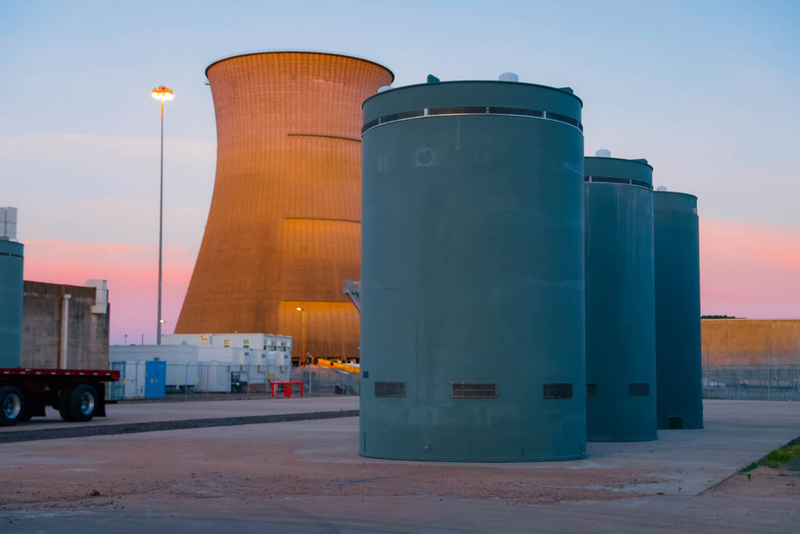
There are 102 steel-reinforced concrete storage casks holding spent nuclear fuel rods at Arkansas Nuclear One in Russellville. (Courtesy of Taylor Kendrick/Entergy Arkansas One)
Building new nuclear reactors in Arkansas is both “feasible and advisable,” a consultant hired by a legislative panel said Thursday, but state assistance with preparation and financing may be required.
The finding came one year after the Joint Energy Committee hired the consultant, Maryland-based EXCEL Services Corporation, to study the possibility of new nuclear reactors in the state.
A 2025 law directed the state Department of Energy and Environment to hire a firm to conduct the study, but the agency did not receive funding to do so.
The 533-page report identified several areas across the state that would be possible contenders for future nuclear power, particularly in central and southwest Arkansas, where transmission capacity is highest.
Pope County is already the home of Arkansas Nuclear One, a two-reactor nuclear plant owned by Entergy Arkansas that’s been in operation since 1974. The plant supplies more than half of the annual power demand from Entergy’s Arkansas customers, according to the utility.
The U.S. has not seen a new nuclear reactor come online since 2023 and 2024, when the third and fourth units of the Vogtle nuclear plant in Georgia were completed seven years late and $17 billion over budget. Prior to that, the last nuclear reactor completed since the turn of the century was the second Watts Bar reactor in Tennessee in 2016 — also years late and billions over budget.
Brian Meadors, the executive vice president of legislative initiatives for EXCEL Services Corporation, told lawmakers that those kinds of cost and time overruns are to be expected with “first-of-a-kind” nuclear reactors. But he said the cost drops each time a reactor design is replicated.
“Arkansas does not have to choose between building first at triple cost and doing nothing,” the final report says. “The state can position itself for the NOAK (next-of-a-kind) price by supporting the acquisition, characterization, and permitting of sites now.”
Amid a boom in energy demand and subsequent focus on “American energy dominance,” the Nuclear Regulatory Commission and the second Trump administration have moved to loosen certain longtime safety standards to spur new nuclear construction. It comes as some utilities are bringing shut-down nuclear power plants back online.
States like Texas, Utah and Tennessee have placed millions of dollars in taxpayer money into nuclear funds to promote nuclear power construction.
That, Meadors said, was why he recommended Arkansas position itself to take advantage of these recent pushes as data centers and lithium and steel production in the state require more power and coal plants begin to come offline. Even if completion of the first round of new nuclear reactors is still a ways off, the state can prepare for the lower prices that will likely come once those reactors come online, Meadors said.
“Government support is necessary, and that can take a lot of different forms,” said Paul Murphy, the managing director for Murphy Energy and Infrastructure Consulting, which contributed to the report. It was important to recognize that not all states have the same financial resources, he said. “It’s important to be mindful of what your peers are doing, recognizing all states are not equal in terms of size and financial resources.”
Among other recommendations, the report said the governor should appoint someone to be the state’s atomic development coordinator — a role created by state law in 1957 but has never been filled, he said.
The report also recommended passing a proposed “Arkansas Nuclear Competitiveness Act,” which would define nuclear as clean energy, expand the atomic coordinator’s duties, and create the Arkansas Nuclear Energy Development Fund to pay for things like siting studies and workforce training. Money for the fund would come from legislative appropriations, federal funds and gifts, grants or other contributions.
Lastly, the report recommended the state begin preparing potential sites alongside counties “receptive to new nuclear industry” by or getting a site approved by the NRC prior to construction of a nuclear plant.
Several lawmakers expressed support for nuclear generally, but also voiced skepticism about some of the financial tools the report raised as possibilities, particularly a cost overrun mechanism, given how expensive previous nuclear plants have been. Also called “cost overrun facilities,” such a mechanism would see the state cover all or part of cost overruns associated with a potential project if the state enacted one.
“We could literally bankrupt the state if we want to do some of this stuff,” said Republican Rep. Zack Gramlich of Fort Smith.
Committee co-chair Sen. Mark Johnson called the growing demand for power “a different kind of crisis,” and the broader public was becoming more welcoming to nuclear power after a long period of skepticism.
“I know the 1950s attitude — people still have that mushroom cloud in their mind,” the Republican from Conway said. “They’re starting to get more comfortable with nuclear energy — and I think the public generally is.”
Little Rock