Utah, feds strike $18 million deal to help repair damage from Cottonwood Fire
Aug 06, 2026 | 6:24 pm ET
Description
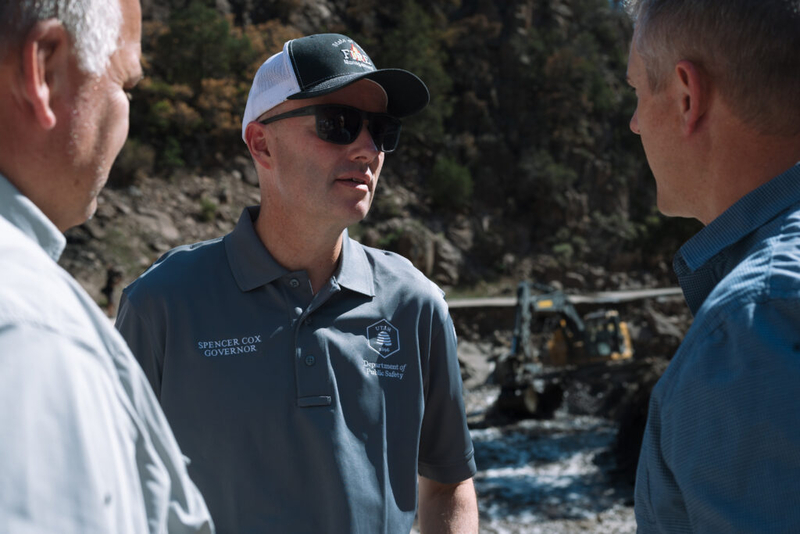
Utah Gov. Spencer Cox, center, tours wildfire and flood stricken areas in Beaver County on Aug. 6, 2026. (Courtesy of the Utah governor's office)
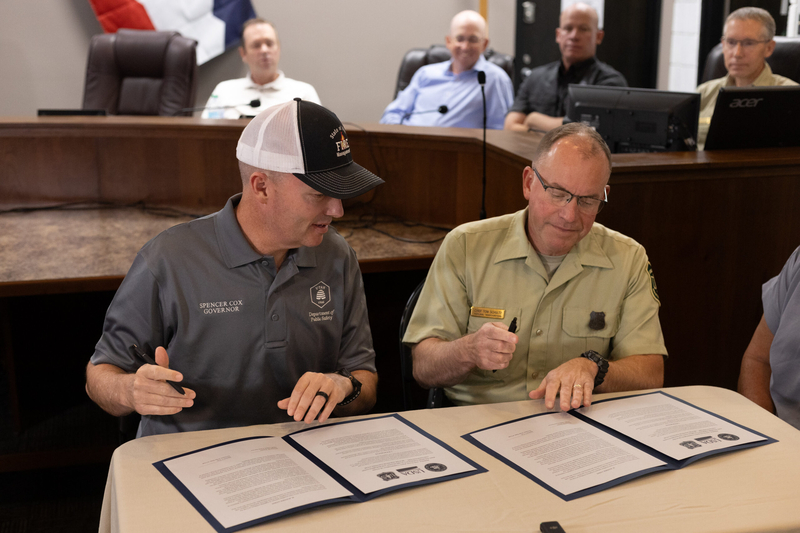
Utah Gov. Spencer Cox and U.S. Forest Service Chief Tom Schultz on Thursday struck an $18.4 million deal to help Beaver and Piute counties recover from wildfire and flooding damage.
Cox and Schultz signed the agreement Thursday ahead of touring areas impacted by the over 97,000-acre Cottonwood Fire in Beaver County (including where flash flooding came in the wake of the fire, worsened by its burn scar) and the over 96,000-acre Widemouth 2 Fire near Kanosh in Millard County.
“As if the fire was not enough,” Cox said of the Cottonwood Fire, “Mother Nature got another blow to this area.”
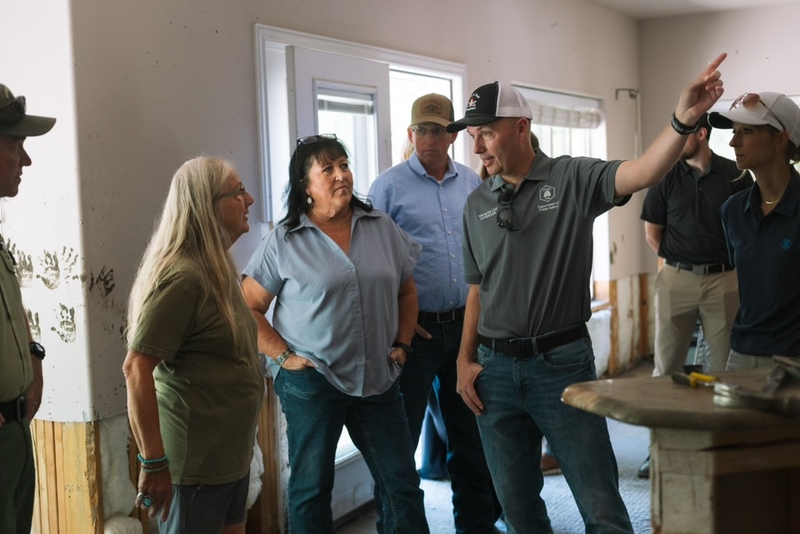
Monsoon storms over the fire’s burn scar brought flash flooding and debris flows that surged into Beaver County neighborhoods, forcing evacuations for about 200 homes while damaging roughly 80 houses, washing out important sections of S.R. 153 and impacting drinking water supply.
This morning, U.S. Forest Service Chief Tom Schultz and I signed an agreement committing $18 million to help Beaver and Millard counties recover from this year’s devastating wildfires and flooding.
This partnership includes $9 million from @forestservice and $9 million from the… pic.twitter.com/ebjN8Bhili
— Governor Cox (@GovCox) August 6, 2026
The governor, while expressing “our deepest gratitude” to firefighters and other emergency responders to bring the Cottonwood Fire under control, said “we celebrate that there was no loss of life, (but) we also grieve for what was lost.”
“We will not leave you to pick up those pieces alone,” Cox said in a message to Beaver County residents.
Under the agreement with the U.S. Forest Service and the Department of Agriculture, the federal government and the state of Utah will each match $9.2 million to help stabilize and rehabilitate damage done by the Cottonwood Fire. Utah’s share will come from the state’s wildfire fund, according to the governor’s office.
The agreement, signed by Cox and Schultz, says “there is no other word to describe the Cottonwood Fire other than ‘catastrophic.’”
“Homes were destroyed. Grazing allotments were burned. Cattle have been lost. Entire timber stands were engulfed in flame,” the agreement says. “Unfortunately, the damage and loss did not end when the wildfire’s flames were extinguished by State and Federal wildland firefighters. Then came the floods. It is unfathomable for anyone to fully understand the hardship Utah communities have suffered as a result of the Cottonwood Fire.”
The agreement also said the Cottonwood Fire will go down in state history with infamy.
After fire and flooding, Cox declares a state of emergency in 3 Utah counties
“All told, the Cottonwood Fire takes the ominous position as being the most destructive wildland fire in Utah’s history,” the agreement says.
Federal and state partners vowed to “stand side-by-side in natural resource rehabilitation and assisting communities impacted by wildfire and resulting floods.”
“Miles of fence will need to be rebuilt, roads repaired, timber salvaged, trails and trailheads reconstructed,” the agreement says. “Watersheds will need to be enhanced to prevent further flooding. The list is long for the challenges lying ahead for affected Utah communities and their surrounding natural resources.”
The agreement signed Thursday morning doesn’t specifically extend to areas in Millard County ravaged by the Widemouth 2 Fire. But Schultz told reporters the U.S. Forest Service will conduct a post-fire damage assessment of the burn scar — like it did for the Cottonwood Fire — to look at the fire’s impacts and whether additional federal funding will be necessary.
“What I’ll tell you right now is that we don’t have unlimited funding for post-fire recovery,” Schultz said. “Right now, we’ve prioritized Cottonwood given those tremendous funding impacts.”
Schultz also said federal officials are evaluating fire damage “across the country right now.”
“We’ve got a lot of fire in Oregon, Washington, Idaho (and) Colorado,” he said. “So there’s a lot of other considerations, but we will be definitely looking at that immediate … emergency funding that we have to get on the ground within the first six months. That’s something that will initiate here in the next week or two on this project.”
Western US emergency experts say FEMA response still favors East Coast hurricanes over Western fires
Cox added that alongside federal officials “we’re trying to get additional funding” for wildfire mitigation “because we know that Washington’s going to need it,” along with Oregon, Idaho and Utah.
“There’s going to be a general need because this year is so unique,” he said.
Cox also alluded to an issue that was highlighted during a recent Western Governors’ Association meeting in June, where uncertainty about the Federal Emergency Management Agency’s future loomed over the governors’ concerns about increasingly devastating wildfires, and how FEMA favors East Coast hurricanes over fires in the West. Some New Mexico senators in that meeting called on FEMA to change the way it deals with post-fire flooding.
Cox on Thursday also suggested some changes to FEMA were necessary for better wildfire and flooding response.
“We need our federal friends to step up,” Cox said. “FEMA was more designed for hurricanes. It really hasn’t been designed for these types of disasters. We’re working on changing that. I’m grateful for an administration that will do that.”
Cox also said state and federal officials are “going to work together to see if we can unlock some … rainy day funds to help with the recovery as well.”
While noting that “Mother Nature” played a role in the fires’ destruction, Cox also placed some blame on past forest management.
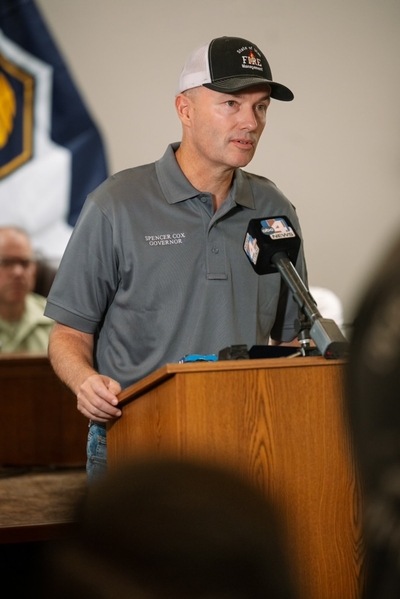
“We had done some things right (in) this forest,” he said, noting that some forest thinning or other treatments had helped prevent even further destruction. But he also said “we were wrong in clear cutting the forest 100 years ago.”
“That was wrong, and it was terrible for our forests,” he said. “And we were wrong by not allowing any treatments on the forest, equally as wrong. You can’t have 3,000 trees per acre in some places. It’s just that’s not what Mother Nature intended. You know, we should have 50 to 90 trees per acre, whatever the ideal number is. But that’s not what we have in most of these places.”
Cox said the fire just “clear-burned an entire forest, an entire mountain, which is maybe worse than clear cutting because it kills everything else and washes things away,” while also worsening air quality.
The governor said to “people who are angry about carbon being burned in this country, I’d love to see them out here protesting the burning of these forests, because that’s exactly what happens when you do it the wrong way.”
“I’m grateful that we have people who understand we need to do this the right way,” he said. “We need to get serious about it.”
Salt Lake City, UT