New Mexico congressional delegation members demand info on military GPS jamming before fatal crash
Aug 06, 2026 | 5:25 pm ET
Description
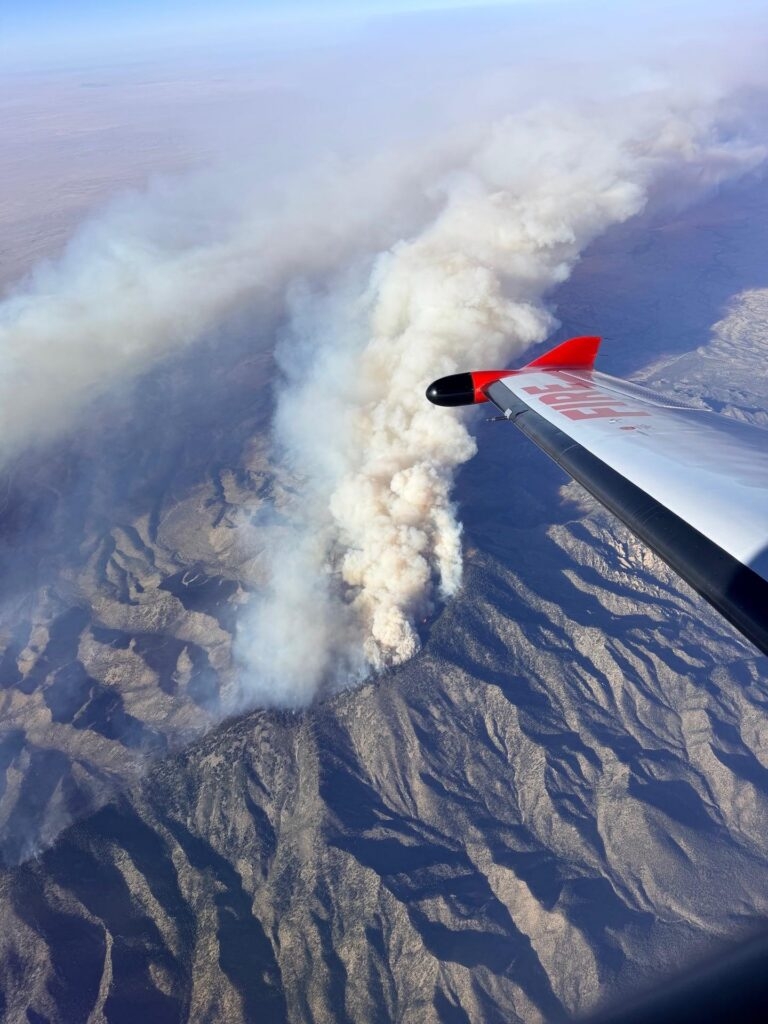
Smoke rises on May 19, 2026, near Ruidoso over the Seven Cabins Fire, which was a fire sparked after a medical transport plane crashed and killed all four occupants aboard. Recent reports have suggested that military GPS jamming may have contributed to the crash. (Photo courtesy Lincoln National Forest)
Members of New Mexico’s congressional delegation are demanding answers from federal transportation and defense agencies following recent reports that White Sands Missile Range officials may have contributed to a fatal plane crash in May by jamming the pilot’s global positioning system.
The May 13 crash of a small medical transport plane near Ruidoso killed four people and ignited the Seven Cabins Fire, which burned nearly 17,000 acres in the Lincoln National Forest. A recent preliminary report from the National Transportation Safety Board notes that the pilot reported issues navigating the plane at the same time that White Sands Missile Range officials were conducting GPS jamming tests.
The military jams GPS to help determine whether United States military weapons systems are vulnerable to interference. These are planned, government-sanctioned activities and military exercises that support national security, according to the FAA’s GNSS Interference Resource Guide.
This week, U.S. Rep. Gabe Vasquez (D-N.M.) and U.S. Sen. Martin Heinrich (D-N.M.) announced in news releases that they were demanding information from U.S. Defense Secretary Pete Hegseth and Transportation Department Secretary Sean Duffy.
“Military technology definitely had a role to play in the flight path of this tragic crash,” Vasquez said in a statement he released Wednesday after a briefing with the NTSB.
But even before the May crash, pilots had warned for years about GPS jamming while flying near the White Sands Missile Range, according to a Source NM review of hundreds of anonymous pilot testimonials contained in the federal Aviation Safety Reporting System. The system allows pilots to voluntarily and anonymously report safety issues to authorities that can investigate and take action.
Since 2010, according to Source NM’s review, nearly 70 different narratives published in the system have mentioned GPS jamming in New Mexico, most of them near White Sands, and sought to alert authorities about the potential dangers.
“This extremely frequent jamming of critical GPS navigation is a significant threat to aviation safety,” one pilot wrote in September 2019. “This jamming has to end.”
Another pilot, in 2014, warned about similar issues navigating the steep terrain in New Mexico at night with a sudden loss of GPS technology.
“The GPS jamming, in a high terrain airport area, at night, with a runway that abuts high terrain, is an accident waiting to happen,” the pilot wrote.
Several pilots said that while they were able to safely navigate their planes without the help of GPS, they received insufficient advance notice of the jamming.
As recently as last year, one pilot flying in New Mexico said he was unaware that his GPS was at risk of being jammed despite receiving official clearance to take off, following a review of weather conditions and other pre-flight considerations, through what is known as a flight release.
“I had searched the flight release for any news of GPS outages prior to the event but I did not see any. It was a bit of a surprise,” one pilot wrote following a flight in July 2025. “This sort of thing ought to be publicized and disseminated to airlines and aircraft operators through FAA communications.”
Source NM requested an interview with Federal Aviation Administration officials regarding pilots’ concerns about GPS jamming in New Mexico. A spokesperson declined to make someone available for an interview, but noted that pilots can use another navigation system, called Very High Frequency Omni-Directional Ranges, if GPS interruption occurs.
“We will continue to maintain these navigation aids to ensure aircraft can safely navigate and land during any satellite outages,” FAA spokesperson Chris Mulloly told Source NM in May.
Several flight experts told Source NM that the safety of the airspace relies on several systems that work together, so the loss of GPS alone shouldn’t cause a crash by itself.
Still, “If you’re getting ready to land, and you’re in the clouds, and all of a sudden you have a disruption of what your position is, that’s not good,” said Robert Joslin, associate professor of the practice at Embry-Riddle Aeronautical University Joslin said.
Source NM reporter Patrick Lohmann contributed to this article.

Santa Fe, NM