Meet Iowa’s secretary of agriculture candidates
Aug 06, 2026 | 12:05 pm ET
Description
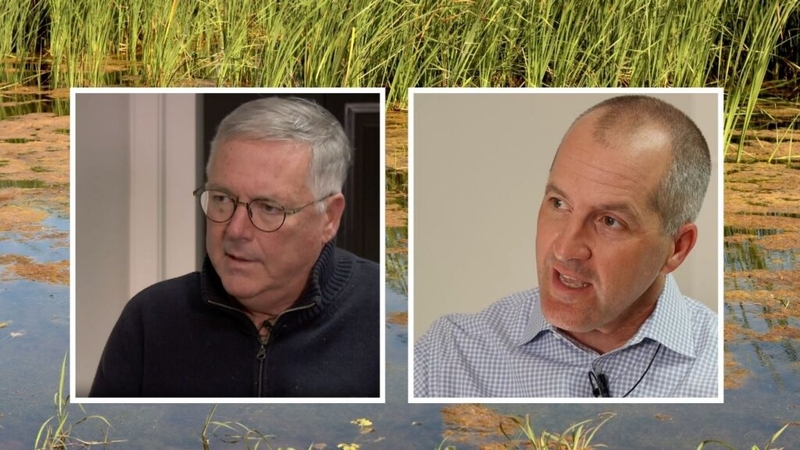
Democrat Chris Jones, left, is running against Republican incumbent Mike Naig for Iowa secretary of agriculture. (Candidate photos by Zach Sommers for Iowa Capital Dispatch, wetland photo by Cami Koons/Iowa Capital Dispatch)
Water quality is shaping up to be a big issue in many of Iowa’s races for the Nov. 3 election but especially in Iowa’s race for secretary of agriculture, where Republican incumbent Mike Naig faces water quality advocate and Democratic candidate Chris Jones.
Iowa Capital Dispatch sat down with each candidate to talk about water quality, a struggling farm economy, local food initiatives, conservation practices and foreign animal disease.
As water quality issues hit urban areas like Des Moines and urban Iowans increasingly hold the agricultural industry responsible, the question of who leads the Iowa Department of Agriculture and Land Stewardship is interesting to more than just farmers.
Meet Naig and Jones
Video filmed and edited by Zach Sommers for Iowa Capital Dispatch.
Mike Naig grew up in the northwest region of Iowa near Cylinder, where he’s still part of the family century farm. He was elected Iowa secretary of agriculture in 2018 and reelected in 2022.
Naig said in his time as secretary of agriculture, he has seen the impact the role can have on the people he has met across the state through the office.
“Those businesses, those farms, you really can do things to help them,” Naig said. “You really can do things to make the situation better, and I love being able to do that. So that’s what I’ve enjoyed about the job, and certainly that’s why I’m hoping to be reelected again this year.”
Video filmed and edited by Zach Sommers for Iowa Capital Dispatch.
Chris Jones is a researcher, author and water quality advocate. He previously worked at Des Moines Water Works, at Iowa Soybean Association and as a research engineer at the University of Iowa. Jones is also known for his book “Swine Republic” and his Substack of the same title, where he writes about agriculture and water quality in the state.
Jones said he views his run for the office as a “referendum on the condition of Iowa’s water.”
“If people think the water quality is what it should be, and they like what their drinking water is, and they like what the lakes and beaches are in Iowa and the conditions of the rivers, then, you know, I’m probably not the candidate for them,” Jones said. “If you think all these things are lacking and need improvement, and that we need some urgency in getting them improved, then I think my candidacy is worth consideration.”
Water quality
Naig said he agrees with Jones that Iowa needs to improve the quality of its water.
“Clean water is non-negotiable – everybody, every Iowan, deserves access to clean water,” Naig said. “It’s not a debate as to whether or not we need to improve the situation … my opponent and I both agree on that, but the how is a completely different approach.”
Naig’s approach in office has centered on incentive-based programs to increase adoption of conservation methods through Iowa’s Nutrient Reduction Strategy, a “batch-and-build” method of installing edge of field practices on cropland and most recently the state’s “Farm to Faucet” program, which increased conservation incentives and provided funding to water treatment facilities.
Naig said rather than play the “blame game” between agriculture and downstream water users, the two should be working “in partnership.”
“Let’s recognize that it is a farm to faucet approach that will actually deliver the results we need,” Naig said. “That means you have to, yes, have the water treatment infrastructure that’s required to serve not just Central Iowa but also communities all across the state, but we should also be working to make sure that pollutants don’t enter the streams to begin with.”
IDALS and partners at Iowa State University have tracked an increase in the adoption of conservation practices like cover crops, and reduced tillage and nutrient reduction strategies like buffer strips and bioreactors, since the start of the Iowa Nutrient Reduction Strategy.
Jones has criticized the industrial agriculture model in his writing, and in his campaign for secretary of agriculture he has called for taxpayer-funded offramps to help producers move away from the corn, soybean and ethanol dominated system.
Jones argued that funding this transition would do more for water quality than the batch and build method and other edge of field incentives.
“This edge of field approach to try to capture tile water off a few acres here and there is just this Band-aid and diaper approach,” Jones said. “I think that money could be much better spent on helping farmers transition to more sustainable production systems, ones where they’re integrating oats and small grains and forage crops.”
Farm economy
Jones argued that if the ethanol industry was built to create better markets for corn and soybeans, then markets for other crops, like oats, could also be developed for farmers.
“If you’re a farmer, you just don’t wake up one morning and decide I’m going to grow oats, or you just don’t wake up one morning and decide I’m going to grow apples – that’s not the way it works,” Jones said. “You need to have infrastructure to support that activity.”
He said taxpayer-supported programs could help to “indemnify those crops” as farmers transition from more traditional crops and learn what grows well on their land.
“I think it’s entirely appropriate for the taxpayer to participate in this, and I think this is money that’s better spent than these diapers and Band-aids that we’re putting on the corn-soy system,” Jones said.
Naig argued that approach would “gut” Iowa’s economy.
“That’s actually a plan to shrink Iowa agriculture, not to grow it,” he said.
He said Iowa grows corn and soybeans because of its soil and climate. Because it leads in those commodities, he said it also leads in livestock feeding and biofuel production — a way of “turning those row crops into something of higher value.”
“If ag is strong in Iowa and growing, all Iowans benefit from that,” Naig said. “We shouldn’t be turning away from it, we should be thinking about how do we add even more value to what we do, but also creating opportunities for diversity and create opportunities for more food production in the state of Iowa.”
Naig said that as he visits with farmers, profitability is “at the center of everything.” It’s a combination, he said, of several years of low prices for corn and soybeans, high input costs and policy uncertainty as Congress has punted farm bill legislation for the past several years.
Jones argued that if farmers transitioned to crops that required fewer inputs — like fertilizers, pesticides or machinery — it would help farmers financially and help the rest of the state because it “would reduce the amount of pollution in our streams and lakes.”
Foreign animal disease
Naig said the heart of the issue with agriculture is “making sure Iowans have access to safe, affordable food.”
“We do this wrong — especially given Iowa’s outsized role in agriculture in this country — we do it wrong, consumers pay in the end for those things,” Naig said.
The highly pathogenic avian influenza H5N1 outbreak has affected more than 208 million commercial and backyard birds since it began in 2022, which greatly affected consumer egg prices at the end of 2024 and in 2025.
Naig said Iowa’s response to foreign animal diseases, including the highly pathogenic avian influenza, is one of the things he is most proud of over the past eight years. He said he has worked to build up partnerships, response teams and secure additional funding to make Iowa “if not the best, one of the best, in terms of our capabilities to respond.”
“That didn’t happen by accident, that happened because it’s important,” he said. “That’s nothing short of protecting those family farms, which then, of course, it protects our Iowa economy as well.”
Jones said animal disease is a “huge issue” in Iowa, because of its large livestock operations.
“Whenever you put this many animals under a roof, like we do with hogs and chickens, that’s the way nature works: you’re going to have disease,” Jones said.
Rather than continue to fight off the diseases with antibiotics and other methods, Jones said he would push for alternative animal production means.
“Let’s return some of these animals to pastoral systems, where they’re not eating commodity grains and they’re eating forage crops and they’re eliminating their waste in ways that’s not going to get into the streams,” he said.
Local food
Iowans increasingly are looking to source food locally, according to a poll from Iowa Farm Bureau.
Jones’ policy propositions to move away from a corn- and soybean-dominated ag economy include building better markets for farmers to grow and sell food crops.
He proposed requiring schools to source 50% of their food from Iowa farms as a starting point.
“Here in Iowa, we need to strategize about what comes after ethanol,” Jones said. “Let’s talk about it now, and let’s figure out what else we can do with this land to keep farmers in the state prosperous.”
Currently, more than half of the corn grown in Iowa is processed into ethanol, according to the Iowa Corn Growers Association.
Under Naig’s leadership, IDALS launched the Choose Iowa program, a marketing program to promote Iowa grown, raised and made products. The program has grants to help expand local food farm operations and funding matches for food banks and schools to purchase locally grown food.
Naig said the program is only three years old, but it is growing in popularity as more Iowans support it.
“We’re seeing a lot of growth in that area, and I’m really proud of that work that we’ve done to diversify agriculture,” Naig said. “That creates opportunities for the next generation of farmers, new farmers, actually get into it too.”
Jones argued the program is underfunded to the point of being “almost trivial.” He said more money needs to be allocated to local food programs to make them effective.
Iowans can vote for secretary of agriculture in the upcoming general election Nov. 3.
Des Moines, IA