Arkansas healthcare providers alarmed by potential end of state’s Medicaid expansion
Aug 04, 2026 | 6:00 am ET
Description
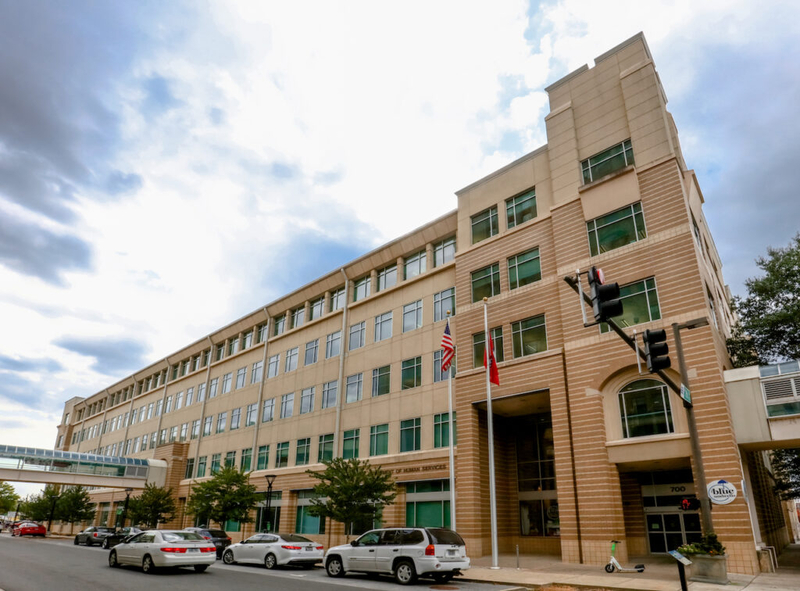
The Arkansas Department of Human Services building on Main Street in downtown Little Rock.
(Photo by John Sykes/Arkansas Advocate)
The Trump administration’s decision not to renew Arkansas’ hybrid Medicaid expansion is alarming medical providers and experts who say the loss of insurance for thousands would be devastating and would damage a state healthcare system already facing serious strains.
The disclosure Friday by Gov. Sarah Huckabee Sanders’ office has created uncertainty for a first-in-the-nation program that supporters credit with cutting the number of uninsured and the costs hospitals pay to provide care for patients without coverage.
The decision also comes as hospitals around Arkansas have had to cut back services or partner with other providers to deal with financial hardships.
“Any threat to people not having a payment source is a threat to hospitals, especially in rural areas where margins are razor thin,” said Jodianne Tritt, executive vice president of the Arkansas Hospital Association. “Hospitals can’t absorb any more uncompensated care right now.”
Arkansas was the first southern state to expand Medicaid under the Affordable Care Act, under a model that uses Medicaid funds to purchase private insurance coverage for those eligible. More than 200,000 people are enrolled in the program, known as ARHOME, and the state’s waiver ends Dec. 31. It’s unclear what will happen to those receiving coverage after that date, though Sanders’ office has said it’s discussing a short-term extension with the federal Centers for Medicare and Medicaid Services.
Arkansas Explained: What’s happening to the state’s Medicaid expansion?
The decision not to renew the program comes less than a month after Centene, one of two insurers providing coverage through ARHOME, announced it would not participate in the program next year.
State officials had already been preparing to roll out new work requirements for the program next year under the federal One Big Beautiful Bill Act, a mandate expected to lead to thousands of people losing coverage.
CMS has not formally notified the state or commented publicly on its reasons for denying the renewal. Sam Dubke, a spokesperson for Sanders, said CMS determined Arkansas’ program doesn’t comply with the rules regarding budget neutrality, which requires ARHOME not cost the federal government more than would be projected without the program, under the federal One Big Beautiful Bill Act.
Joan Alker, executive director of Georgetown University’s Center for Children and Families, said the decision may signal how the Trump administration is handling programs like Arkansas’ expansion that were created under a request known as a section 1115 waiver.
Recent guidance from the administration restricted budget neutrality requirements for such waivers.
“Certainly Arkansas has a unique model,” Alker said. “However, this push towards limiting section 1115 waivers, even terminating them in some cases, is now very clear that that’s on the administration’s agenda and is part of this larger federal effort to cut Medicaid.”
Experts say the decision about the Medicaid expansion threatens to add to confusion for those using the program when combined with other changes, including the looming work requirements.
“I think anything that creates confusion and uncertainty will have an impact on how people interact with the program and coverage,” said Allison Orris, senior fellow and director of Medicaid policy for the Center on Budget and Policy Priorities.
Medicaid expansion in Arkansas and other states under the federal health overhaul has been linked to economic and health benefits, including a drop in the uninsured.
Department of Human Services spokesperson Gavin Lesnick did not say how long a possible temporary extension the state is seeking. In a statement, he said discussions with CMS were continuing. If the temporary extension is not granted, Lesnick said any changes to the expansion program would “center on service delivery, not eligibility.”
Arkansas’ hybrid expansion has been the subject of fierce fights in the Legislature since it was adopted in 2013. Supporters have struggled to win the three-fourths majority needed in both chambers of the majority-Republican Legislature for its reauthorization. The program, however, easily won reauthorization earlier this year.
Sanders doesn’t plan to call a special session before the Legislature convenes next year, “but looking ahead to the next legislative session, will work with her partners in the legislature to build a sustainable model that maintains the same high quality of care and saves taxpayer dollars,” Dubke said.
The Legislature is scheduled to convene for its regular session in January. Medical groups said they were ready to be a part of the conversation on next steps forward.
“Any path forward must prioritize keeping patients connected to their care, reducing administrative barriers that delay treatment, and preserving access to the full spectrum of healthcare services — from primary care clinics to hospitals — in every community across the state,” said Carl Vogelpohl, president of the Arkansas Medical Society, which represents physicians in the state.
Tritt and former state Medicaid Director Ray Hanley said the federal government’s decision leaves two options for continuing coverage for those on the program, but both face challenges.
One would be to move those on the program to traditional fee-for-service Medicaid, but it would reimburse less than what qualified health providers pay through the ARHOME program.
The other would be to move them to a managed care system, though Hanley said contracting with a managed care organization for that would take at least 15 months.
Hanley said abandoning those receiving coverage altogether isn’t a feasible option.
“I think there is a bipartisan interest in not letting that happen,” Hanley said. “It would be political suicide.”
Advocate reporter Ainsley Platt contributed to this report
Little Rock