BLM advances frozen solar project in Nye County
Aug 04, 2026 | 7:30 am ET
Description
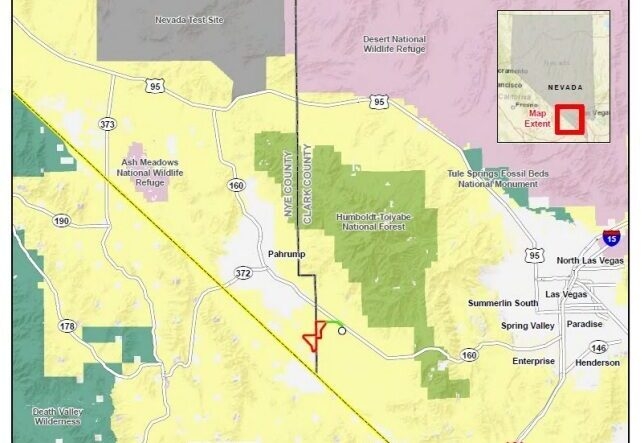
Mosey Solar Project map illustrated in Clearway plan of development.
Federal land managers are moving forward on a massive proposed solar project about eight miles southeast of Pahrump — one of few to be cleared following renewable energy permitting hurdles under the Trump administration.
Last week, the Bureau of Land Management announced their intent to prepare an environmental analysis and resource management plan for the proposed Mosey Solar Project, a 500 megawatt solar project that could produce enough energy to power more than 200,000 homes in California and Nevada.
The project would be built on more than 3,500 acres of public land in Clark and Nye counties near several other existing and planned renewable energy developments.
Clearway Energy Group LLC, the project developer, said the solar project would support “the growing energy needs of emerging western U.S. industries, including large data centers and AI-related development,” according to a development plan prepared for BLM.
The announcement also follows the June approval of upgrades to the GridLiance West Core Transmission Line Project located in Nye and Clark counties, which is expected to increase energy capacity in the region.
Mosey Solar Project is one of six solar projects either under construction or planned in the Mojave Desert, which spans parts of California and Nevada. Many of those projects have faced delays following Trump’s “Unleashing American Energy” executive order which targeted renewable energy.
The Department of the Interior later issued a memo mandating that all solar and wind energy projects on public lands be personally approved by Interior Secretary Doug Burgum, bringing the permitting process to a crawl. Some of those projects have been cleared to move forward, while others, including portions of a massive solar project in Esmeralda County, haven’t.
Gov. Joe Lombardo has lobbied to advance several projects in Nevada facing delays as a result of the Trump administration’s executive orders, including the Libra Solar in Lyon and Mineral counties and Purple Sage in Pahrump.
In a statement, Lombardo praised the federal government’s decision to move forward with another solar project in Nevada.
“My office has been actively engaged with the federal government to help move this project, and others, toward approval because expanding Nevada’s energy capacity is essential to supporting our state’s continued growth,” Lombardo said.
According to Clearway, the Mosey Solar Project will still be required to undergo tighter review under an executive order directing federal agencies to phase out wind and solar tax credits and a secretary order calling for the end of “preferential treatment” for “unreliable” energy sources, specifically wind and solar.
Federal land managers are now seeking public comments through the end of the month for the proposed Mosey Solar Project, which will be fast tracked under an Obama-era permitting process.
Construction is expected to start in early 2027 and be completed by August 2029, according to Clearway Energy Group LLC’s development plan.
The developer estimated the construction period will require a workforce of about 200 to 300 workers. Once constructed, the solar project would employ between 10 and 20 people.
Conservation groups have pushed back on the solar project, citing the destruction of tortoise habitat and water use as a concern.
“Water is definitely an issue. When you get into a water basin like the Pahrump Valley, which is already severely overdrafted, that’s the first concern that local people have,” said Kevin Emmerich, co-founder of Basin and Range Watch.
Groundwater in the Pahrump Valley Basin, where the project’s water would be sources, is hydrologically connected to sensitive areas, including Devils Hole – a critical habitat for the endangered Devils Hole pupfish — and spring systems within the Ash Meadows National Wildlife Refuge.
Clearway estimates they will need about 500 acre-feet of water for the project’s construction, primarily for dust control. That water would be sourced from new on-site wells. Once constructed, the solar facility would need about 20 acre-feet of water per year for operation and maintenance.
Groundwater impacts will be evaluated by the National Park Service and U.S. Fish and Wildlife Service during the National Environmental Policy Act process.
The project area also falls within the Trout Canyon Tortoise Connectivity Zone, which the BLM manages as a high-priority connectivity corridor for the federally threatened desert tortoise.
Emmerich said the Trout Canyon Tortoise Connectivity Zone is one of a dwindling number of areas that still has a healthy breeding population.
“About 30 years ago, it wouldn’t have been as significant because there were other areas that had far more plentiful populations. But there have been a lot of environmental impacts that have caused the number of desert tortoises to plummet, and we’re seeing decline in every recovery unit of the desert tortoise now,” Emmerich said.
Construction of the solar facility will require the removal of any desert tortoises in the area, which will fit with radio transmitters to track tortoises for future relocation if needed.
Las Vegas, NV