Legal services contract expires, and unaccompanied immigrant children face deportation
Aug 03, 2026 | 4:57 pm ET
Description
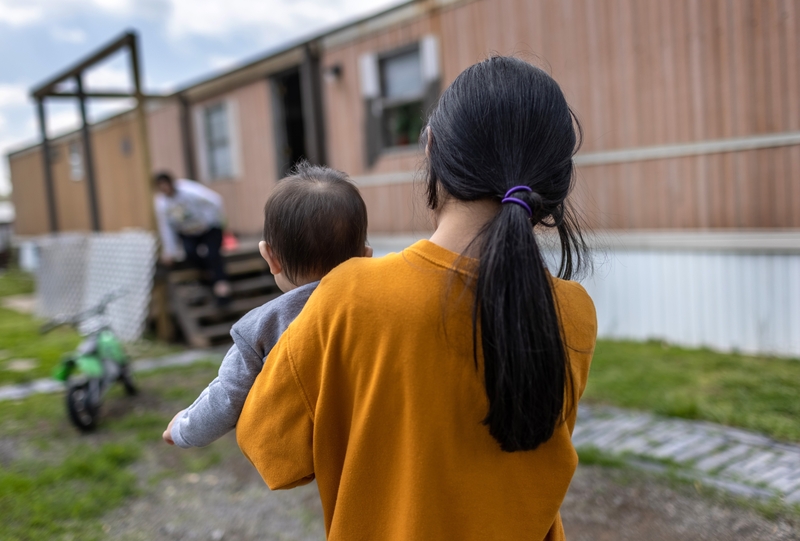
A 10-year-old Honduran immigrant who came into the United States as an unaccompanied minor carries her baby cousin on April 25, 2021, after reuniting with extended family in Sellersburg, Indiana. (Photo by John Moore/Getty Images)
WASHINGTON — More than 20,000 unaccompanied immigrant children Monday lost their legal representation because the Trump administration has not entered into a new agreement to take over their legal services after it let a longstanding contract with a nonprofit expire.
Without legal representation, fewer than 10% of immigrant children win the right to remain in the United States while their case goes through immigration court. Immigration attorneys and advocates worry the loss in legal aid will put children on a fast track to deportations.
“Right now we're all in the dark, and the secrecy is a big part of the problem,” said Shaina Aber, the executive director of the Acacia Center for Justice, which previously held the contract that expired July 31.
The Department of Health and Human Services, which issues the contract, did not respond to several emails from States Newsroom asking which new organization will take over legal services in immigration courts for unaccompanied kids.
HHS has also not submitted any request for new contractors to provide legal services to unaccompanied minors, according to a States Newsroom review of the federal government’s website for contracts.
Additionally, Scott Ehlers, the director of the Texas Indigent Defense Commission, an organization that the Trump administration was initially eyeing to take over legal services for unaccompanied minors, told States Newsroom it had not been awarded a contract from HHS and had not been contacted by the department regarding one.
Aber said that HHS has not informed Acacia who the new contractor will be, implemented a transition of children’s cases to new attorneys, or paid the organization for completed legal work since December.
HHS has not reimbursed $65 million to Acacia, which distributes the federal funding to roughly 100 organizations across the country who provide legal representation to unaccompanied children in immigration cases.
Struggle over sensitive information
The Trump administration let the contract with Acacia expire after attorneys refused to hand over sensitive case information about their clients, such as whether a child has a pending visa.
Aber said since January, immigration attorneys have seen government attorneys try to use visa information in order to place children in deportation proceedings.
“The government has come up with this novel idea that they're using in the immigration court proceedings that if a visa is pending for a child, that means it's purely speculative that the child would ever have status, and therefore they are ordering deportations for kids who actually have pending T visas, that's a trafficking visa, kids who have pending special immigrant juvenile status, kids with U visas,” she said. “All of those kids are being ordered removed by the courts, even as their visas are awaiting them.”
U nonimmigrant status, or U visas, are set aside for immigrants 21 and younger who were the victim of a crime, or helped provide information to prosecutors about criminal activity.
Separately, a special immigrant juvenile status is extended to immigrant children who have been “abandoned, abused, or neglected” by a parent, and that visa provides a pathway for a green card.
A nonprofit in Pennsylvania, the Jewish Family and Community Services of Pittsburgh, recently filed a lawsuit on behalf of several immigrant children against the Trump administration’s practice of targeting children with pending visas for deportation.
Aber said she is worried that the next organization to obtain the contract will hand over that sensitive information to the Trump administration.
“We are very concerned about any agreement that the government has entered into with a new contractor about sharing confidential details or privileged information contrary to children's interests,” she said.
Confusion about legal services
Aber said HHS is still working on accepting a transition proposal, meaning that Acacia and providers in its network cannot even begin having conversations with children to inform them that someone else will be representing them in immigration court.
“To have those really sensitive conversations with the child, where you're saying, ‘Hey, I'm not going to be able to represent you anymore, or like these are your options in terms of representation’ …. we can't start having those conversations with kids without that information,” she said.
She added that officials at the Office of Refugee and Resettlement, the agency within HHS that houses some unaccompanied immigrant children, are still reaching out to Acacia and its legal services providers even after the contract expired, asking for legal services for newly arrived children. Almost 1,800 children are in ORR’s care, according to agency data from June.
“They keep on reaching out to our legal service services network, asking if someone could please go over on their own dime to talk to new arriving children,” Aber said.
Some of the organizations that partner with Acacia have been able to dip into reserves to continue providing services to kids, but others have had to stop providing the services altogether, Aber said.
All States Newsroom content is free to republish. Read our republishing policy for more information.