Gaetz: Next governor should review KidCare challenge before continuing DeSantis’ fight
Aug 03, 2026 | 2:43 pm ET
Description
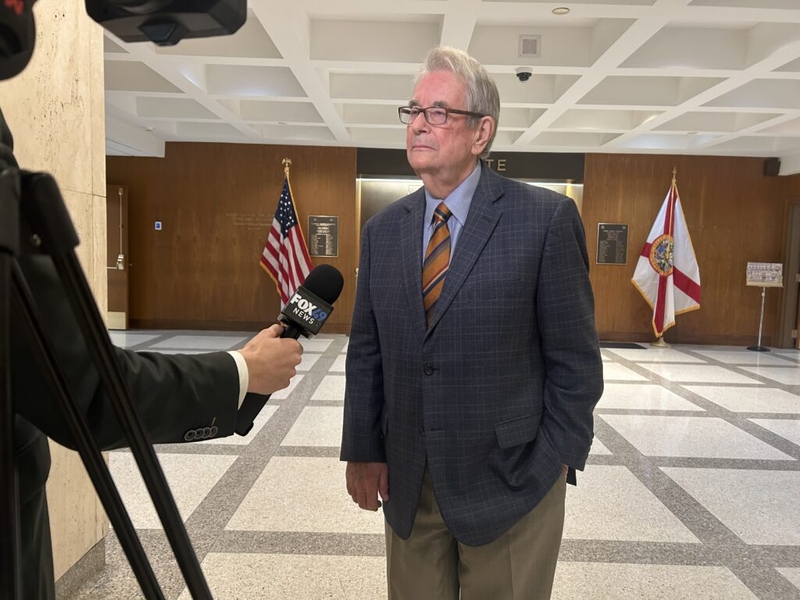
Sen. Don Gaetz talks to reporters outside Senate chambers on March 10, 2026. (Photo by Christine Sexton/Florida Phoenix)
Florida Gov. Ron DeSantis has spent two years in court arguing with the federal government over a requirement that Florida ensure children enrolled in a Medicaid-funded safety-net healthcare program remain continuously eligible for one year.
The policy, the DeSantis camp says, is the reason it won’t implement the 2023 bill the governor signed into law that could allow as many as 68,000 additional children to qualify for the Florida KidCare program, Florida’s version of an optional Medicaid expansion that provides healthcare children who don’t qualify for traditional Medicaid.
With DeSantis leaving office in five months, a leading Senate Republican says Florida’s next governor should take a close look at the legal challenges and consider dropping them.
“I don’t want to tell them what to do with the law, because I am not a lawyer. But before any governor goes into federal court to pursue litigation that was initiated by the previous governor, I would assume there would have to be, and I would argue there should be, a serious examination of whether it’s in the state’s interests and whether or not the litigation has legitimacy,” Gaetz said.
The Centers for Medicare and Medicaid Services in December 2024 approved the state’s request to increase the amount families could earn and still qualify for the KidCare program. The agreement increased the maximum allowable income from 200% of the federal poverty level, or $54,640 for a three-person household, to 300%, or $81,960.
As part of the agreement, CMS said the state needs to abide by a 2023 law requiring children enrolled in Medicaid or the federal state Children’s Health Insurance Program or CHIP to have continuous eligibility for one year, a requirement the administration doesn’t want to abide by.
The DeSantis administration maintains that the eligibility requirement runs afoul of a state law requiring families to contribute to the costs of Florida KidCare coverage and, moreover, that the premiums are a vital financing component for the program.
So the state turned down the approval and instead the DeSantis administration challenged CMS in federal court.
As the legal tussle plays out, the DeSantis administration has removed tens of thousands of children from the Florida KidCare program when their families missed a premium payment, which advocacy groups have argued is illegal.
Mum is the word
The DeSantis administration, however, has been reticent to publicly discuss its KidCare legal tussles.
When senators asked how many children the state removed from KidCare for failing to pay premiums in October 2025, Medicaid Deputy Secretary for Medicaid Brian Meyer said he didn’t have that information. After the Phoenix reported Meyer’s comment, the Florida Healthy Kids Corp. told the Phoenix that more than 17,000 children were disenrolled for failing to pay premiums.
The Phoenix discovered the disenrollment information wasn’t a complete picture. It represented the number of children disenrolled for not paying premiums and never re-enrolled. The state removed more than 43,000 children over a 12-month period for failing to pay the premium.
When Meyer was asked by a state House panel the next day to verify the higher disenrollment data number, he said he couldn’t.
When asked about KidCare litigation in April, Meyer testified that he had been having conversations with CMS and the state was “actively trying to get to an agreeable place between both parties so we can move this program.”
Gaetz wasn’t a member of the Senate in 2023 when the Legislature agreed, for the first time since the Florida KidCare’s inception in 1998, to increase how much families could earn and continue to access the low-cost health insurance policies.
But he says he would have voted for the law then and that he supports expansion now.
And Gaetz is no Medicaid spendthrift.
Legislative consultation
A former Senate president, Gaetz made headlines earlier this year when he championed legislation that would require Florida Medicaid beneficiaries to work to maintain their healthcare benefits.
The work requirements were included in Donald Trump’s signature One Big Beautiful Bill and apply to states that expanded Medicaid eligibility to lower-income childless adults under the federal Affordable Care Act, often called Obamacare. Florida is one of 10 states that hasn’t expanded Medicaid, so the work requirements didn’t affect the state.
Gaetz defended his push for work requirements, saying, “There’s got to be a distinction drawn … between those who can’t get up off the couch and those who won’t get up off the couch.”
As a member who “cares about Medicaid a good bit,” Gaetz told the Phoenix he thinks the next governor should consult with the Legislature about the KidCare legal wrangling.
“I want there to be some consultation with the Legislature, or at least with legislative leaders, before the [new] governor makes a decision to proceed with filing or continuing to pursue the litigation that’s in the Pensacola federal court right now,” he said.
Pensacola litigation
The DeSantis administration has filed at least three lawsuits against CMS and the continuous eligibility requirement, one of which still is being litigated in Pensacola.
That case initially centered around the administration’s complaint that the Centers for Medicare and Medicaid Services weren’t timely responding to its requests for documents under the Freedom of Information Act.
According to the initial complaint, the Agency for Health Care Administration submitted a request for information under the Freedom of Information Act on Jan. 8, 2026, “seeking any CMS records related to expanding subsidized children’s health insurance in Florida, including records related to consideration, approval, or implementation of the Eligibility Extension.”
The complaint notes that AHCA asked the federal government to expedite its request and that any fees for the information be waived. The state received a receipt acknowledging submission of the request but never any information.
AHCA amended its complaint in May to allege CMS is misreading the federal statutes regarding 12-month continuous eligibility. Attorneys for the state argue a “plain and ordinary meaning” of the 2023 law is that a child remain eligible for CHIP benefits for an entire year.
But eligibility and healthcare coverage are different things, the administration argues, noting “enrollment may require additional steps, such as paying an enrollment fee and monthly premiums.”
The judge on June 30 agreed to a joint scheduling order proposed by both parties that set aside the FOIA issues and pushed the litigation into January 2027, after DeSantis leaves office.
And that leaves time for reflection.
“There has to be an examination, it would seem to me, by the new governor. And I don’t think when [Republican gubernatorial hopeful] Byron Donalds is sworn in that he necessarily would pursue inherited litigation without examining it.”
Tallahassee, FL