Missourians getting abortion pills by mail from out-of-state providers quadrupled since 2023
Aug 03, 2026 | 11:00 am ET
Description
More than 3,200 Missourians ended pregnancies last year through telehealth appointments with out-of-state clinicians who mailed them abortion pills, according to new data from the Guttmacher Institute (Anna Spoerre/Missouri Independent).
In the midst of navigating a turbulent divorce last year, Claire learned she was pregnant.
“It wasn’t the right time for me to have a child,” said Claire, who lives in Kansas City and agreed to speak on the condition that she be identified by her first name, citing concerns for her privacy and the charged political climate around abortion in Missouri. “But I knew at that point that I did want to have children in the future.”
Claire is among about 3,220 Missourians who obtained medication abortions through telehealth from out-of-state clinicians in 2025 — up from roughly 880 two years earlier, a quadrupling — as Missourians looking to end their pregnancies were forced to look elsewhere for broader options.
The data was recently released by the Guttmacher Institute, the nation’s leading reproductive rights research and advocacy organization.
In 2025, Claire’s local Planned Parenthood clinic, where she’d been a patient since she was 15, wasn’t legally allowed to provide medication abortions. That changed in June following a Jackson County court ruling striking down dozens of abortion regulations challenged under the reproductive rights amendment Missouri voters approved in 2024, overturning the state’s abortion ban.
But even after that ruling, Missouri’s ban on in-state providers prescribing abortion medication via telehealth remained in place. Patients who want pills mailed to them without an in-person clinic visit must still turn to providers in other states.
At the time, abortion was banned in Missouri with limited exceptions for medical emergencies.
Claire said she still would have preferred to drive a short distance to see her doctor at her local Planned Parenthood clinic.
“I had wished that I would have been able to go to my doctor, someone that I’ve been going to for years at a clinic that I’ve been going to for decades,” Claire said. “But, of course, I was very relieved that I was not going to be forced to have a child that I wasn’t ready to have, I was able to access what I believe is a human right.”
Medication abortion in Missouri, beyond
Medication abortion, which was approved by the FDA more than 25 years ago, has become the most common method for ending a pregnancy in the U.S., accounting for about two-thirds of abortions.
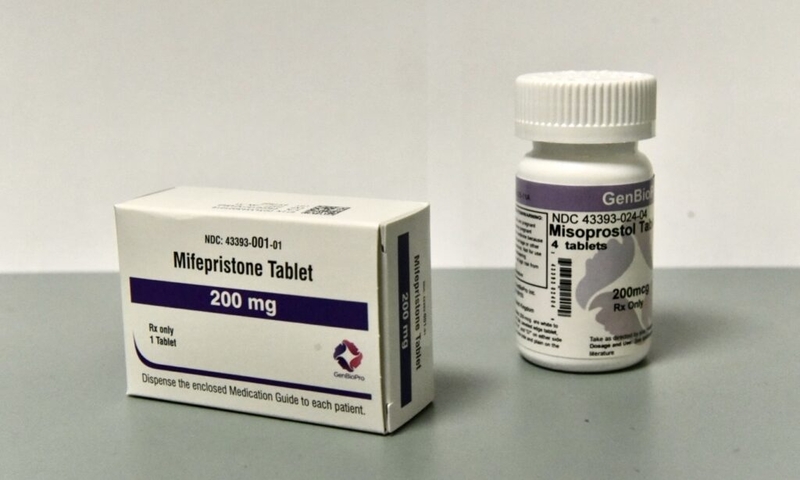
It typically involves two drugs. The first, mifepristone, causes the embryo or fetus to stop growing and detach from the uterine wall, ending the pregnancy. The second, misoprostol, causes the uterus to expel the pregnancy tissue. Both medications are also used to treat miscarriages.
Missouri follows a national trend of growing access to abortion pills through out-of-state telehealth providers, said Isaac Maddow-Zimet, a data scientist and the lead researcher on Guttmacher’s Monthly Abortion Provision Study. But even as the number of medication abortions obtained through telehealth increased, the number of Missourians traveling out of state remained high.
In 2025, 11,690 Missourians traveled out of state for abortion access, primarily going to clinics in Kansas and Illinois, down from 12,600 in 2023, according to the latest Guttmacher data.
“It’s been true for a very long time that access to care in Missouri has had really significant obstacles. And because geographically, there are sometimes clinics that are relatively close across state lines, there has long been a pattern of many Missouri residents traveling out of state,” Maddow-Zimet said. “If anything, the big change in Missouri has been the increased availability of telehealth, which was not really an option pre-Dobbs.”
Abortion returns to southwest Missouri after more than two decades without local access
Maddow-Zimet, who compiled the latest statistics using data from abortion facilities and telehealth providers, the aggregate numbers do not capture how differently those barriers affect individuals.
“People are often left to navigate a really complex web of laws and react to things that are in the news that they might not have a clear idea about,” he said. “People shouldn’t have to be paying extremely close attention to the news to figure out how they can access a really common reproductive health procedure.”
The shift in availability of medication abortion is tied in large part to states with abortion protections enacting stronger shield laws protecting doctors who prescribed mifepristone to patients in states with abortion bans. And, more people are finding out it’s an option.
As mifepristone becomes widely used and available, anti-abortion lawmakers and prosecutors have pursued efforts to restrict access, particularly in states such as Missouri, where telehealth abortion remains prohibited under state law.
Missouri’s’ push to ban mailing pills
In Missouri, anti-abortion lawmakers have also for years proposed legislation aimed at preventing out-of-state providers from mailing abortion pills into the state.
In 2022 and 2023, Republican state Rep. Brian Seitz of Branson filed legislation that would have created a trafficking offense for anyone who “imports, exports, distributes, delivers, manufactures, produces, prescribes, administers, or dispenses” medication abortion to Missouri in violation of state or federal law.
Neither bill ever passed the House, but states like Louisiana have attempted to extradite doctors in states with legalized abortion who prescribed medication abortion to patients in states with bans.
This year, he helped lead the passage of the “Born-Alive Abortion Survivors Protection Act.”
Although Seitz touted the bill’s passage as a victory, the final version was substantially narrower than the one originally proposed. The earlier version would have opened the door to civil liability for people involved in illegal “self-induced abortions,” including medication abortions.
The language was struck from the bill in a deal with Senate Democrats, who threatened to filibuster the legislation.
But Seitz said restricting Missourians’ ability to obtain abortion pills through telehealth from out-of-state providers will likely be a priority for anti-abortion Republicans next session.
“Missouri does need to protect its borders as far as this activity goes,” Seitz said. “I have always been supportive of the advancements in telehealth, but we’re talking about the taking of a human life.”
The Guttmacher data show that thousands of Missourians continue to obtain abortions despite the state’s restrictions. Seitz said lawmakers should also focus on policies that make it easier for families to raise children.
“If we’re going to have a cultural life, then we need things that would make it easier for the Missouri family to survive,” Seitz said. “And we can do that as a legislature.”
Republicans fight against FDA approval of mifepristone
At the same time, Missouri Attorney General Catherine Hanaway continued her predecessor’s legal challenges to medication abortion, including a challenge to the U.S. Food and Drug Administration’s 2025 approval of a new generic version of mifepristone. Missouri is also the lead plaintiff in a major federal lawsuit seeking to limit access to the drug.
“Missouri’s commonsense health and safety regulations protected women from the threats of dangerous mail-order abortion drugs prescribed by out-of-state clinicians,” a spokesperson for the Missouri Attorney General’s Office said in a statement reacting to the Guttmacher data. “We have already filed an appeal with the Missouri Supreme Court seeking to reinstate these protections for women.”
The attorney general’s office has repeatedly argued that mifepristone is dangerous to women, an assertion echoed by Hawley and other anti-abortion officials at the federal level.
Missouri maternal deaths remain mostly preventable, sixth state report finds
Hawley frequently cites a 2025 study from the Ethics and Public Policy Center, a conservative think tank, that found serious complications from mifepristone are much more common than the FDA reports.
Critics, including medical professionals, have called the study flawed and politically motivated. The paper concluded that 1 in 10 people who take mifepristone experience a serious adverse event.
The FDA states that mifepristone is safe to use if taken as directed through 10 weeks of pregnancy, citing serious adverse reactions in less than 0.5% of women who take the medication.
Bleeding and cramping are expected side effects. More rarely, there can be hemorrhaging and infection. Those prescribed mifepristone are urged to call their doctor if they experience heavy bleeding, abdominal pain or a fever. This guidance also applies to those who recently underwent surgical abortions, experienced miscarriages or delivered a baby.
In November, Missourians will vote on whether to repeal the current reproductive rights amendment and replace it with a ban on abortion, with limited exceptions for medical emergencies and pregnancies resulting from rape or incest.

Jefferson City, MO