Argue all you want about the cause of climate change. The 911 calls still come.
Aug 03, 2026 | 5:15 am ET
Description
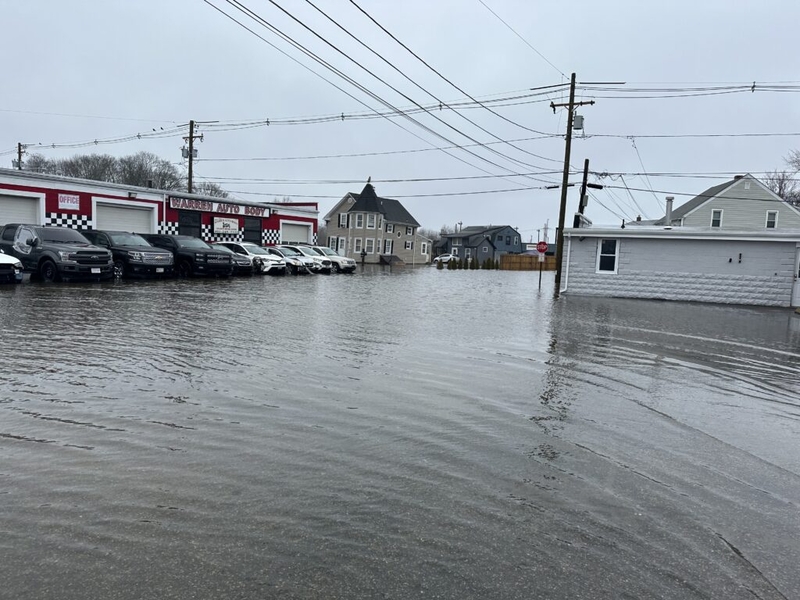
Flooding is shown on Redmond Street at Market Street in Warren, R.I., in 2019. (Photo by Warren Fire Chief James Sousa.)
No one dials 911 to report climate change. They call because the water is over the doorsill. They call because a neighbor on the third floor, in an apartment with no air conditioning, stopped answering the door. They call because the road they were told to evacuate on is already under two feet of water.
In my 20 years wearing a badge in East Providence, I learned that the public rarely argues with a police officer about causation. They want the problem handled now. That instinct is worth borrowing for a debate that has been stuck for a generation.
So set aside whatever you believe about carbon, computer models, and international accords. Look at it the way an investigator looks at a case. What does the evidence on the ground actually show, and what does it oblige us to do about it?
What it shows, first, is a workload changing under our feet. Ambulance dispatches nationally rise somewhere between 6% and 18% during heat waves. Boston EMS has measured call volume climbing roughly 14% once the temperature clears 90 degrees. A research letter published this year in the Journal of the American Medical Association found heat-related EMS activations rose 65% nationwide between 2019 and 2024, with the sharpest acceleration in lower-income ZIP codes, which is to say the same neighborhoods that already generate the heaviest call volume for everything else.
Rhode Island is not exempt from the arithmetic. Summers here now carry roughly three more weeks of health-threatening heat than they did in the 1950s, and researchers project hundreds of additional heat-related emergency room visits every year by mid-century.
Then there is the part cops know in their bones and criminologists have finally quantified. Violence tracks heat. A systematic review in Environmental Health Perspectives, national analyses out of Japan and South Korea, and a 28-city American study all point the same direction: as the thermometer climbs, so do assaults, robberies, and homicides. One widely cited estimate puts the cost of a single degree Celsius at about a 6% increase in violent crime in this country.
That is not an environmental statistic. That is a staffing statistic.
I live in Warren, in a converted luggage factory a short walk from water that is coming for the street. In September 2021, the remnants of Hurricane Ida dropped more than 66 inches of rain on this town in a matter of hours. Market Street went under. It goes under now on ordinary king tides, without a storm’s help at all.
Warren did something unusual and honest about it. The Market to Metacom plan, adopted in 2021, proposes a managed retreat: voluntary buyouts, phased over decades, of the 300 to 400 structures projected to sit below the tide line by 2100, with new housing built on higher ground along Metacom Avenue. Planners around the country hold the plan up as a model. State environmental officials point to it as the template for every other coastal community that will eventually face the same conversation.
Five years on, nobody has moved. An $18 million grant application to NOAA was denied. A Department of Agriculture application failed. Until this spring, the town had been without a planner since late 2024. The plan is sound. The money is not there.
And the money is getting scarcer. In May, the FEMA Review Council recommended raising the threshold for federal disaster declarations and holding the federal cost share to the statutory minimum. In plain English: FFewer disasters qualify, and states pay a larger share of what is left. The Building Resilient Infrastructure and Communities program, which funded precisely the kind of work Warren needs, was canceled in 2025. Hazard Mitigation Grant Program allocations have been stalled since the spring of that year. Emergency Management Performance Grants were frozen last October. FEMA absorbed a 14% workforce reduction and a 76-day departmental shutdown before its 2026 appropriation finally cleared at the end of April.
What does the evidence on the ground actually show, and what does it oblige us to do about it?
Reasonable people can argue FEMA needed reform. Having dealt with my share of federal bureaucracy, I will grant the premise without a fight. But reform that arrives as an invoice mailed to the smallest towns in the smallest state, in the middle of hurricane season, is not reform. It is a transfer of risk to the people least equipped to carry it.
There is a specific operational reason this ought to worry anyone who has ever run a shift. Emergency response in Rhode Island rests on mutual aid, the standing assumption that when Warren is overwhelmed, Bristol and Barrington can send apparatus. That assumption holds when emergencies are local and randomly distributed. It collapses when they are regional and simultaneous. The storm that floods Warren floods Bristol and Barrington the same afternoon. Every unit is committed. Nobody has anything left to send. We have built a system on the premise that our neighbors will not be having our emergency at the same moment, and that premise is quietly expiring.
Layer on the toll the responders themselves absorb. Firefighters working in turnout gear at a triple-digit heat index, in an occupation already carrying a disproportionate rate of sudden cardiac death. Shorter recovery windows between calls. A behavioral health burden that research already places well above the general population’s, and that does not improve when the summer never lets up.
Here is the point, and it does not require anyone to revise a single belief about causes.
You can be entirely unconvinced by the climate science and still read a tide gauge. You can doubt every model ever built and still count ambulance runs. You can think the whole business is overstated and still notice that Market Street floods on a cloudless afternoon. Preparedness does not require agreement about etiology. Emergency management, done well, was never ideological. It is actuarial.
So treat it that way. Fund resilience in the same budget conversation as police and fire staffing, because it is the same conversation. Give Warren, and the dozen other Rhode Island communities staring at identical math, a state-level buyout mechanism that does not depend on winning a competitive federal grant lottery. Build the surge capacity now, before we need it: cooling centers with real staffing, mutual aid compacts written for regional events instead of local ones, EMS deployment models built around the hot week rather than the average one.
We can keep arguing about why the water is rising. The water is not waiting for us to finish.
Providence, RI