Petitions for Arkansas direct democracy proposal fall short, secretary of state says
Jul 30, 2026 | 2:01 pm ET
Description
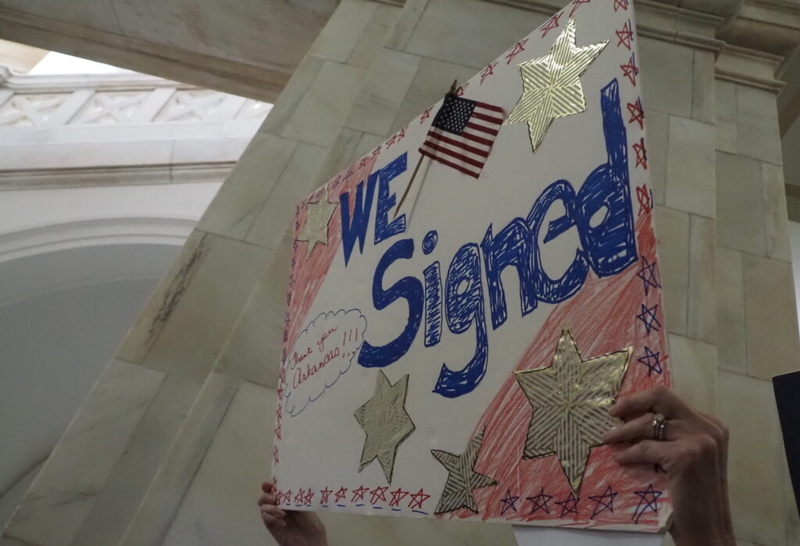
A supporter of the Arkansas Abortion Amendment holds up a sign in an Arkansas Capitol hallway where petitions to put the amendment on the November ballot were delivered Friday, July 5, 2024. (Photo by Tess Vrbin/Arkansas Advocate)
All signatures submitted in favor of putting on the November ballot a proposal to strengthen Arkansas’ initiative and referendum process were tossed because none of them were countable under state law, the secretary of state’s office announced Thursday.
Secretary of State Cole Jester wrote in a letter to the proposed constitutional amendment’s sponsors that 19,924 petition pages submitted to his office had an incorrect ballot name on them. The popular name approved by the Arkansas Attorney General’s Office was “The Arkansas Ballot Measure Rights Amendment.” Jester said the name attached to the signature pages was “The Ballot Rights Amendment of 2026.”
“No petition part had attached or on its face the ballot title approved by the Attorney General,” Jester wrote. “Therefore you have submitted zero countable signatures” under state law.
At least 90,704 valid signatures from registered voters must be submitted for a proposed constitutional amendment to qualify for the ballot.
Even if the correct name had been attached and submitted properly, Jester said Protect AR Rights, the group behind the measure, would have only had 83,211 signatures, falling short by 7,493 the number required for his office to begin checking whether they were valid.
But that figure doesn’t include signatures on 2,453 pages that he said could not be counted due to “notary and canvasser defects.” An additional 87 pages submitted to his office also did not count because they were attached to an unrelated proposed ballot measure on education.
Gennie Diaz, the spokesperson for Protect AR Rights, said the group was meeting with its legal team today, and that they remained committed to defending Arkansans’ constitutional rights.
“The Secretary of State’s letter underscores exactly why this fight matters,” Diaz wrote in the statement. “Arkansas’s citizen ballot initiative process has become so burdened with unnecessary obstacles that it threatens the very constitutional right it is supposed to protect.”
Jester, a Republican, added that even if those reasons did not disqualify the proposal, state law prohibited him from counting signatures from canvassers who have violated state laws regarding petition signatures. Arkansas law says that the secretary of state cannot count the signatures if it determines those laws were broken by a “preponderance of the evidence.”
“The petition submitted to my office contains evidence of such laws being violated,” he wrote, pointing to several examples he provided of canvassers printing their name but not signing it on petitions, among other issues his office said were present.
Jester said in a statement his office has “a legal obligation” to apply state law equally to proposed changes to the state constitution.
“Our responsibility is not to determine the merits of the proposal, but to ensure the constitutional and statutory requirements established by the people and the General Assembly have been satisfied before a measure is certified,” Jester said.
Protect AR Rights was one of three groups collecting signatures this spring for their proposed constitutional amendments. Protect AR Rights was the only group to submit signatures to the secretary of state’s office by the July 3 deadline.
All three groups are involved in a lawsuit against the secretary of state that’s challenging a number of state laws restricting the state’s initiative and referendum process.
Opponents of the laws have said they make it nearly impossible for Arkansans to propose their own laws or constitutional amendments and place them to a statewide vote. Supporters of the laws argue they protect the integrity of the process.
U.S. District Judge Timothy Brooks issued a preliminary injunction in November that temporarily blocked the state from enforcing some of the laws against parties involved in the suit, including two that require canvassers to request a photo ID from potential signers and inform them that petition fraud is a criminal offense.
Earlier this month, Brooks deemed some of the challenged laws unconstitutional, but took no additional action. He held a two-day bench trial in the case in Fayetteville this week.
Aug. 2 was the deadline for the secretary of state’s office to review the signatures. Aug. 20 is the deadline for the secretary to certify ballot measures to the counties for inclusion on the ballot for the General Election on Nov. 3.
Election officials in 2024 rejected signatures submitted in favor of an abortion rights amendment, saying the group behind it did not comply with state law regarding documentation of paid signature gatherers. The state Supreme Court upheld that rejection.
- 3:44 pmThis story was updated to include an additional written statement sent by Protect AR Rights.
Little Rock