North Dakota mammoth dig unearths ‘rare’ array of bones from beneath garage
Jul 30, 2026 | 1:18 pm ET
Description
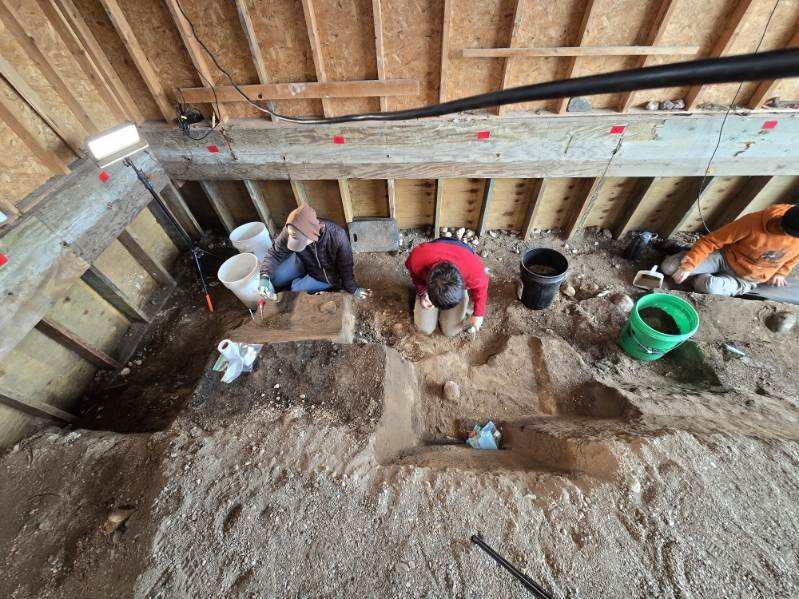
Team members excavate mammoth bones under the supervision of the North Dakota Geological Survey beneath a garage in Burke County in June 2026. (Photo courtesy of North Dakota Geological Survey)
A mammoth excavation under a northwest North Dakota garage is unearthing a more complete prehistoric beast than paleontologists had hoped for when the discovery was made in the 1980s.
The excavation in Burke County is being spearheaded by the North Dakota Geological Survey, which has used its team, summer interns and some geology students from the University of North Dakota since June to carefully dig out the iconic animal.
“When you dig something up, you never know if it’s going to be one bone and the whole thing is going to be over,” North Dakota State Geologist Clint Boyd said. “Very quickly it became clear, no, there is a reason we are digging here.”
Boyd said this mammoth skeleton is a rare find and the most complete mammoth from North Dakota, though not as encompassing as the mammoth site in Hot Springs, South Dakota.
He said the team is still working to determine the type of mammoth, either woolly or Columbian. The team is also trying to determine the sex of the mammoth.
Boyd said the excavation underneath the garage could wrap up in September so the garage can be reconstructed for the home owner this fall. He added the excavation team plans to return in spring 2027 to excavate areas outside of the garage.
So far, he said the team has recovered bits of the skull, lower jaw and some ribs. They are beginning to find the limbs of the animal and are hopeful to find the mammoth’s tusks waiting to be uncovered outside of the garage. The timeline to complete the mammoth excavation remains fluid.
The bones were discovered on a northwestern North Dakota property in 1988 while the owner was digging a foundation for a garage. The family sent a couple of teeth to North Dakota State University, which verified that the teeth had come from a mammoth that lived during the Pleistocene Epoch, commonly called the Ice Age.
However, by the time the North Dakota Geological Survey was notified of the verified discovery, the garage foundation had already been poured, and the garage, attached to the home, had been constructed. The Geological Survey was not able to fund the demolition of the garage, excavation and construction of a new garage in an agreed timeline with the owner.
For about 35 years, the mammoth stayed under that garage until former North Dakota State Geologist Ed Murphy reexamined his old notes from the 1988 discovery and learned the property had changed hands over the years. He reached out, spoke to the new owner and agreed to conduct site testing around the garage.
“They’ve been wonderful to work with,” Boyd said.
In 2025, state lawmakers allocated $150,000 for the excavation as part of Senate Bill 2014.
Andrew Clark, deputy state historic preservation officer, told members of the State Historical Society Board at their July meeting that a team from the Historical Society convinced the landowner to rip up the garage floor and used ground penetrating radar to evaluate the mammoth site.
Clark said radar results showed the mammoth skeleton may have been damaged by the construction of the garage due to some “pushing around” of the bones.
The excavation team discovered when the property’s former owner dug the 3-foot foundational footings for the garage, some of the bones were severed, removed as part of the construction process and then returned to the site as part of soil backfill, Boyd said.
He added the situation is unique because if the construction crew hadn’t struck the bones, they would have never known they were there.
“But, you’d prefer less of it had gotten hit than actually did,” Boyd said
The skeleton may be at the Burke County property because water carried it from the location it died, he said. Though Boyd said they don’t think the water carried the mammoth far, most likely yards instead of miles.
The property owner has indicated the mammoth will become part of the North Dakota state fossil collection though a formal agreement has not yet been finalized, he said.
“Ideally, it will eventually go on display upstairs in the Heritage Center,” Boyd said.
If a display at the museum is not possible, he said they would look to display the mammoth near the place it was discovered. Any display is still years away.
Boyd said the excavation should not need any additional state funding until they are ready to prepare an exhibit, which might not be until the 2029-31 biennium.
He said his team’s first mammoth excavation was in the Freedom Mine near Beulah in 2023, which yielded a large tusk, part of a hip and some ribs from what was likely a Columbian mammoth.
If a fossil discovery is made on private land, there are no mandatory reporting requirements in the state for encountering fossils. Residents will not lose their rights to fossil finds on private land if they alert the Geological Survey, Boyd said.
“We’re mostly coming there to give the landowner information, and if they decide that they want to keep it, that’s their right,” Boyd said. “But, if we get to see it, where it was found, that adds to our information about the state.”
Rare T. rex find in North Dakota, mammoth fossil digs ‘significant’ for research
The team is working with the property owner to finalize a name for the skeleton.
Meanwhile, about 160 people have participated in public fossil digs this year supervised by the Geological Survey. The digs this year are being held in the Pembina Gorge, Dickinson and Bismarck areas.
In July, one dig participant found a 3.5-inch T. rex tooth.
The 2026 events are sold out, but a wait list is available through the department’s website. Fossil events in 2027 are expected to be posted this fall with sign-ups occurring in January or February.
North Dakota Monitor reporter Michael Achterling can be reached at [email protected].
Bismarck, ND