Democrat Jim Priest talks tariffs, bipartisan problem-solving ahead of Oklahoma Senate runoff
Jul 30, 2026 | 2:45 pm ET
Description
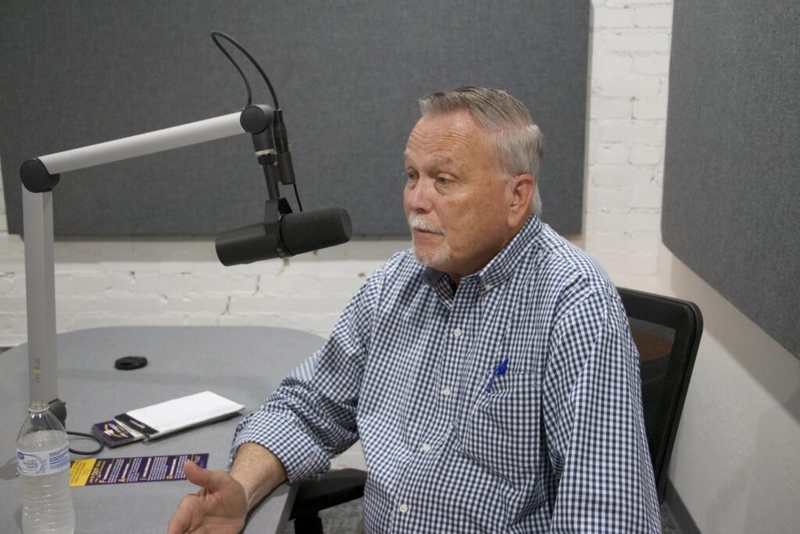
Jim Priest, one of two Democratic candidates to take Markwayne Mullin's seat in the U.S. Senate, sits for an interview in the KOSU studio on July 6. (Photo by Natalie Armour/KOSU)
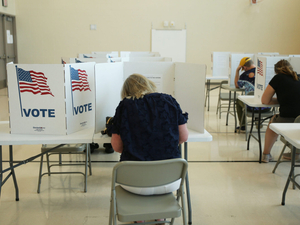
In an Aug. 25 runoff election, Oklahoma voters will choose the Democratic nominee to replace Markwayne Mullin in the U.S. Senate after his March appointment to lead the Department of Homeland Security.
In the June primary, N’Kiyla Jasmine Thomas led the five-way Democratic primary with 45% of the vote, and Jim Priest followed with nearly 24%. State law requires a runoff when no candidate in a primary earns more than half the vote.
The winner of the runoff will face Republican Kevin Hern in the general election in November. Hern has served as the Congressman for Oklahoma’s first district since 2018 and swept the Republican primary in June.
Neither Thomas nor Priest has held elected office before. Priest, a lawyer and nonprofit executive, ran in 2010 to serve as state Attorney General and lost to Republican Scott Pruitt. Thomas is a nurse.
Both candidates would face an uphill battle in November. Oklahoma has not elected a Democrat to the Senate since 1990, and Hern alone received more votes in the Republican primary than every Democratic candidate combined. President Donald Trump endorsed Hern shortly after Mullin’s cabinet appointment, a decision the New York Times wrote “all but assured” Hern would take the seat.
Hern has also raised significantly more money than either Democratic candidate, including more than $5 million he personally loaned his campaign.
KOSU interviewed Priest and Thomas about how they would approach a race against Hern, their attitudes toward the President and what their priorities would be in Congress. KOSU’s interview with Jasmine Thomas will be published on Wednesday.
Sabrina Thaler, KOSU reporter: Why are you running for Senate?
Jim Priest, Democratic candidate for U.S. Senate: It was probably watching the chaos in Washington on TV and news feeds that began to eat at me. I wrote an editorial in The Oklahoman back in November, and I said, ‘We can’t give up. We’ve got to keep fighting for democracy in this time when the danger is that democracy might not survive.’
Then I got to thinking about my grandson, James. He’s eight years old, and I thought someday when he’s older, James may turn to me and say, ‘Papa, what did you do when our democracy was in danger?’ And I need to have a good answer. So I’ve told James, ‘I’m going to run for United States Senate, James.’ And with your help and with the help of your listeners, I’ll succeed, and maybe I can make a difference and bring some sanity and thoughtfulness back to Washington.
Thaler: You don’t have conventional political experience. What experience of yours does make you a qualified candidate for Congress?
Priest: Well, I was a lawyer for 35 years in both federal and state court, so I’ve handled a wide variety of issues. But in particular, I spent a lot of time in civil rights cases and employment law cases, reading the law, reading the Constitution, understanding constitutional concepts. And then I did run for attorney general back in 2010, and when I came in second, I learned that you don’t get a consolation prize or a participant trophy. You just have to go pick up your signs. But that loss really became a pivot point for me, because I knew I wanted to serve people in a bigger way than just in my law practice.
So I pivoted into the nonprofit world, and for the next 15 or so years, I led three different organizations here in central Oklahoma, including Sunbeam Family Services, that provides a wide variety of social services to those in need. And, then I went on to be the ‘Chief Encouragement Officer,’ the CEO, at Goodwill Central Oklahoma, where I really was able to put my experience to work in workforce development, training and trying to help people find jobs or better jobs. So I think that whole experience, both in the nonprofit world and in the legal world, has prepared me well.
In addition, at one point during my law career, I went back and became ordained. And I’d always felt like maybe there’s something I could do in the church community that would be helpful. So I became an ordained minister, and I’ve pastored a church for a short period of time and then helped other churches in a part-time capacity. And, you know, when you’re in the ministry, you’re helping people in some of the most critical times of their lives. Sometimes they’re joyful, but sometimes they’re very sad. And so experiencing those highs and lows, I think, has also prepared me not just from a brain standpoint, but from a heart and a head standpoint.
Thaler: Oklahoma has not elected a Democrat to the US Senate since 1990, and the state has also struggled with low voter turnout. In June, less than a quarter of registered voters cast ballots. If you win the August runoff, how do you plan to reach Republican and independent voters?
Priest: I think this is a great opportune time for Democrats to be true to themselves and to tell the real story about what Democrats stand for. Democrats stand for working people, and we’ve got a lot of working people in Oklahoma. But even if people don’t consider themselves working folks, I’d say the vast majority of Oklahomans are tired of what they see going on in Washington: the opportunism, the people who are taking advantage of inside positions with insider trading and corruption, the people that are reckless and out of control as ICE agents. All of these are creating a spirit of unhappiness and discontent in the state.
We’ve got to motivate Democrats to get out and vote. Low voter turnout is one of the awful things about our state. We have so many great things, but people have either given up on voting or don’t see their vote as important. And so we’ve got to encourage them and urge Democrats, independents and Republicans to get out and vote. I think independents are naturally inclined this year to go with Democrat candidates because they recognize what’s happened in our state and in our nation when Republicans have an overwhelming majority.
I’ve had the good fortune of having many friends who are Republican come up to me and say, ‘Thank God you’re running. We need you in Washington.’ They recognize the failings of not their party, per se, but people in their party, and the current resident of the White House, who has failed to live up to true Republican ideals. I think all of that combines to give Democrats a real chance this year.
Thaler: How will you translate Oklahomans’ day-to-day concerns into federal policy? What exactly will you propose?
Priest: I think what Oklahomans are, above all else, is they are practical problem solvers, whether it’s fixing a tractor that’s broken down in the field or trying to come up with a solution for homelessness in the city. I go as a Democrat to the US Senate, but when I get there, I want to be a collaborator with whoever wants to be a problem-solver, whether that’s Senator Lankford or somebody in the Democratic ranks or in the Republican ranks. Let’s set aside the partisan bickering. Let’s set aside the name-calling, which really doesn’t move the ball down the field, and let’s get to the solutions for the American people.
Thaler: What are some of those solutions?
Priest: I think one of the biggest backsteps that this current administration has taken was the passage of the One Big Beautiful Bill, which is not very beautiful for those in need. What we have found is that it has cut back on health care for all Americans, particularly rural areas. It’s decimating rural health care. And so we’ve got to get in there and reverse the bad effects of the ‘big ugly bill.’
And then Congress has to reclaim authority over tariffs. Tariffs are a tax on the American people. They’re not a tax on other countries. And so one of the reckless things that this administration has done is imposing tariffs in a willy-nilly fashion. You know, it’ll be 10% one day, but then if they look at the president funny or they offend him in some way, well, it’s going to get raised 100%. That kind of unpredictability in foreign relations not only affects our relationship with other countries, but it becomes a tax, through tariffs, on the American people. That’s why people in rural areas and farm areas are finding it difficult to get fertilizer that’s affordable, to find parts for tractors and farm equipment. The tariffs have been a terrible blight on the American people, and Congress has the authority over those. The Supreme Court has cut back a little bit on the president’s authority in that realm, but he’s still trying to find a way to get around the Supreme Court ruling.
Thaler: If you win August’s runoff, you would face Representative Kevin Hern in the general election, who is a sitting congressman and swept the Republican primary. His campaign has also raised over $9 million, and that includes $5 million of Mr. Hern’s own investments. How are you planning to bridge that gap and defeat Kevin Hern in the general election?
Priest: When I was a lawyer and went into the courtroom, I would always think, ‘what is the strength of the other side and how can I use that to my advantage?’ I think the great wealth that Kevin Hearn has accumulated, both in his campaign coffers, but in his personal wealth as well, is really a sign of what’s wrong with America today. Politics is being influenced, to a sinister effect, by money. And we know about the Supreme Court case that needs to be reversed, that allowed dark money into politics. What I would do is just shine a light on Kevin Hern, on his finances, on how he’s financing his committee.
It would be great to have $9 million in our campaign coffers. You could do a lot of communications that way, but money doesn’t win elections. Money helps in getting your word out, but what wins elections is credibility, sincerity, integrity. And so I think if we just shine a light — ‘here’s my track record, here’s my experience, here’s my history helping people and solving problems’ — and here’s Congressman Hern. What legislation has he passed? How has he helped the people of Oklahoma? And what about all these allegations of insider trading and accumulation of wealth? I think if we shine a light on those things, people will come to a common sense solution when they vote.
Thaler: Representative Hern has been a fierce champion of President Trump and received the president’s endorsement in this election. And your potential predecessor, Markwayne Mullin, left his post in the Senate to join the president’s cabinet as a senator. How would you approach a working relationship with the president?
Priest: I am willing to work with people from a wide divergence of opinions. It will be challenging to work with President Trump if he continues on the reckless path that he’s on. Perhaps cooler minds will prevail; people will speak wisdom into his ear instead of just telling him what he wants to hear. And as long as there are areas where we can collaborate, I look forward to working with President Trump. I don’t know how many of those areas he’s interested in. He’s already told us he doesn’t think affordability is a real thing. He called it a hoax. Well, if that’s job one, which I think it is, then President Trump is either going to have to come around and recognize that maybe it doesn’t affect him and his billionaire friends, but it affects most of America’s working people. And he either needs to get concerned about that and roll up his sleeves and work with us, or he needs to get out of the way and let Congress enact legislation that will address those needs.
Thaler: What differentiates you from Jasmine Thomas, your opponent in this runoff?
Priest: Jasmine is a young woman who has a licensed practical nurse background. But I think the thing that distinguishes us is our approach to problem solving. I have a history in all my different careers of solving problems for people, being involved in the community consistently, for the past three, four decades. Miss Jasmine doesn’t have that kind of a track record. She’s young, so she hasn’t had the same opportunities, but she’s not looked for those opportunities either. So I think in terms of what we see wrong in Washington, we both agree things need to change. The difference happens with looking at the track record and who has the best chance not only to solve problems in Washington, but to win the fall election. And I think I’m the best candidate to beat Kevin Hern in November.
This transcript has been lightly edited for clarity and brevity.
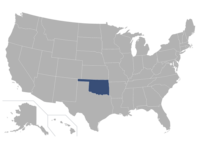
Oklahoma City, OK