U.S. appeals court revises Black-empowerment group’s discrimination claims against Pinellas
Jul 29, 2026 | 3:49 pm ET
Description
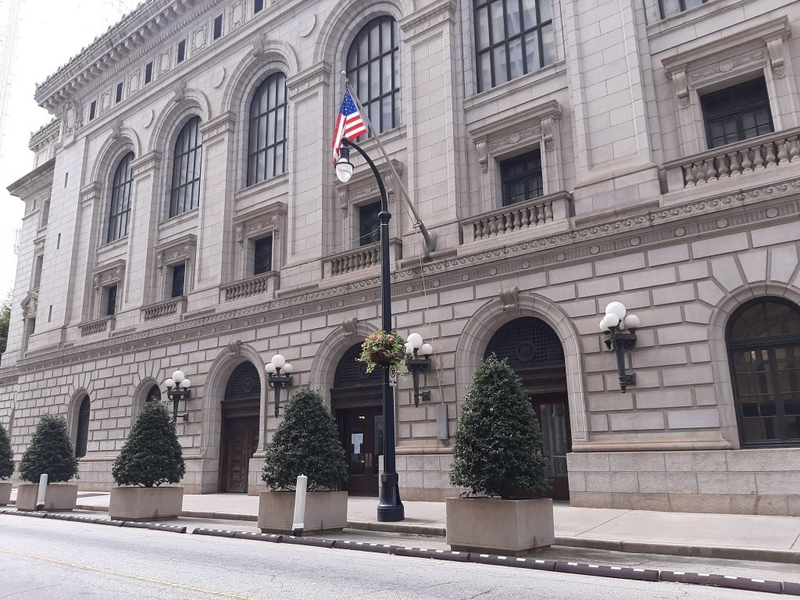
Elbert P. Tuttle Courthouse in downtown Atlanta, home of the U.S. Court of Appeals for the Eleventh Circuit. (Photo by John McCosh/Georgia Recorder)
The Pinellas County Commission violated the First Amendment rights of a Black-empowerment group by withholding COVID-response grants for political and racial reasons, a federal appeals court ruled Tuesday.
A unanimous opinion by a three-judge panel of the U.S. Court of Appeals for the 11th Circuit rejected a trial judge’s ruling that the grant denials didn’t offend the African People’s Education and Defense Fund’s (APEDF) First Amendment and equal-protection rights.
“Giving it the benefit of all reasonable inferences, APEDF has plausibly alleged that the County intentionally discriminated against it on the basis of race when it revoked its previously awarded grant for radio equipment and then denied its second grant request,” Judge Kevin Newsom wrote for a three-judge panel, including Judge Andrew Brasher and Paul C. Huck, of the U.S. District Court for the Southern District of Florida, sitting by designation.
“Accordingly, we reverse the district court’s dismissal of APEDF’s equal-protection claim and remand for further proceedings,” he continued.
Additionally, he wrote, the organization plausibly argued it was being punished for its relationship with the Uhuru Movement and its “goal of Black empowerment” in violation of First Amendment protections for speech and association.
The defense fund is a nonprofit that serves the South St. Petersburg community from a structure it calls Uhuru House (Swahili for “peace”), operating a gym, a licensed kitchen, a community center, and a Saturday school, and performing free HIV testing. It also operates a radio station called “Black Power 96,” according to the opinion.
The organization applied for grants under the COVID-era American Rescue Plan Act of 2021 (ARPA), and was recommended by the Pinellas Community Foundation for $36,801 to buy radio equipment to keep its station on the air and $67,327 for a back-up power generator.
Chris Latvala, at the time a newly elected county commissioner, objected, accusing the organization of anti-semitism and asserting it shared its space with the African People’s Socialist Party (which the organization denies.) White-run groups conducting roughly the same activities were not penalized, according to the opinion.
The panel rejected the organization’s due-process claim, reasoning the government wasn’t obliged to award any grants.
Still, “[t]he essence of APEDF’s First Amendment claim here is that the County manipulated the ARPA grant program to suppress ideas that it viewed as dangerous — namely, those associated with the Uhuru Movement,” Newsom wrote.
“That, it seems to us, is the very kind of claim that [legal precedent] suggested might have merit. Though the government can deny funding to applicants for many reasons, it may not deny even a discretionary benefit to a person on a basis that infringes his constitutionally protected interests — especially, his interest in freedom of speech.”
The case goes back to the trial court for further proceedings.
Tallahassee, FL