Shekarchi makes the list of Rhode Island Supreme Court potential nominees. But will he make the cut?
Jul 29, 2026 | 12:00 pm ET
Description
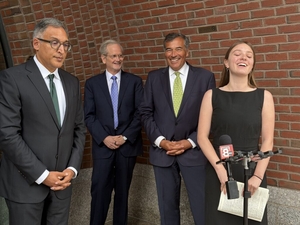
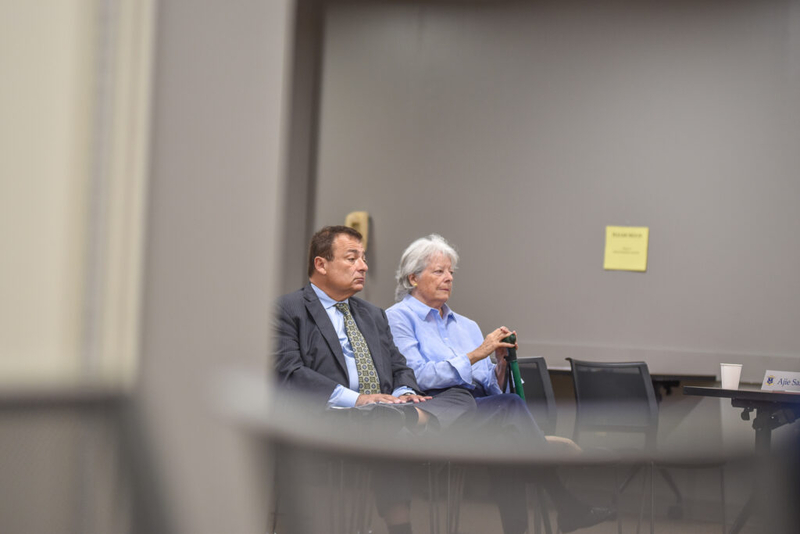
Former House Speaker K. Joseph Shekarchi, left, has landed on the governor's shortlist of nominees for the Rhode Island Supreme Court. At right is retired Rhode Island Superior Court Presiding Justice Alice Gibney, who testified in support of Shekarchi's application before the Judicial Nominating Commission on Tuesday, July 28, 2026. (Photo by Christopher Shea/Rhode Island Current)
Two judges, a state prosecutor, an appellate litigator who has argued before the U.S. Supreme Court, and former House Speaker K. Joseph Shekarchi made the list of potential nominees to fill an open seat on the state’s high court the Judicial Nominating Commission approved Tuesday.
All five applied in May to fill the vacancy left when Rhode Island Supreme Court Justice Maureen McKenna Goldberg retired in March. But only four of them received unanimous support from the nine-member panel in a vote at the end of a three-and-a-half hour interview and public comment session.
They are Assistant Attorney General Christopher Bush, Family Court Judge Laureen D’Ambra, Superior Court Judge Luis Matos and attorney John Roberts.
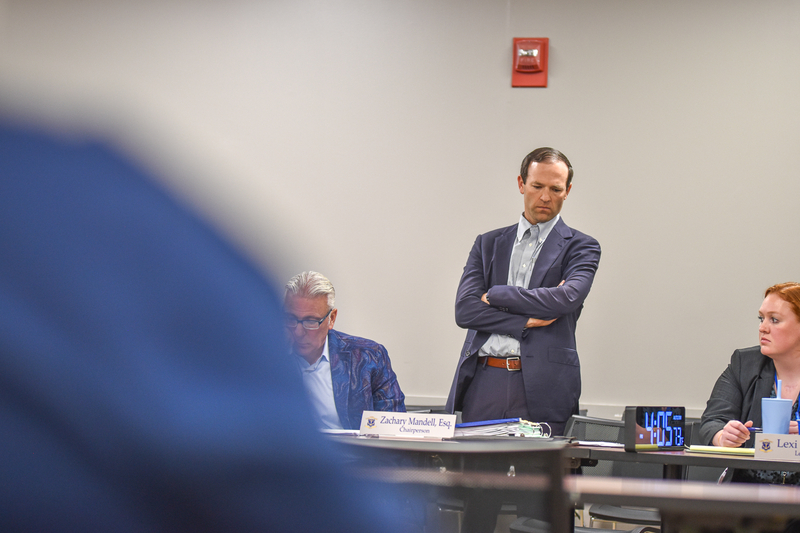
Commission members David Holley and Lamel Moore did not vote to support Shekarchi after questioning his attempt to jump from the legislative branch to the judicial. The Warwick Democrat stepped down as House speaker May 7, the same day Roger Williams University School of Law Professor Michael Yelnosky filed a complaint to the state Ethics Commission arguing that a lawmaker leaping directly from one branch of government to another would violate the state’s revolving door rule. The rule in the state ethics code was written into state law in 1992
Superior Court Judge Richard Licht ruled otherwise Monday, siding with Shekarchi’s legal arguments that the Supreme Court is a constitutional position exempt from the state’s ethics law.
That didn’t stop members of the public from urging commission members to vote against recommending Shekarchi as a nominee before the panel began interviews with the five finalists.
“I believe with all my heart that this is a good man, but you must refuse,” H. Philip West, the former executive director of Common Cause Rhode Island, said of Shekarchi. “You should not recommend him to the governor, because if you do, he will appoint him. Because the fix is in.”
Shekarchi shook his head from the audience. He denied any collaboration with state leaders during his interview before the Judicial Nominating Commission.
“I have no special arrangement with the governor,” he told the commission. “I have never discussed Justice Goldberg’s seat with the governor. There’s no quid pro quo.”
As we always have, we will take the time necessary to thoroughly vet candidates for this important position on our state’s highest court.
Also lingering over Shekarchi’s bid are questions about what he will do with his $4.7 million campaign account. The Rhode Island Code of Judicial Conduct prohibits judges and judicial nominees from making contributions to political organizations and candidates.
“Judges and nominees cannot maintain political war chests,” Yelnosky told the commission.
Holley too questioned why Shekarchi has not yet cleared his political bank account.
“Why not remove all doubt?” he asked.
Shekarchi responded that the only reason he has not yet donated his campaign money is because then “it would look like this was already a done deal.” If he were to be nominated by the governor, he said he would divest the money “in accordance with the law” to various charities and universities.
“I have worked very hard for a reputation, and I want to preserve that reputation,” Shekarchi told the commission.
Shekarchi applied for the Supreme Court vacancy three days after he stepped down as House speaker. He was first elected to the Rhode Island General Assembly in 2012 to represent Warwick’s District 23. He was elected as House speaker in 2021 after his predecessor, Nicholas Mattiello, lost his State House seat to Republican Barbara Ann Fenton-Fung.
Since 1995, he has been the sole proprietor of Shekarchi Law Offices in Warwick, where he concentrates on zoning and land use matters, as well as personal injury law.
“Applying to the Supreme Court is something that I have always wanted,” Shekarchi said. “The law is an equalizer for everybody.”
Shekarchi called his tenure as one of the state’s most powerful lawmakers an asset.
“I had to learn to compromise,” Shekarchi said.
Retired Rhode Island Superior Court Presiding Justice Alice Gibney testified in support of Shekarchi along with former Rhode Island Supreme Court Judge Robert Flanders.
“Always respectful, always gracious to the other side,” Gibney said of Shekarchi. “He’s a very good listener, and that takes discipline.”
Gov. Dan McKee now has 21 days by law to pick a nominee to fill the seat left when Justice Maureen McKenna Goldberg retired in March. The governor’s nominee must be approved by members of both the state Senate and House of Representatives.
“As we always have, we will take the time necessary to thoroughly vet candidates for this important position on our state’s highest court,” spokesperson Andrea Palagi said in an email to Rhode Island Current.
The annual salary of a Rhode Island Supreme Court justice, which is a lifetime appointment, is $228,325.
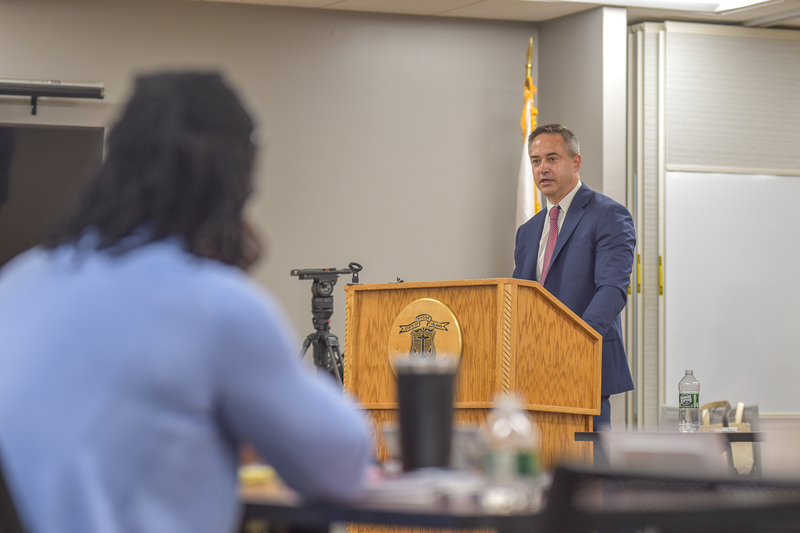
Also on the list …
Each applicant presented an opening statement and answered questions from the commission in alphabetical order, while the other contenders waited outside the Department of Administration conference room. Shekarchi went last.
The panel began with Bush, an assistant attorney general for the office’s appellate unit. Bush highlighted his 23 years working as a state prosecutor that included briefing and arguing more than 160 cases in the Rhode Island Supreme Court.
He said the part of the job that’s stuck with him the most has been working with families and seeing the impact on their lives on his career.
“You are making decisions that will impact the lives of people,” Bush said. “You can’t decide cases on sympathy or emotions. But as a judge, you can make people feel like justice is done.”
D’Ambra, a Family Court judge since 2004, detailed her lengthy career presiding over child abuse and sexual abuse cases, divorces, and custody trials. She touted herself as a consensus builder, highlighting her role in working with state leaders to purchase the St. Mary’s Home for Children following its 2024 closure.
“Every day, I strive to build public trust in fairness, equality, and justice for all,” she said.
D’Ambra was among the commission’s recommendations in 2020 to fill the seat now held by Melissa Long.
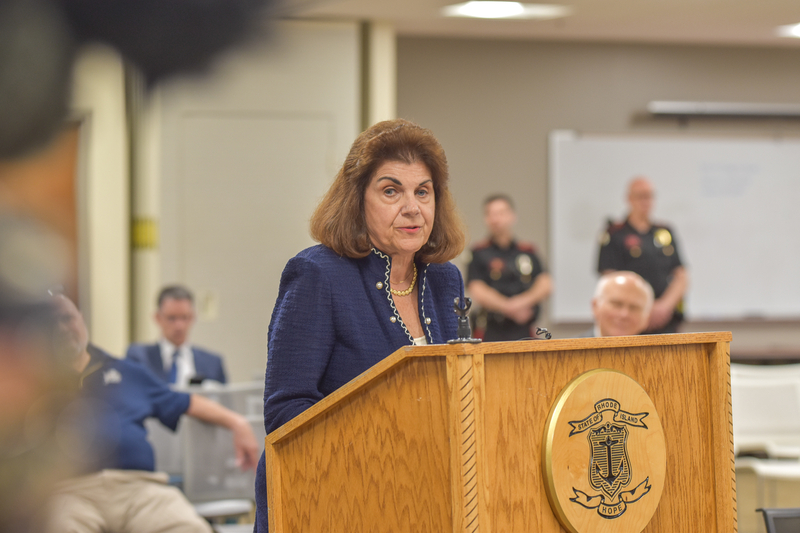
Matos, a Superior Court judge since 2012, spoke of his immigrant roots arriving from Portugal at 5 year -old and becoming the first member of his family to graduate from college.
“I’ve always endeavored to build trust in our institutions,” Matos said.
Roberts was previously on the 2020 shortlist for the Supreme Court seat now occupied by Erin Lynch Prata. He is a partner in the litigation department of the Boston law firm Proskauer Rose LLP, and said he has litigated almost 200 appeals in nearly every federal circuit and many state appellate courts. He has argued before the U.S. Supreme Court six times.
Before his legal career, Roberts said he worked for National Public Radio, establishing WRNI in Rhode Island.
More than one commissioner asked why Roberts would even consider joining the bench now given his record of achievement.
“The highest and best use of my talents and skills that I’ve learned is through judicial service,” Roberts responded. “I want to devote the rest of my professional life to serving the people of Rhode Island. I can’t think of a better way to give back to a state that’s done so much for me.”
Providence, RI