Federal appeals court hears Maine test case on regulating super PACs
Jul 29, 2026 | 5:06 pm ET
Description
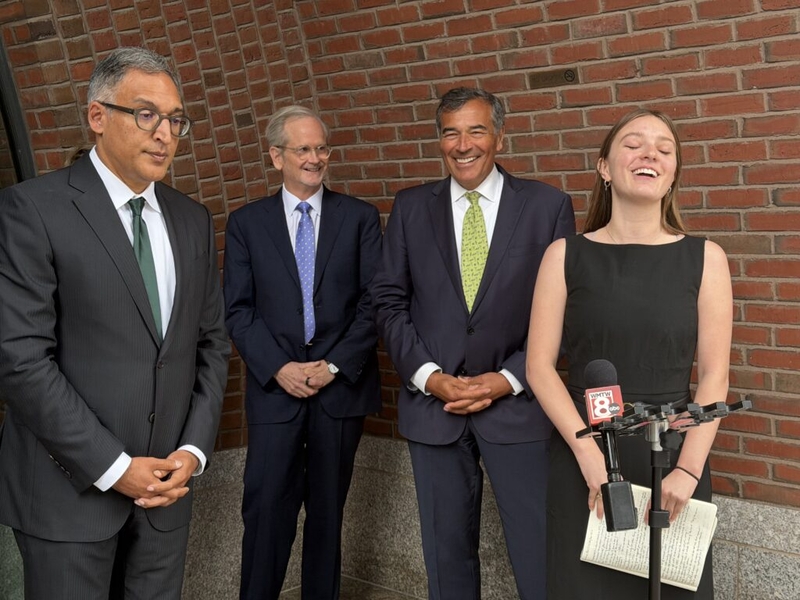
Neal Katyal (left), Larry Lessig, Rick Bennett and Maia Cook address reporters outside the U.S. Court of Appeals for the First Circuit in Boston on July 29, 2026, after oral arguments. (By Emma Davis/ Maine Morning Star)
The U.S. Supreme Court’s landmark decision that struck down limits on independent political spending does not need to be overturned to rein in Big Money in politics, Neal Katyal argued before the U.S. Court of Appeals for the First Circuit in Boston on Wednesday in defense of Maine’s 2024 referendum regulating political spending.
Whether the three-judge panel agrees could determine whether the Maine test case will go before the U.S. Supreme Court, which has been the goal of those behind the ballot referendum from the outset.
“Isn’t it reasonable to infer that if someone is giving a million dollars to a super PAC that is specifically set up for that one candidate that that is at least the perception of an appearance of corruption?” Judge Ojetta Rogeriee Thompson asked the counsel of the political action committees that had sued over Maine’s law.
Thompson’s line of questioning sums up the overarching argument of those defending the law, which set a $5,000 limit on contributions to political action committees that independently spend money to try to support or defeat candidates, commonly referred to as super PACs.
In the 2010 ruling Citizens United v. Federal Election Commission, the high court said there needs to be a wall of independence between a candidate and a PAC.
Katyal, an attorney with Milbank LLP, did not dispute that, but rather pointed out that such restrictions do not stop the potential for corruption, given that donors and candidates have the opportunity to collaborate even if a PAC is independent.
It will likely be months before a decision is issued. If the judges rule in favor of Maine’s law, the case would head to the nation’s highest court by default — since it would conflict with earlier rulings.
Pointing to that case law, Charles Miller of the Institute for Free Speech, one of the plaintiffs’ attorneys, told Maine Morning Star after oral arguments Wednesday that the matter was settled. Though Miller conceded, “The court is clearly taking the argument seriously.”
The appellants had a similar reaction after Wednesday’s presentation, with Katyal describing the judges as having “incisive questions at every turn.”
Case law to date
Since Buckley v. Valeo in 1976, the Supreme Court has allowed contributions to be regulated when there is a risk of “quid pro quo” corruption, essentially a favor for a favor. In the case of elections, if there is a risk someone could be making a donation to a candidate in exchange for a favor, then Congress can regulate that contribution.
The Supreme Court extended this reasoning to corporations and unions in Citizens United, and three months later, the D.C. Circuit Court of Appeals ruled in SpeechNow.org v. FEC that contributions to PACs cannot be regulated either, as long as the PAC is “independent” of the campaign.
“Donors can and do send their funds to super PACs and other outside groups that have a First Amendment right to receive and spend unlimited money,” Miller told the judges.
How SCOTUS striking limits on party spending could impact Maine’s Senate race
“They absolutely do,” Judge Seth Aframe responded, but countered that that point doesn’t answer the question in the Maine case, which he described as, “Can they do that by going to one guy, or do they have to do that by going to 1,000 guys?”
Aframe also pointed out that super PACs did not exist when Buckley had been decided. They were officially born through SpeechNow, said legal scholar Lawrence Lessig, one of the defenders of Maine’s law, which he helped initiate through his nonprofit Equal Citizens, a nonpartisan organization dedicated to political and democratic reform.
“Citizen’s United did not create super PACs, and the First Circuit in this case will end them,” Lessig said outside the court after the arguments concluded.
According to Lessig, the First Circuit Court is the best place to bring this challenge because it hasn’t considered SpeechNow — meaning there is no precedent.
When Lessig tried the effort earlier in Massachusetts, which would also have been in the First Circuit, it was blocked by the state attorney general, who under Massachusetts law can block an initiative they deem unconstitutional. There isn’t any requirement for citizen initiatives to have a constitutionality check before going on the ballot in Maine.
The lawsuit, which was filed by two PACs — Dinner Table Action, founded by state Rep. Laurel Libby (R-Auburn) and activist Alex Titcomb, and For Our Future, run by Titcomb — was an expected and welcomed part of Lessig’s plan, which is to get the U.S. Supreme Court to rule that super PACs can be regulated.
If the First Circuit upholds Maine’s law, such a decision would contradict the D.C. court and therefore provide a direct path to the U.S. Supreme Court. If those behind the Maine law have to appeal, that path is possible but murkier. In a typical year, more than 8,000 petitions are filed with the Supreme Court for review of lower court decisions, the vast majority of which are denied.
The referendum Maine passed is one example of how states are trying to intervene to weed out Big Money in politics. Hawaii passed a law, which is also now being challenged in court, to bypass Citizens United by depriving corporations and other “artificial persons” of the power to spend in elections. And Montana will decide whether to adopt a similar law in November.
This moment is possible because we were able to win in the court of public opinion.
Bipartisan backing
When Katyal, Lessig and Maine Assistant Attorney General Jonathan Bolton, counsel for the Attorney General and the Maine Commission on Government Ethics and Election Practices, exited the courtroom Wednesday, they were met with cheers and applause from numerous supporters in attendance: people from Maine and out of state, including some of Lessig’s former Harvard Law students.
Among the crowd of supporters was Richard Painter, an Equal Citizens board member who served as the chief White House ethics lawyer under President George W. Bush. Big Money in politics mirrors historic taxation without representation, he told Maine Morning Star, making the case for why Republicans should embrace campaign finance regulations.
“They finally have,” Maine Sen. Rick Bennett of Oxford, a former Republican now running as an independent for governor, chimed in. “Well, some of them.”
Pointing to the referendum’s overwhelming passage in the November 2024 election, Bennett, an intervener in the case, said Mainers have made clear they want to curb the influence of Big Money in politics — further shown by the passage of another referendum with a similar aim in 2023, which he’d also been involved with.
That support is not partisan, evidenced by the spectrum of supporters of Maine’s law, including former U.S. Congresswoman Claudine Schneider, a Republican from Rhode Island.
“The government of the people, by the people, and for the people can only exist if the courts reaffirm the decision of the Maine voters,” Schneider, who attended on behalf of the crosspartisan political reform group Issue One, said outside the courthouse.
Tasked with translating the legalese of campaign finance law to the public, Maia Cook, executive director of Equal Citizens, filled her notebook with points about various aspects of the case as she waited for oral arguments to begin. She said that task has gotten easier as the influence of money in politics has become more apparent.
“This moment is possible because we were able to win in the court of public opinion,” Cook said.
Augusta, ME