Courts order North Dakota to pay landowners’ legal fees in 2 lawsuits
Jul 27, 2026 | 6:00 am ET
Description
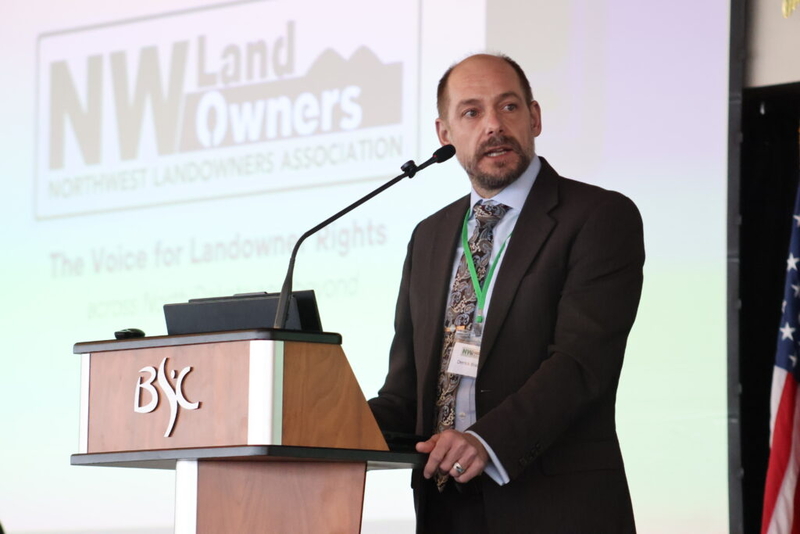
Bismarck attorney Derrick Braaten updates landowners on the status of pore space litigation against the state of North Dakota on Feb. 2, 2026. (Photo by Jacob Orledge/North Dakota Monitor)
A judge this month awarded North Dakota landowners attorney fees in a lawsuit against the state over a property rights law found to be unconstitutional.
The ruling means the state could owe nearly $975,000 in legal costs to the landowners and groups behind three related court challenges filed since 2019.
“We are grateful that the court recognized not only the merits of our case, but also the substantial time, effort, and expense required to defend our property rights,” Kurt Swenson, a landowner in Oliver and Mercer counties, said in a statement.
Swenson is the lead plaintiff in a lawsuit challenging the North Dakota Industrial Commission’s decision to grant permits for Summit Carbon Solutions’ proposal to inject carbon dioxide gathered from five states into underground storage in North Dakota.
Summit permit for CO2 storage voided as second judge finds North Dakota law unconstitutional
The storage involves injecting carbon dioxide deep underground into small cavities called pore space for long-term storage in order to receive federal tax credits. But some landowners have challenged the constitutionality of the North Dakota law, which allows the Industrial Commission to authorize the use of pore space without landowners’ consent. These opponents argue the state’s actions violate their property rights.
South Central Judicial District Judge Jackson Lofgren agreed. He ruled earlier this year the law was unconstitutional because it did not guarantee “just compensation,” determined by a jury, to be paid to the landowners for the use of their pore space.
This month, Lofgren went a step further and ruled the landowners who filed the lawsuit can recover about $429,000 in attorney fees and legal costs from the state.
“Families should not have to spend years and significant resources fighting the State simply to keep what is already theirs. The ruling confirms that when the government overreaches, there can be real consequences,” Swenson said.
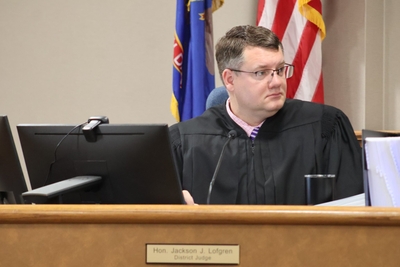
Derrick Braaten, a Bismarck attorney representing Swenson and other landowners in the case, said it was important that Lofgren ruled the Industrial Commission was not “substantially justified” in issuing the storage permits to Summit.
“What the judge is saying is, it’s not just unconstitutional. It wasn’t even a close call,” Braaten said.
This is the second time in eight months that a district court judge ruled the law was unconstitutional and the state is responsible for paying the attorney fees and legal costs of the people who challenged it.
Northeast Judicial District Judge Anthony Swain Benson first declared the law to be unconstitutional in December of last year, reaching a similar legal conclusion as Lofgren later did, in a case brought by the Northwest Landowners Association and North Dakota Farm Bureau. That case challenged the law itself, rather than the permits issued to Summit.
Benson ordered the state to reimburse the Northwest Landowners Association and North Dakota Farm Bureau approximately $278,000.
Both cases are being appealed to the North Dakota Supreme Court. If the Supreme Court overturns the district courts’ decisions, the roughly $707,000 the state has been ordered in attorney fees and legal costs would also be reversed.
“We’re going to be challenging the attorney fees awards and appealing them as part of our broader appeal of the case,” the Attorney General’s Office said in a statement.
North Dakota judge rules in favor of landowners, finds law unconstitutional
Lofgren’s decision to award attorney fees in the case was supported, in part, by his observation that the Legislature had the opportunity to correct the law’s “constitutional defects.” The judge wrote that a reasonable interpretation of a related court case, resolved in 2022, would lead to the conclusion this law was unconstitutional.
The Northwest Landowners Association previously challenged a 2019 law that excluded pore space from the definition of land and allowed the pore space to be used for oilfield operations, such as injecting carbon dioxide or disposing of saltwater, while prohibiting the surface owner from asking for payment.
The North Dakota Supreme Court ruled the law was unconstitutional in 2022. Benson, the district court judge in that case as well, ordered the state to reimburse the landowners association for about $266,000 in attorney fees.
After the latest district court rulings, Rep. Todd Porter said lawmakers will likely wait until the Supreme Court definitively settles the dispute before taking any further action.
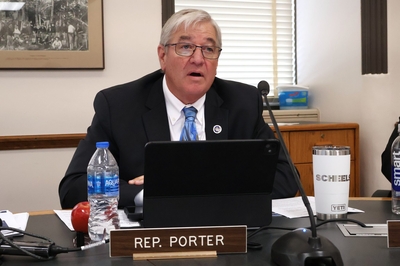
“The law is not in effect, and so there really isn’t anything to do until the Supreme Court comes out with their ruling,” Porter said.
Porter, R-Mandan, has been the chair of the House’s energy committee for more than a decade. He said the 2009 law at issue was an attempt to tackle a complex subject during the brevity of an 80-day legislative session.
Porter said it is possible the Legislature may not consider any changes to the law until the 2029 legislative session, if the Supreme Court confirms it is unconstitutional, depending on the timing of the decision. The next legislative session begins in January and typically ends by early May.
“They will tell us what we did wrong and what we did right,” Porter said. “That sometimes will make us go back to square one and start over and create an even better law that meets the muster of what the court has decided.”
North Dakota Monitor reporter Jacob Orledge can be reached at [email protected].
Bismarck, ND