Sen. Ted Cruz calls for regulating kids’ use of AI chatbots at Hinson campaign event
Jul 25, 2026 | 3:00 pm ET
Description
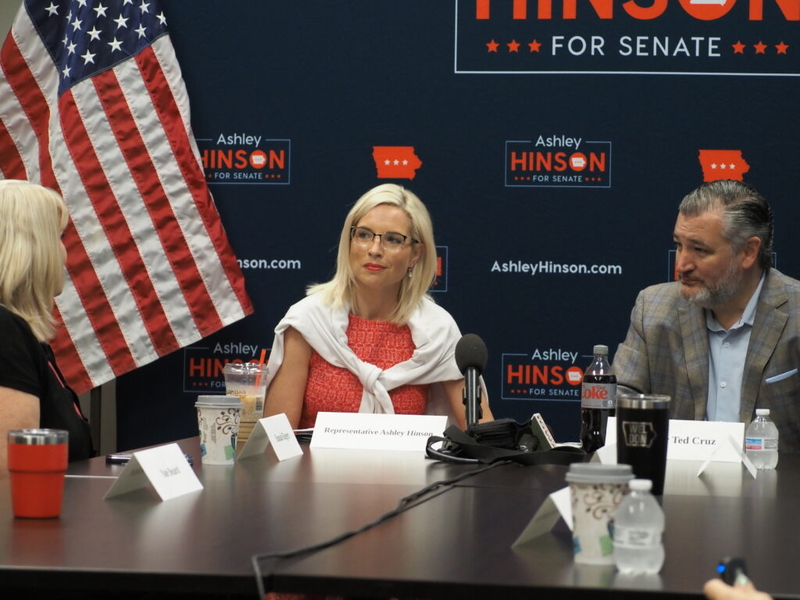
U.S. Rep. Ashley Hinson was joined by U.S. Sen. Ted Cruz July 25, 2026 in Ankeny at a campaign event for her 2026 Senate run where the Republicans spoke with Iowans for a roundtable focused on children's online safety. (Photo by Robin Opsahl/Iowa Capital Dispatch)
ANKENY — U.S. Sen. Ted Cruz said Saturday Congress needs to find a balance between regulating artificial intelligence chatbots and incentivizing the growth of the country’s AI industry as he joined U.S. Rep. Ashley Hinson at a roundtable in Ankeny.
Hinson aims to join Cruz in the Senate through her 2026 campaign to fill the seat currently held by U.S. Sen. Joni Ernst, and is running against state Rep. Josh Turek, D-Council Bluffs, in the 2026 general election. At Faith Baptist Bible College Saturday, she and the Cruz spoke with Iowa parents about what lawmakers in Washington D.C. can do to help better protect children in online spaces.
Cruz pointed to measures already passed by the U.S. Senate to address these concerns — like the “TAKE IT DOWN Act,” led by him and Democratic Sen. Amy Klobuchar of Minnesota, to criminalize both real and “deepfake” revenge pornography. He also pointed to the Kids Off Social Media Act, known as KOSMA, which sets the minimum age for social media platforms to 13, requires schools receiving federal funds to block social media on campus and bans companies from algorithmic boosting of content for users under age 17.
Cruz said there was a “generational divide” in the U.S. Senate on these issues — a majority of the sponsors of KOSMA, he said, were senators in their 40s and 50s, while older senators were not as involved.
“That’s one of the many reasons why why I’m excited for Ashley to come join us, because I think bringing the perspective of a mom dealing with these challenges every day when you go home at night,” he said. “That’s real, and we need that kind of urgency to understand why we need to be doing what we do.”
Members of the roundtable also brought up concerns about children interacting with predators or other bad actors on gaming platforms. Hinson said her sons play games like Roblox, which involve interaction with others online, and that could be an area where the government could set age restrictions or put other protections in place for children.
“You think about all the different places where we may need to be looking at these protections — it’s not just social media; it’s any place there may be a social interaction, and technology is that intersection,” Hinson said. “So whether it’s a big tech company or a gaming company, we may need to have conversations about what age limits are appropriate.”
The federal government has taken some steps to address concerns about social media, but members of the roundtable said there’s a new major concern about regulating digital spaces for minors: the use of artificial intelligence. Cruz said he’s working on a bill that he is calling “chatbot KOSMA” that he said would give parents control over whether their children interact with chatbots, like ChatGPT or Claude, and allow parents to see their children’s conversations.
Hinson said there were some chatbot protections included in the Kids Internet and Digital Safety Initiative passed by the House that regulate when an AI bot is “masquerading as a professional” or counseling a minor on issues like suicidal ideation or medical advice. But she said there was more work to be done.
“We want to make sure that the chatbots are also in their own lane, right?” Hinson said. “Because I think that’s the new frontier dealing with AI and the challenge that we are frankly struggling to keep up with on the policy side, because it’s moved so fast and advanced so quickly. Trying to figure out how we rein that in so that we’re not limiting everything, but we make sure we protect our kids from nefarious actors.”
Though the politicians said they want to put guardrails on AI, Cruz said it was also important to keep in mind that the U.S. was competing with China to become the “dominant standard” in the field — a competition he said it was vital for the U.S. to win.
“I very much want America to win that race, both because trillions of dollars of investment and millions of jobs are going to flow to whoever wins that race — and so I want them to come to America and not go to China — but equally important, whichever country wins that race, the values of that country are going to suffuse AI,” Cruz said. “So if China wins, the values of the Chinese Communist Party will suffuse AI. You will have surveillance and espionage and propaganda and control throughout AI. I very much want American values of free speech and individual liberty and free markets and individual rights, those values to suffuse AI.”
State Rep. Ryan Weldon, R-Ankeny, who joined the panel, said regulating chatbots has been a serious discussion in the Iowa Legislature as well. When state lawmakers were considering measures to restrict minors’ access to interact with chatbots — primarily large language models — concerns came from the private sector about these measures inadvertently impacting businesses that use “closed loop” AI chatbots for customer service or other specific purposes.
Weldon also said Congress should consider ways to encourage businesses to develop AI and other technologies that fall in line with their safety standards.
“We talk a lot about restrictions and I think those are good conversations,” he said. “In the private sector, we talk a lot about, ‘you get what you incentivize.’ And so I just wonder if there’s some some ways that we can incentivize our innovative companies to create products and services that will be safe for all of us to use without without these scary things. I’m a big believer in the free market and getting government out of the way so that people can do what they do, but just on the incentives, I wonder if there’s maybe some options.”
Des Moines, IA