In rare Idaho state audit of a city, report finds major procedural shortcomings in Kamiah’s spending
Jul 24, 2026 | 6:25 am ET
Description
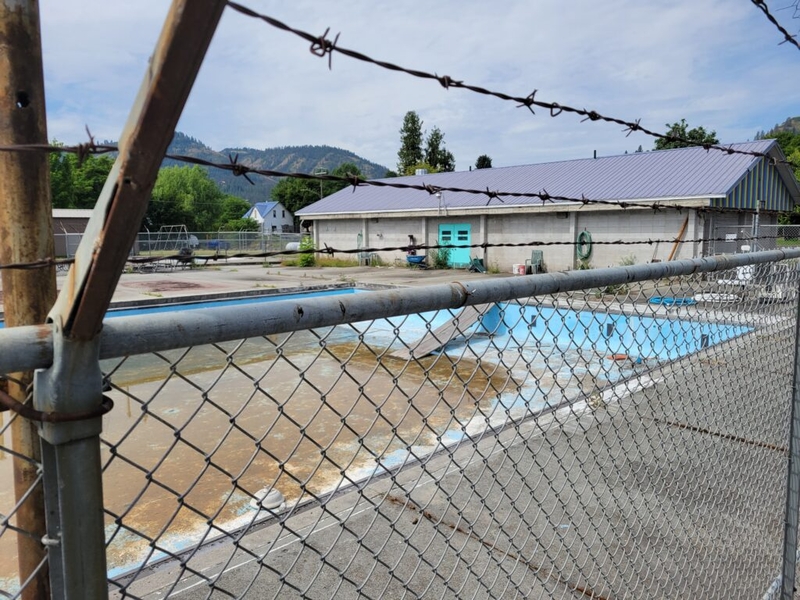
The Kamiah city pool seen last month. The city spent more than $500,000 on a renovation project that is not yet complete. (Photo courtesy of Idaho County Free Press)
Amid a rapidly declining cash balance and a half-a-million dollar public pool renovation project that isn’t yet complete, Idaho state auditors are referring a report on spending by the city of Kamiah to the state’s chief legal officer.
The audit report, published Thursday, included information on employee pay raises, vacation time, large vendor payments for candy, and a nearly $455,000 over-spend on a contract for the pool renovation — all with little to no documentation to justify the expenses and seemingly with little input from the City Council.
“The level of missing documentation across all financial transactions reviewed is very concerning,” the report said. “We were unable to determine if the missing documentation was due to incompetence or fraudulent activities, but it does call into question the integrity of many transactions.”
The financial audit largely looked at activity between 2020 and 2024. The city has since changed leadership and has implemented policies to try and address many of the findings, according to its response to the report.
The city’s response said that there was no evidence fraud took place. Current Mayor Genese Simler and current legal counsel Geoffrey Schroeder wrote the response. Simler was not mayor and Schroder was not legal counsel during the time period reviewed in the audit.
Simler and Schroeder wrote the city had a new mayor, new city attorney, and city council voted to remove the prior city clerk and hired an accounting firm to perform treasurer and in-house accounting reconciliation.
The Kamiah mayor could not be reached for comment.
Many of the findings in the report were based on the lack of documentation to justify certain expenses and policies that lacked safeguards against fraud.
Kamiah signed a $43,700 contract for pool renovations. It paid nearly $500K, and the pool still isn’t renovated.
In October 2020, Kamiah entered a contract with Idaho Stage Construction to renovate a municipal pool. Several change orders were made and largely attributed to the COVID-19 pandemic, the report said. The city has paid Idaho Stage Construction $498,453.22 in total, including around $40,000 to close out the contract with no documents provided to indicate services provided for the last payment, the report said.
The city has paid an additional $54,634.75 to two other vendors on the pool renovation project.
“Current Kamiah staff could not explain why Kamiah paid over $500,000 and the pool was still inoperable,” the report said.
Photos of the pool depict the “dilapidated state” auditors found it in when they visited the pool last year.
Last September, a citizen asked Kamiah City Council members about the opening of the pool, the Idaho County Free Press reported.
Former deputy city clerk Mike Tornatore responded, “It is going to take $1.5 million to repair the pool correctly.” He said it may take as long as two years, the newspaper reported.
According to the city response, Idaho Stage Construction is no longer in business. The city wrote there were “no indications of fraud or even suspected fraud” in previous communications related to the project failure.
The city decided that “pursuit of purported overpayments would be fruitless given the potential cost of pursuing them,” the response said.
Audit found unusual vendor payments with no supporting documents
The 30-page report included examples of a number of unusual payments that lacked documents to justify their business purpose.
The lack of documentation itself required auditors to refer the audit report to the Idaho attorney general, who has the authority to investigate potential fraud or misappropriation of public funds, State Auditor April Renfro told the Idaho Capital Sun.
“If you don’t have the support and you can’t prove that (expenditures) were for business purposes, then it becomes questionable whether or not that’s a misappropriation or an illegal use of public funds,” she said.
The following are expenditures that were highlighted in the reported:
- Then-interim city Fire Chief Jared Silvis personally paid a vendor $6,893.72 for tires and then was reimbursed by the city. Auditors couldn’t determine if the charge was for a city vehicle or why the city didn’t directly pay the vendor instead of reimbursing the employee. Auditors also couldn’t identify the vendor that sold the employee for tires.
- Then-Deputy City Clerk Mike Tornatore was also hired as a contract grant writer for the city. He was paid directly $2,842.70 instead of through his business, MFT Inc. Costs covered include candy, postage, and food.
- Tornatore’s business MFT Inc. was also paid $39,972.31 for grant writing fees as well as for candy for a barbecue, snacks for a meeting, and utility billings. The city “could not provide an explanation as to why the contractor was paid for items outside of grant writing,” the report said.
- Kamiah paid itself as a vendor $9,277.52, and auditors were “unable to determine the purpose of the payment or payments.”
- The city made an automated clearing house, or ACH money transfer, in May 2021 for $19,252.23 that “appears to have been paid to either a fake vendor or for ransomware,” the report said. The city had no documentation on the payment other than a handwritten note by an unknown author. The City Council did not approve the payment.
Kamiah employee credit card usage wasn’t documented while cash reserves declined
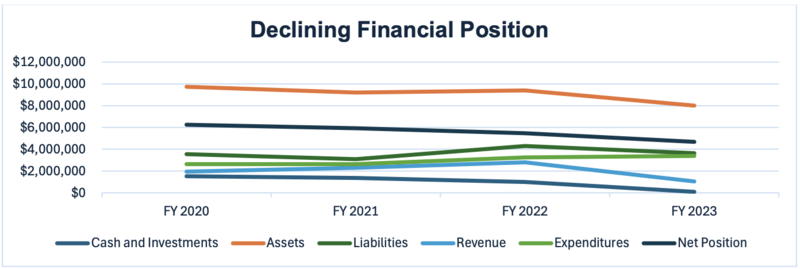
The city’s cash and investments declined by 94% between 2020 and 2023, the report said. All withdrawals were initiated by city employees. Credit card usage by employees at the time didn’t require supporting documentation, the report said, making it not possible to determine “if purchases had a legitimate business purpose.”
Auditors reviewed 59 credit card purchases that totaled $35,994 from 2021 to 2024, with vendors that included electronic stores, specialty clothing retailers, gym outfitters, grocery outlets, hotels, convenience stores, and large commercial equipment supplies.
Several purchases appeared to be travel-related, the report said, but without documentation of what the travel was for. One purchase was for the medical flight operator Life Flight in Oregon with no reason provided as to why.
“While all the purchases may have a legitimate purpose for city business, there was no way to verify that without supporting documentation,” the report said. “The accounting system included some abbreviated notes, but nothing definitive for the transactions.”
Some payroll, sick leave, vacation records don’t’ include documentation of City Council approval
In 2021, the city provided most long-term employees a $2 per hour pay raise using federal pandemic relief funds through the American Rescue Plan Act. However, those funds were time-limited, and auditors suspected that permanent raises using temporary funding “could contribute to future declining cash balances.”
Some employees in 2022 were given a $1 an hour cost of living adjustment, while two employees — former clerk Brenda Taylor and the former deputy clerk Tornatore were given a $2 adjustment. Tornatore is now the temporary interim city clerk as the city looks to replace him with a permanent city clerk, according to the city response to the report.
“They appear to be the only employees that received the increased amount,” the report said. “None of these wage increases had supporting documentation showing the mayor and City Council’s approval, as required by city policy.”
Tornatore was first employed by the city at an hourly rate of $13 in 2020, the report said. His pay increased three times until it was set at $22 per hour in 2022. However, Tornatore asked to switch from full-time to part-time, and had his pay cut to $12.50 an hour, and he entered a contract to be an outside grant-writer for the city.
As a contracted grant writer, his contract was for $1,200 a month along with 3% of grants he obtained, provided those grants had terms allowing the payment. He provided the mayor and City Council a memo in 2023 detailing more than $3.5 million in grants secured. Auditors were not able to verify that amount, the report said.
None of the grants allowed him to receive the 3% cut, so he requested a new contract for $2,400 a month for grant-writing services. Auditors found no evidence of approval of the new contract by City Council, but there were signed contracts provided to auditors showing the new terms.
Taylor, the former clerk, on four occasions was paid for sick time in addition to 80 or more hours of regular, holiday or overtime pay in a single pay period, which is contrary to federal labor laws, the report said. In a pay period that only included one holiday, Taylor was paid for two holidays.
Silvis, the former interim fire chief, was offered the temporary position at a rate of $2,500 biweekly. He was paid $3,000 biweekly in late 2022 into 2023, and the city provided no documentation of the reason for the increase or that it was approved by City Council.
Based on city vacation policy, Tornatore maximum vacation accrual should have been 120 hours between Oct. 1, 2020, and Dec. 31, 2022, the report said. Between October 2022 and December 2022, he received payment for 240 hours of vacation.
“When asked about the discrepancy, Mike Tornatore indicated that Kamiah kept paying so he kept asking,” the report said.
Some discrepancies occurred in utility billing
As deputy city clerk, Tornatore was the only city employee with access to utility information with the ability to make changes, the report said. Auditors found some discrepancies when tracing amounts billed to billing rates provided by Tornatore.
In some cases, rates charged to cover the cost of city bonds did not match the appropriate bond year, the report said. In one case, an account was over-billed by 56 cents, and another account was under-billed by $60.72.
“The lack of segregation of duties in the utility revenue process significantly increases the risk that fraud could occur,” the report said. “Given the current process, the deputy city clerk could intentionally enter incorrect rates, meter readings, and adjustments.”
The city wrote in its response there was no evidence fraud took place. “While there had been occasional forbearance of nonpayment shutoffs in some instances, all amounts due and payable for utility usage appear to be appropriately recorded.”
The city has changed its practices for utility billing.
Why did the state audit a city?
It’s not common for the state to audit a city, Renfro said. The Legislature’s auditing office does have the authority to audit any entity that is authorized or funded by the Legislature, which includes cities, but it needs approval to do so from the Legislative Council. The council, comprised of legislative leaders, rarely approves these requests, Renfro said.
Idaho State Police had been investigating the city after complaints were initially made to the Lewis County Sheriff’s Office. The sheriff contracts with the city for law enforcement, so it asked state police to take over.
State police asked the audit office to assist in 2024, and the Legislative Council provided the authority to move ahead with the audit at a June 17, 2024, meeting. The report was sent to Idaho Attorney General Raul Labrador’s office.
Damon Sidur, spokesman for the attorney general’s office told the Sun in an email Thursday, “Our office has received the audit and is reviewing it to determine whether any additional investigation or action is necessary.”

Boise, ID