Hilcorp killed Alaska LNG bill, some legislators say, but governor calls the claim ‘bulls**t’
Jul 17, 2026 | 11:40 pm ET
Description
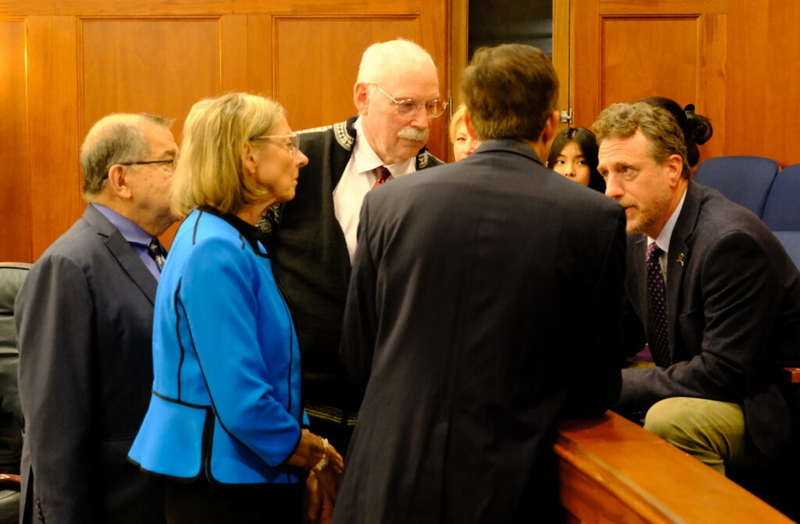
State senators crowd around Matt Kissinger, commercial director of the Alaska Gasline Development Corp., shortly before lawmakers voted Thursday, July 16, 2026, on a compromise version of a tax break intended to benefit the trans-Alaska natural gas pipeline. (Corinne Smith photo/Alaska Beacon)
On Wednesday, one day before the Alaska Legislature voted on a multibillion-dollar tax break for the proposed trans-Alaska gas pipeline, Rep. Calvin Schrage, I-Anchorage, gave the pipeline’s lead developer a sneak preview of the bill.
For weeks, Schrage had been in charge of negotiating a compromise version of the tax break that could get approval from the state House, Senate and Gov. Mike Dunleavy.
He walked Glenfarne Alaska President Adam Prestidge through the compromise, explaining section by section how skeptics in the state Senate had given ground on labor issues and project timing. Skeptics also were no longer insisting that the pipeline be subject to a revised tax on privately held oil and gas firms.
Given those changes, Schrage asked: Could Glenfarne support the bill?
According to Schrage, Prestidge said it could, and Glenfarne would publish a news release to that effect.
Glenfarne disputes Schrage’s account, and that difference in perspectives appears to have contributed to a failed vote on Thursday that killed the bill — and possibly with it, the current version of the gas pipeline project.
“The governor’s probably in a bad mood,” said Sen. Bert Stedman, R-Sitka, “but he was definitely told on several occasions when we were negotiating this bill that this is our last and final offer. The bill goes down, it’s dead. There’s no playing around.”
Glenfarne has repeatedly said that changes to the state’s petroleum property tax are needed in order to get financing for the pipeline project, which is expected to cost as much as $54.5 billion.
The bill wouldn’t have guaranteed a pipeline, but as Rep. Will Stapp, R-Fairbanks, said earlier this year, the lack of a bill would guarantee not having a pipeline.
The tax break would require the state and local governments to forgo more than $10 billion in revenue over 30 years, and some legislators are skeptical of the proposal. Getting their votes required a compromise.
A tax revision, variously called an “S Corp tax” or “pass-through entities tax” would apply certain income taxes to some companies that don’t currently pay them. It was included in the pipeline bill to win the votes of skeptical lawmakers, but prior versions of the tax have drawn opposition and led to an impasse.
On Thursday, after Schrage told fellow lawmakers that Glenfarne supported the new version, a bipartisan, bicameral committee voted 4-2 to advance it to the full House and Senate.
No news release came, and Schrage talked to Prestidge again.
Hilcorp, an oil and gas firm owned by billionaire businessman Jeffery Hildebrand, is the operator of the Prudhoe Bay and Point Thompson oil and gas units on the North Slope. Those units would supply gas for the pipeline that Glenfarne intends to build.
Hilcorp is also the company that would be most affected by the revised tax.
“What I heard from Glenfarne is that Hilcorp told them that if they came out in support of the bill, that they would make all their contractual negotiations impossible for them, and essentially threatened to use their future negotiations, which they knew they would have to enter into, to leverage them and and make things incredibly difficult,” Schrage said.
After Thursday’s committee vote, pro-development groups issued a statement asking legislators to vote down the revised bill, citing the tax revision and its potential effect on natural gas prices in the state.
“When you tax entities that are providing you with a commodity, it will increase the end cost of said commodity,” said Steve Wackowski, president and CEO of the Alaska Oil and Gas Association, a trade group that signed the statement.
Before the state Senate voted on Thursday afternoon, lawmakers there learned that Glenfarne and the Alaska Gasline Development Corp. — a state-owned firm developing the pipeline with Glenfarne — might have issues with the S Corp provision after all.
AGDC owns 25% of the gas line project, while Glenfarne owns 75%.
They called for a brief break in order to talk with Prestidge and Matt Kissinger, the commercial director of AGDC, in private.
Kissinger told senators that AGDC was fine with gasline-related provisions of the bill but had no comment on the pass-through provision because AGDC isn’t a tax-paying entity.
“They wouldn’t touch that with a 10-foot pole because they answer to the (governor),” said Sen. Bert Stedman, R-Sitka on Friday.
By phone to senators on Thursday, Prestidge said Glenfarne opposed the S Corp provision.
Members of the 14-person Senate majority caucus left that meeting with no agreement on whether or not to pass the bill. It ultimately passed the Senate by a single vote after Sen. Matt Claman, D-Anchorage, changed from “no” to “yes.”
Before the House could vote, Gov. Mike Dunleavy issued a statement saying he opposed the latest version of the bill and would veto it if it passed the House.
No veto was needed: Only 19 members of the House voted for the bill, two short of what was needed to advance it.
Only one of the House’s 21 Republicans — Rep. Louise Stutes, R-Kodiak — voted for the bill; all of the House’s Democrats and independents voted for it. That flipped a vote on a prior version, when opposition came from a handful of Democrats and independents.
Several Republicans who voted against the bill said they did so because it would affect companies that are drilling for oil and gas in Cook Inlet — Hilcorp, as well as HEX and Furie. Armstrong Oil and Gas, a firm active on the North Slope, would also be affected.
Partially because of corporate secrecy and partially because of the haste with which the compromise advanced, there was no information on how much each company would pay.
In addition, members of the all-Republican House minority caucus were excluded from the closed-door negotiating that led to the compromise bill. The exact text of the final version came as a surprise to them.
“All of a sudden, we would have a tax on our three most important companies, which would be Hilcorp, HEX, and Armstrong,” said Rep. Kevin McCabe, R-Big Lake. “I think (voting no) was the right thing to do, and my whole caucus apparently agrees, as well as the Senate minority.”
Schrage, who voted for the bill, disagreed.
“The bill worked for Glenfarne and would have allowed them to keep moving the project forward and given them a shot. They were happy and pleased with the work product. I don’t think they ever loved the S Corp provision, but it didn’t harm them. And it was only when Hillcorp came in to essentially leverage the parties at play that everything fell apart,” Schrage said afterward.
Glenfarne disputes Schrage’s account of what occurred, calling it “misleading and incorrect.”
“Glenfarne didn’t take a position on a bill we hadn’t seen, and once we saw the bill we immediately opposed it, including our June 19 statement to the media. This tax increases commercial and economic uncertainty in Alaska for the whole industry working together to support this project and bring energy relief. A $16 project energy price cap and tax-driven cost increases make project economics increasingly challenged,” said spokesman Tim Fitzpatrick by email.
Fitzpatrick’s statement refers to a clause in the gas pipeline bill that caps the price of natural gas for Alaskans. If taxes rise on Hilcorp, it could then raise the price of North Slope gas it sells into the pipeline, making it difficult for Glenfarne to meet the required price, said those familiar with the issue.
“It’s frustrating that Hillcorp has so much influence over the state of Alaska,” said Sen. Lyman Hoffman, D-Bethel on Friday. “Glenfarne or the governor wouldn’t stand up to them for the better interests of the state of Alaska.”
Schrage says he has phone records and text messages to back up his account.
“I think the evidence is pretty clear,” Schrage said. “The governor, Glenfarne and minority Republicans all indicated support for the bill passed out of the conference committee minus the closure of the passthrough entity tax loophole which the entire AKLNG project was exempted from. Given that exemption and the support for the rest of the bill, what possible reason would Glenfarne have to oppose the bill other than pressure from Hilcorp?”
Sen. Bill Wielechowski, D-Anchorage, took to social media on Thursday to accuse Dunleavy of working for “a Texas billionaire,” the owner of Hilcorp.
“Yeah, that’s bulls**t. OK, that’s bulls**t. He’s just — and you could quote me, that’s bulls**t. OK, he’s a bulls**tter,” Dunleavy said of Wielechowski, speaking to reporters after a news conference on Thursday evening. “He is one of a handful in the Senate and the Democrats that are going to try and kill this gas line for the very people they purport to represent — poor people, single moms with kids — that their bills are going through the roof. Why doesn’t he give a rip about them? Why doesn’t he care about them?”
“Why is he insisting on an S Corp in this bill?” Dunleavy asked.
Because Dunleavy would veto a standalone bill, Wielechowski said afterward.
“The reason that it hasn’t been passed is because he’s threatened to veto it, and you need 45 votes to override that, and there’s zero chance we’re going to get it,” Wielechowski said.
Alaska is facing a long-term deficit, with spending on services and the Permanent Fund dividend expected to greatly exceed the amount of available revenue. Legislators have been trying since 2017 to pass a bill containing the S Corp provision.
Dunleavy has vetoed numerous standalone tax bills, saying repeatedly that he will not approve any that are not part of a comprehensive plan to bring state expenses and revenue into line over the long term.
“He’s killed all of the new revenue bills that we’ve offered,” said Sen. Cathy Giessel, R-Anchorage.
“This is a huge gap in our revenue stream. It is an inequality in our tax structure,” she said, noting that other oil companies pay the tax that Hilcorp would pay. “How is it that Conoco and Exxon have been able to pay this tax and still continue to explore on the North Slope?”
Dunleavy said insisting on an S Corp provision in the gas pipeline bill amounts to hostage-taking.
“So you can’t get an S corp bill passed that’s unvetted, that nobody really knows what it does, unless you hold the people hostage with a gas bill? Well, that’s a representative for you. That’s a senator for you. That’s pretty sad, to be perfectly honest with you,” he said. “Pretty sad.”

Juneau