Kansas Board of Regents defines CRT and DEI in terms skeptics view as vague, imprecise
Jul 17, 2026 | 9:42 am ET

Description
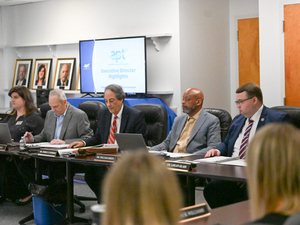
The Kansas Board of Regents adopts definitions of diversity, equity and inclusion and critical race theory in response to the Kansas Legislature's mandate that each campus police DEI and CRT in classrooms at Pittsburg State University and the five other public state universities or miss out on state appropriations of $2 million each. (Photo by Anna Kaminski/Kansas Reflector)
TOPEKA — Amy Reid loathes the Kansas Legislature’s campaign to restrain public university instruction of critical race theory and diversity, equity and inclusion.
Reid, program director for the Freedom to Learn program at PEN America, denounced as an affront to academic freedom the Legislature’s decision to attach CRT and DEI strings to $12 million appropriated to six universities in the Kansas Board of Regents system.
To claim $2 million each in the current fiscal year, the 2026 Legislature required in a budget bill that the Board of Regents formally adopt definitions of DEI and CRT. An underlying objective was compliance by Pittsburg State University, University of Kansas, Kansas State University, Wichita State University, Fort Hays State University and Emporia State University with the Legislature’s mandate that no student be required to study those topics to earn a degree.
“We spoke out against the restrictions enacted through the Kansas budget earlier this year because we understood it would result in the stifling of important classroom conversations about race and social inequity,” Reid said. “Unfortunately, to protect state funding for higher education, the Kansas Board of Regents has chosen to adopt a vague and confusing definition of content related to diversity, equity and inclusion and critical race theory.”
While there are divergent definitions, DEI has generally been viewed as a framework for promoting fair treatment among all people. CRT has referred to the academic examination of systemic racism in legal and social institutions.
John Yeary, interim president and CEO of the Board of Regents, said it was no small feat to find consensus on the statement regarding how state university faculty and students should address DEI and CRT in the classroom.
“There were lots of competing ideas and interests,” Yeary said. “Those have all been weighed and vetted.”
The statement approved by the Board of Regents to comply with House Bill 2513 said DEI content referred to establishment and promotion of preferential treatment of people based on race, color, gender, ethnicity or national origin. In terms of CRT, the Board of Regents’ said the subject would be defined as institutionally engrained racism characterized by faculty promoting that concept through indoctrination instead of scholarly study.
The Board of Regents’ policy said classroom discussion of race, racism or the history of the civil rights movement wouldn’t be considered DEI or CRT content at state universities.
Peter Johnston, a Salina attorney serving on the Board of Regents, said the most significant element in the document was the statement that instruction about the civil rights movement wouldn’t be labeled DEI or CRT.
“It is very important to me that professionals be able to study this difficult topic from the lens of history,” Johnston said.
Doug Girod, chancellor of the University of Kansas, said he was concerned classroom instruction could be mistakenly interpreted as an attempt to “promote” DEI or CRT concepts.
He urged the Board of Regents to replace “promote” in the definition with “required” so there was more clarity about the line being drawn in university classrooms. The board didn’t take Girod’s advice.
“Anywhere there is ambiguity there’s real risk,” the chancellor said. “Promotes can be defined a whole lot of ways.”
Reid, representing PEN America, said the Board of Regents’ guidelines on CRT and DEI didn’t go far enough to define those terms and could leave faculty and students on shaky ground during contemporary debates on historical events.
“How will faculty judge whether classroom discussions about the goals, successes and challenges of the civil rights movement toe the line of scholarly, historical or legal study or present racism as systemic?” she said. “Under these definitions, it seems unclear whether a professor could even ask students to discuss arguments about whether or not racism is systemic.”
Kathy Wolfe Moore, a member of the Board of Regents who represented a Kansas City, Kansas, district in the Kansas House as a Democrat, said adoption of the policy on DEI and CRT wouldn’t end political controversy in Kansas on the subject.
“This is very important and I’m sure it will come under scrutiny from groups,” she said.

Topeka, KS