Legislators get answers from DOC on capacity, out-of-state prisoners
Jul 16, 2026 | 6:59 pm ET
Description
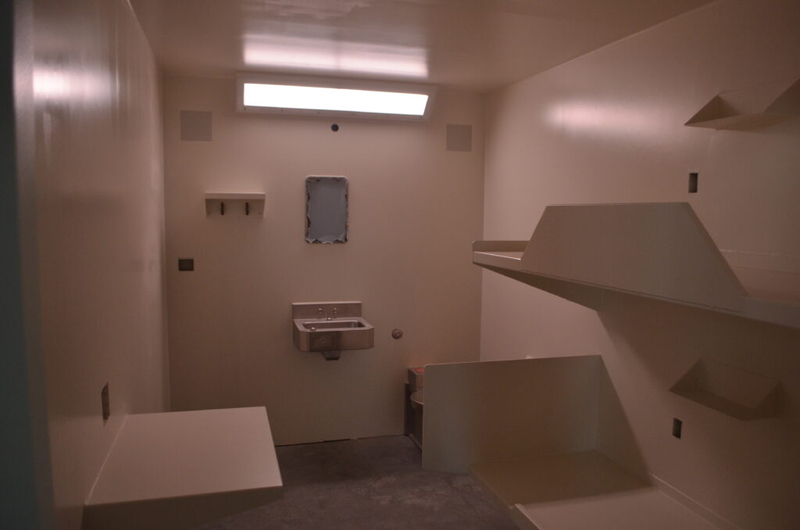
A prison cell at Montana State Prison, which is part of an additional housing facility currently under construction outside of Deer Lodge, Montana on April 15, 2026. (Jordan Hansen / Daily Montanan)
Four Montana inmates have died at Tallahatchie County Correctional Facility in Mississippi this year, bringing the total deaths among inmates in Montana Department of Corrections custody to 14 in 2026.
That’s according to Department of Corrections officials, who appeared before legislators during a Law and Justice Interim Committee meeting this week. The committee has been digging into complaints around the facility this summer.
Legislators received some answers on Tuesday from DOC following a request for information about the consolidation of out-of-state prisoners in Mississippi at Tallahatchie County Correctional Facility earlier this year.
Montana transferred 360 prisoners that were being housed in Arizona to Mississippi, which previously had 240. According to the DOC’s dashboard, there are currently 591 prisoners housed in Mississippi.
Public outcry and frustration over the move has simmered for months. Those concerns come on the heels of a major water crisis at Montana’s largest prison and a system itself over capacity for both male and female prisoners.
The DOC said the Tallahatchie County Correctional Facility has agreed to hire more staff “to provide treatment to Montana inmates,” which required changes to out-of-state prison contracts. DOC said there’s now increased law library access for Mississippi inmates, as well as improved access to communication tablets, an updated commissary list and access to a larger recreational yard.
“Tallahatchie did not have staff to accommodate programming, really everything that we needed for all 600 inmates, and so they are in the process of staffing up,” Montana DOC director Eric Strauss told the committee Tuesday. “As they staff up, as those staff come on, the programming will continue to expand.”
The push also comes as Montana inmate deaths have risen this year, with four in the Tallahatchie County prison alone. During the last 15 years, an average of about 14 people have died annually in DOC custody, with the vast majority of those listed as “natural causes.” There were 16 deaths in DOC custody last year, 13 in 2024 and 14 in 2023.
There are eight custody deaths currently under investigation, including all four in Mississippi. Montana DOC director Eric Strauss said he is going down to Mississippi soon, in part to meet with local law enforcement. Suicides are not uncommon among inmates— there’s been 25 in DOC custody during the last 15 years. In that time, two deaths have been ruled homicides and 13 deaths over that period were ruled accidental.
“We’re working to improve our relationships with local law enforcement down in Tallahatchie,” Strauss told the committee on Tuesday. “We’ll be down there next week, and actually, that’s one of the primary purposes is that we’re going to meet with the chief of police down there to make sure that they have an understanding of what our expectations and standards are when it comes to the evaluation of these events.”
Three of the 14 deaths this year have been people of Native American descent, including one woman at the Riverside facility in Boulder. More than 22% of Montana’s male secure population is Native American and they make up 13.5% of the population housed in Mississippi, the DOC document says.
Programming for Native American prisoners has also been a concern, as has religious and cultural practices including smudging, sweat lodges, the ability to have feathers in their cell, and who can be in the drum group.
Some advocates have said opportunities for those things are limited and are pushing for independent oversight of the DOC — an ombudsperson program — which was discussed again on Tuesday.
Scott Eichner, the DOC’s rehabilitative chief, said the programming for Indigenous people is the same in Mississippi as it was in Arizona and currently is in Montana State Prison.
Capacity also remains a major concern for legislators, who have appropriated hundreds of millions for upgrades to the state prison system, including adding more beds and capacity.
The Department of Corrections said last week it will not be building a new women’s prison, but instead repurposing Pine Hills Correctional Facility into a place for adult female prisoners, with the Miles City location also having room for expansion.
Legislators wanted to know where the appropriated $246 million for a new women’s facility will go, and whether all of it will be used in the upgrades to Pine Hills.
“If we budgeted 250 dollars for a new bed,” said Rep. Zooey Zephyr, vice chair of the committee, “And my family came back and said, ‘Good news, we got a 25 dollar couch that we can repurpose into a bed,’ I would go, ‘Great, what happened to the rest of that 225?’”
Strauss said the money was appropriated for “any” capacity concerns within the correctional system.
“This fall as the budget picture comes into clearer view, working with the budget office and governor’s office, if there is remaining dollars, we would engage with any legislative committee or any legislator that’s interested in having a conversation about how or when we might appropriate those dollars differently in the future,” Strauss said. “But I think you know the idea from our perspective is to really ensure that we’re addressing long-term capacity concerns for the correction system.”
Helena, MT