Indiana regulators to investigate utility profits, bill charges
Jul 15, 2026 | 12:14 pm ET

Description
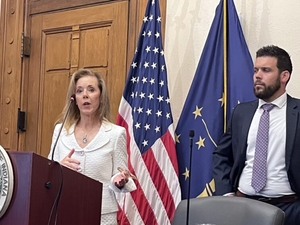
New Indiana Utility Regulatory Commission leader Anthony Swinger announces a pair of affordability investigations on Wednesday, July 15, 2026. (Photo by Leslie Bonilla Muñiz/Indiana Capital Chronicle)
State regulators on Wednesday kicked off investigations into utility profit margins and bill charges — the first two action items in an energy affordability report that also recommends several legislative changes to benefit struggling customers.
Anthony Swinger, the newly elevated leader of the Indiana Utility Regulatory Commission, said regulators are preparing for a statutorily required shift to a three-year ratemaking system.
They’ll first look into the profits utilities are allowed to collect on the investments they make for capital projects.
“If there are specific parameters we can set for considering return on equity in those multi-year rate plans, now’s the time to set those,” Swinger told reporters.
The other investigation will examine how trackers — fluctuating charges added to utility bills for fuel expenses and more — will fit into the new regulatory structure.
“Are all of these trackers necessary, and if they’re not, which ones could be cut back on? And if they are cut back on, what legislative action is necessary?” Swinger said. “Answering those questions is going to be at the crux of the tracker investigation.”
The commission oversees five investor-owned electric utilities, in addition to nine municipal ones. Both cases are docketed on the commission’s online portal.
The Office of Utility Consumer Counselor, which represents customers in regulatory cases, said it was “encouraged” by the announcements.
Spokeswoman Olivia Rivera said the office is looking forward to learning more about the investigations — and “advocat(ing) for affordable rates for Hoosiers across the state” — at a pair of technical conferences scheduled for Aug. 7.
Swinger aims to have both investigations completed by the end of the year, in time for the next legislative session, but said, “We will see what happens and how far into the weeds our technical staff will get.”
Other recommendations
The inquiries are the first two action items listed in an energy affordability report also released Wednesday, following an affordability investigation this spring that included an all-day utility questioning and a 10-stop ratepayer listening tour.
The announcement prompted an approving nod from Gov. Mike Braun.
“Affordability for Hoosiers is my top priority, and my appointees on the IURC have been tasked with making decisions that are fair for Hoosier families,” Braun said in a news release. “Today’s announced action steps are a great step to making energy bills more affordable. Hoosier families work hard to make every dollar count, and utility companies must start doing the same.”
Indiana Lt. Gov’s call for utility bill tax pause faces key skeptics
But he hasn’t said what specific legislative changes he’ll support.
The commission’s report asks the General Assembly to consider repealing the state’s 7% sales tax on utility bills, a move sought unsuccessfully by Democratic lawmakers.
“I think everyone agrees you shouldn’t be taxing necessities, and clearly utilities — which allow you to heat your home, cool your home, you know, run every aspect of life — is a necessity,” said Rep. Matt Pierce, D-Bloomington. “And so, we had an opportunity months ago to do something about that, and we passed it up.”
That elimination would cost state revenues a total of $615 million annually.
Pierce blamed Republicans, who have held supermajorities in both chambers for more than a decade, for laws he said “sided with the utilities.”
“It’s great that the utility commission is working on this stuff and is investigating these things,” he said. “But at the end of the day, the General Assembly is going to have to change its policies of the last decade and begin to legislate in favor of ratepayers.”
The report also calls on lawmakers to give regulators oversight of utility ownership changes — amid bipartisan outcry over the pending purchase of AES Indiana. The state has no control over the proposed $33 billion acquisition by investors like BlackRock.
Lawmakers could also require utilities to join a regional transmission organization, taking customers off the hook for a half-percent profit incentive for utilities. The federal government requires that incentive only when utility participation is voluntary.
“Ironically enough, a couple weeks ago I put in a bill draft request to have this legislation to mandate every utility belong to an RTO, which then would remove that incentive, so that would lower rates for ratepayers,” Pierce said.
Other action items are directed at agencies and utilities.
Regulatory staff will provide guidance on a specific tracker for transmission improvements, according to the report. And they’ll design the performance-based incentive mechanisms required by House Enrolled Act 1002, the March law that established multi-year ratemaking.

Commissioners encouraged Indiana’s Office of Energy Development to synchronize energy affordability and efficiency programs, expand the relatively new Indiana Energy Saver initiative, secure federal funding for energy infrastructure and help utility construction “match the speed of business.”
Investor-owned utilities, meanwhile, should double the amount of shareholder dollars invested in customer pay help and weatherization, along with economic development incentives, according to the report. Other recommendations include better customer service and improved communication about the assistance available.
Utility watchdogs applauded the IURC’s “deep dive” into affordability.
“We have long been critical of tracking mechanisms which allow monopolies to increase bills outside of a rate case and which reduce the discretion and flexibility of regulators,” said Kerwin Olson, the executive director of Citizens Action Coalition, in a news release. “There’s no question that the returns on equity of the Indiana utilities are unjustly high and disproportionate to the risk that investors face. … We are hopeful that these investigations will lead to meaningful policy movement at the legislature and more affordable bills for consumers.”
Consumer advocates in and out of state government have opposed a $71 million rate increase approved for AES Indiana. Swinger said his colleagues are taking a recent request for reconsideration “very seriously.” He is recused from the case, having worked on it in his previous role at the Office of Utility Consumer Counselor.
Indianapolis, IN