Hospital CEOs meet union skepticism over out-of-state acquisition of Allina Health
Jul 15, 2026 | 11:42 am ET
Description
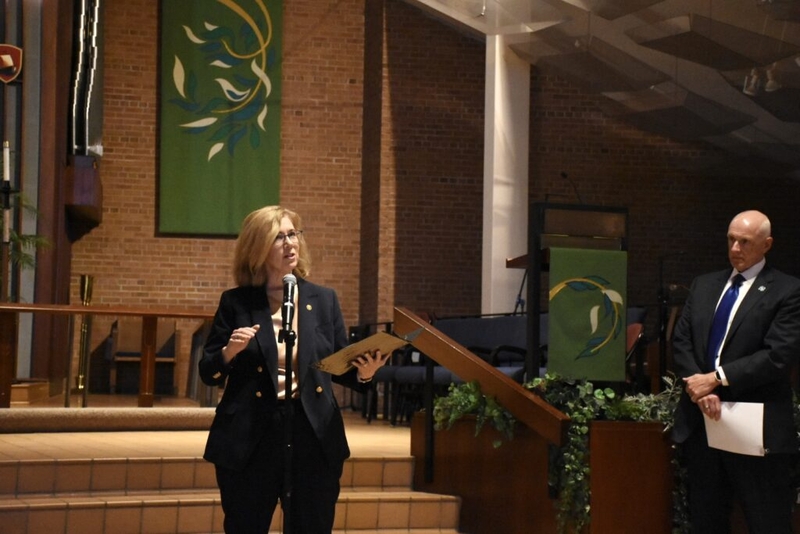
Allina Health CEO Lisa Shannon speaks next to Sutter Health CEO Warner Thomas at a public forum on the proposed acquisition of Allina Health by Sutter Health, hosted by the Minnesota Attorney General's Office in St. Paul Monday July 13, 2026. (Photo by Alyssa Chen/Minnesota Reformer)
In what could be a portentous signal for the fate of a healthcare mega merger, skeptics from labor unions filled a St. Paul church this week to voice concerns — sometimes raucously so — about the proposed joining of two big nonprofit health systems: Allina Health and Sutter Health.
The Office of the Minnesota Attorney General held the first public forum this week on the proposed acquisition of the Upper Midwest’s health giant Allina by the even bigger California system, Sutter Health.
Sutter Health, the fourth biggest health system in California by number of staffed patient beds, has been accused of driving up costs for Californians through anti-competitive behavior in two lawsuits brought by unions, employers, individuals and California’s attorney general. After over a decade of litigation, the health system paid settlements of $575 million and $228 million in the lawsuits, fractions of what the plaintiffs were estimated to have overpaid — $1.2 billion and $411 million, respectively. The settlements also barred Sutter from some anti-competitive practices.
The Minnesota Attorney General’s Office was bestowed with expanded regulatory powers over healthcare mergers by the Legislature in 2023. It’s now able to analyze and sue to block hospital mergers if they are against the public’s interest — for example if they increase healthcare costs for patients.
Elizabeth Odette, an assistant attorney general in the office’s antitrust division, said that public forums are helpful for identifying the public’s concerns and ensuring that the parties are addressing those concerns.
The Monday forum was markedly more lively compared to a recent public forum on another health system merger, one between North Memorial Health and South Dakota-based Sanford Health.
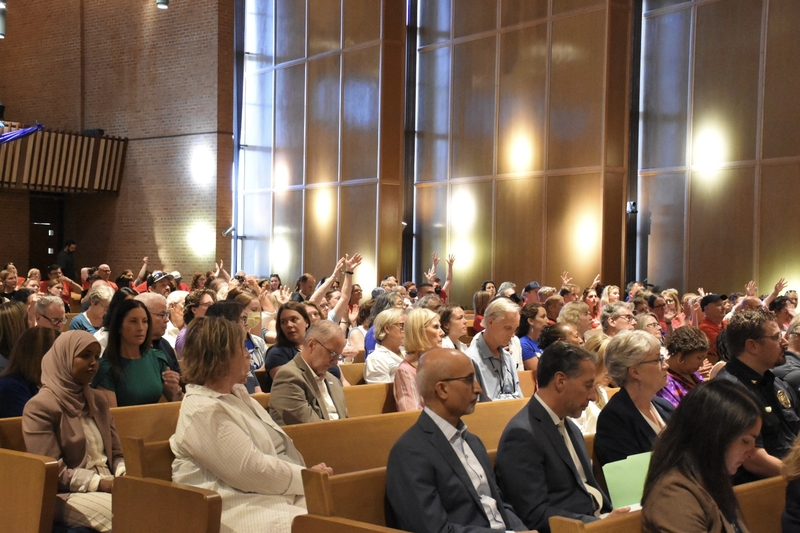
The pews at the forum’s venue, Gustavus Adolphus Lutheran Church in St. Paul, were largely filled by t-shirted union members — Minnesota Nurses Association, Doctors Council and SEIU — who cheered and occasionally hissed at speakers. Members of the public and leadership from Sutter and Allina were also present.
The attorney general is at the beginning of the review process for both the North Memorial-Sanford and Allina-Sutter transactions, which were announced in the spring. The Allina-Sutter transaction is significantly larger and would create a combined $26 billion system with 39 hospitals serving more than 5 million patients in California, Minnesota and Wisconsin. Under the combined system, Allina would maintain its Minneapolis headquarters and become the Upper Midwest Division of Sutter Health, with Allina CEO Lisa Shannon remaining in leadership of the division.
Unionized doctors and nurses said the consolidation would lead to higher costs and worse care and working conditions. Substantial evidence has shown that healthcare consolidation — hospitals and clinics combining into sprawling health systems — has led to higher prices. Evidence on the effects on quality of care is mixed “at best,” according to a brief from KFF, a health policy research organization.
“When the evidence tells me that after a merger, I can expect costs to go up for my patients and quality of care to go down, I will not be reassured by platitudes from Allina and promises of an initial investment into our healthcare system,” said Cora Walsh, a family physician at Allina’s West St. Paul clinic who is involved in union organizing.
At the forum, Shannon, the Allina CEO, emphasized the need to make “bold and proactive decisions,” like merging with Sutter, to preserve Allina’s “incredible legacy” and strengthen its care. The transaction includes an investment of more than $2 billion in Minnesota and western Wisconsin.
Matt Hoffman, also a union organizer and Allina family physician, highlighted Allina’s closures of rural birth centers, primary care clinics, and an inpatient pediatric unit at Mercy Hospital. He noted that Shannon’s pay increased from $1.2 million in 2020 to over $4 million in 2024. Sutter Health CEO Warner Thomas was paid $11.9 million in 2024.
Public comments in support of the acquisition mostly came from Allina leadership, including vice presidents and division directors.
“If we look back 10 years from now, are we gonna feel like this was something that benefited all the important constituencies, from our patients to those with caregivers and everybody else in this community? We believe very strongly that this transaction will facilitate that,” said Tom Schreier, an Allina board member.
In response, one person yelled from the crowd: “Liar!” Another: “Put it in writing!”
John Keller, the state’s chief deputy attorney general, moderated the forum in the absence of Attorney General Keith Ellison.
“Please give everybody a chance to speak and be received respectfully,” Keller said. At one point, Keller requested that the crowd use silent “jazz hands” instead of cheering and applauding to save time in the packed two-hour session of public comments.
Union demands, warnings
The audience member’s call to “put it in writing” likely referred to the unions’ demand for a written “community benefits agreement” from the health systems, which would stipulate protections for workers and patients. Faith leaders with the progressive ecumenical group ISAIAH have joined labor in the effort to win a community benefits agreement in both the Allina-Sutter and North Memorial-Sanford transactions. The coalition has yet to release written demands though they said they asked to meet with Allina and Sutter leadership.
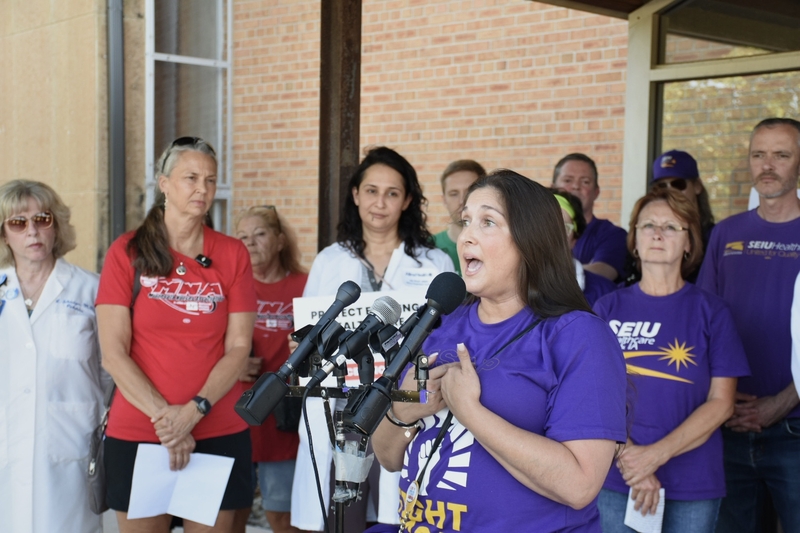
A group of SEIU Sutter Health workers flew in from California to speak at the forum. Sarah Pineda, a surgery scheduler at Sutter Delta Medical Center in Antioch, Calif. who is also an executive committee member for SEIU’s California healthcare labor union, cited problems with workers’ pensions and low staffing.
“This is a giant that you are going to be battling. It is very important that you guys do get this community agreement because you’re going to need it,” Pineda said at a union press conference before the forum.
The unions are demanding protections around artificial intelligence, medical debt forgiveness, limits on hospital pricing, and pension and contract protections for current employees, among other stipulations stated at a press conference before the forum.
Community benefits agreements are more commonly found in real estate development, where developers sign contracts with community groups in exchange for support in a municipal approval process.
Phillip Cryan, the executive vice president of SEIU Healthcare Minnesota and Iowa, said he’s only aware of one such agreement in healthcare — a 2006 community benefits agreement between the Yale-New Haven Hospital in Connecticut and workers and residents. A 2009 paper in the Journal of Labor and Society found that the agreement resulted in some concrete gains, but that the hospital “blatantly violated the union-organizing rights part of the agreement.”

Saint Paul, MN