SJC sides with solar developer in dispute with Petersham officials
Jul 15, 2026 | 4:00 am ET
Description
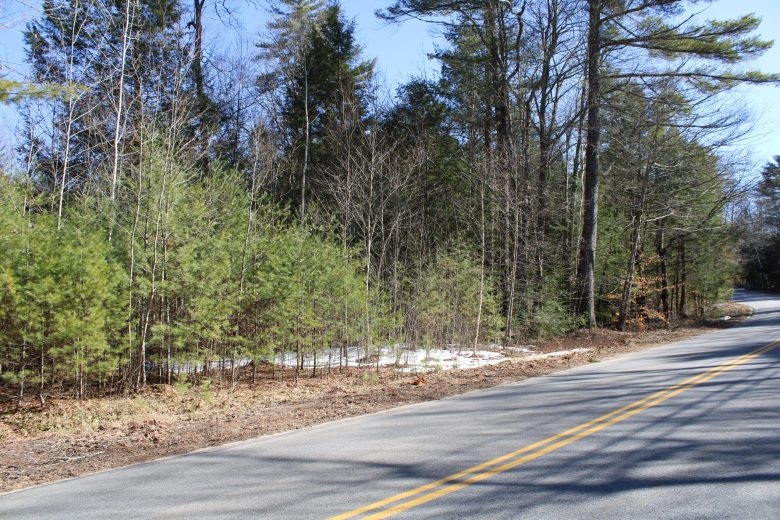
Sunpin Energy’s proposed solar project lies in the heavily forested town of Petersham. (Jordan Wolman/CommonWealth Beacon)
THE STATE’S HIGHEST COURT ruled Tuesday that a decision by a small town in Central Massachusetts to block a solar project in the name of tree preservation was “improper.”
The Supreme Judicial Court’s ruling breathes new life into a proposed solar farm and battery storage project from Sunpin Energy Services over the objections of Petersham, a remote town of 1,200 near the Quabbin Reservoir that consists of 97 percent forest.
The case centered on a select board member’s objection to the project, which required a special permit, given that it would require clear-cutting of trees over 14 acres, or the equivalent of 11 football fields, in order to produce 4.3 megawatts of solar power and 2 megawatts of battery storage.
A decision to grant the permit to Sunpin had to be unanimous, meaning the dissenting board member effectively blocked the project.
But the board erred, the high court ruled, in misapplying a standard that allows the denial of a permit when “necessary to protect the public health, safety, or welfare,” not for deforestation or hypothetical concerns about future development alone.
To be clear, the SJC wrote, “avoiding unnecessary deforestation is an appropriate consideration” in deciding whether to grant a permit for a solar project. But a site-specific analysis alongside a comprehensive review of the town’s regulations is required to inform whether the permit denial is necessary to protect the public.
Now the case, which attracted attention from the solar industry’s main trade group, goes back to the town board to conduct that analysis and reconsider the permit.
“Moreover, because the town is ninety-seven percent forested, denying the application if it causes significant tree cutting has the essential effect of creating a blanket prohibition on large-scale ground-mounted solar systems in all but three percent of the town,” the SJC wrote in its 25-page decision.
Michael Shamgochian, an attorney representing Petersham in the case, said in a statement that he is “pleased” with the SJC’s decision despite the fact that the court sided with the solar developer because the ruling strikes “the right balance” between promoting solar energy and preserving local authority.
“The Court provides municipalities with clear guidance on how to conduct site-specific review of proposed solar projects, gives Petersham the opportunity to do that, confirms that local boards have the authority to act where necessary to protect the public health, safety, or welfare, and recognizes what we know to be true: forests provide major environmental and public welfare benefits,” he said. “That’s a positive outcome for everyone involved.”
The case before the justices laid bare those rising tensions over local control between solar developers and small communities across the state that are potential prime spots for large solar arrays thanks to their relatively cheap and abundant land.
And it put under legal scrutiny one of the biggest tradeoffs associated with solar farms like the one planned in Petersham: the need to cut down trees. Gov. Maura Healey has sought to boost solar power in the state as a means of growing the energy supply and supporting clean power to displace fossil fuels, but since trees absorb carbon dioxide, a greenhouse gas associated with climate change, cutting them down in large quantities can complicate the climate benefits for certain solar projects.
Similar battles are taking place across the state as Massachusetts looks to generate more energy and lower utility bills for ratepayers.
Petersham argued in its legal brief that it’s not against solar energy, it’s just against this specific project at this specific location of undeveloped forest. The town has permitted more than 60 such systems as of June 2023, but the decision to deny Sunpin a permit for its project is actually rooted in a firm belief in the town’s responsibility to fight climate change by protecting trees even if it means passing on a large solar project.
Those policy objectives shouldn’t “work against each other by siting solar by destroying forests,” Petersham’s attorneys wrote.
Yet when the SJC heard the case in April, Justice Serge Georges, Jr. wondered what would be so bad about a large solar array in a heavily wooded town with practically no adverse aesthetic consequences.
“If this project were to go forward and be built as proposed, we’re not talking about a major detractor from the character of the town as being forested,” he said at the time.
The case, in some ways, speaks more to the pitfalls of the current permitting and siting rules than how those processes will play out in the future.
New regulations around the permitting and siting of energy projects like Sunpin’s proposal take effect this fall, upending the current town-by-town scattershot process in favor of a more uniform and standardized regime meant to speed up and offer greater predictability for permitting projects.
The new rules, borne out of the 2024 climate law, are meant to address these exact sorts of disputes and offer relief for developers struggling to get projects off the ground in the face of years of delays. Case in point: Sunpin first started its legal challenges five years ago.
Still, localities will have a role to play, and the SJC’s ruling in favor of Sunpin will be instructive as decisions about where to site energy infrastructure and controversial project proposals continue to unfold.
Boston