Huntington City Council approves purchase of Flock cameras despite public opposition
Jul 14, 2026 | 11:18 am ET
Description
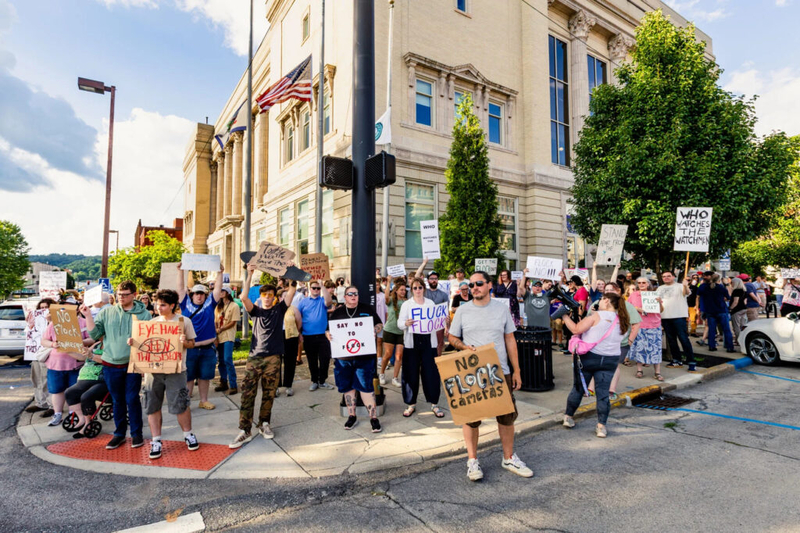
Protestors crowd the corner of 5th Avenue in Huntington, West Virginia, outside of Huntington City Hall as they respond in opposition to Flock Safety items listed on the Huntington City Council agenda on Monday, July 13, 2026. The anti-Flock Safety protest was organized in part by the Huntington Community Action Group. (Photo by Ryan Fischer/The Herald-Dispatch)
Over the concerns of dozens of residents, Huntington city leaders voted 6-4 early Tuesday to move forward with the purchase of audio detection, live video cameras, drone services and license plate recognition with Flock Safety.
Protestors, led by Huntington Community Action Group, rallied against Flock prior to Monday night’s city council meeting, which stretched more than seven hours until around 4 a.m. Tuesday morning.
During a public input portion of the meeting, more than 50 people spoke against the proposal with Flock, a company that’s been criticized over privacy concerns in other jurisdictions the devices have been used in.
“We have quite a few main concerns. It’s honestly surprising how far-reaching some of the dangers of Flock are,” Matthew Lebo, treasurer of the Huntington organization, and an organizer in the group’s Democracy Task Group, told West Virginia Watch Monday.
Lebo cited the recent Supreme Court decision in Chatrie vs. United States that held that people have a reasonable expectation of privacy in their physical movements.
“The Supreme Court used this to say that police need a warrant to access your location data on a phone on your phone,” Lebo said. “And what’s the fundamental difference between that and a nationwide network of surveillance cameras designed to identify wherever you go?”
Flock cameras are easy to abuse, he said. He cited data from the Institute of Justice that found 22 instances of law enforcement across the country using the technology to stalk romantic interests.
“There is no real system of regulations that restricts Flock,” Lebo said. “That there is no ordinance in Huntington protecting our residents against the abuse of Flock data.”

Residents also raised concerns with a lack of transparency related to the contracts. A Freedom of Information Act request by the American Civil Liberties Union of West Virginia Investigative Reporter Kyle Vass turned up emails between the company and the police department indicating they’d been working “several months on a large deployment” of the devices, but the proposal had only been presented to council about a month ago.
During the meeting, Huntington Mayor Patrick Farrell asked council members to approve the contracts with Flock, which total more than $2.1 million for five years, saying the devices would lead to convictions of people harming the community. He said license plate readers had been used in another city to arrest a man suspected in the shooting death of Huntington resident Jackie Harper on July 7.
Harper was reportedly shot to death in the 2400 block of Ninth Avenue in Huntington. In the days after the shooting, one man was arrested in Michigan and charged, and another was arrested in Cabell County.
“So it helps our law enforcement do its work faster, more efficiently, and that’s the kind of success that I think we need more of,” Farrell said. “And that’s why, again, Chief (Phil) Watkins is going to ask you all to give him the evidence-based tools that he needs to do his job, the whole police department (needs to) do their job.”
Farrell said the technology can be used to stop the drug trade in the city.
According to the ACLU, between 80,000 and 100,000 Flock cameras have been installed on urban and rural areas of highways. Less than 1% of the plates scanned by the devices are connected with any crime.
The automated license plate readers are more powerful than typical license plate readers and analyze the make, model and color of cars they see, along with other identifiers like scratches and dents, and even pedestrians passing by, according to the ACLU.
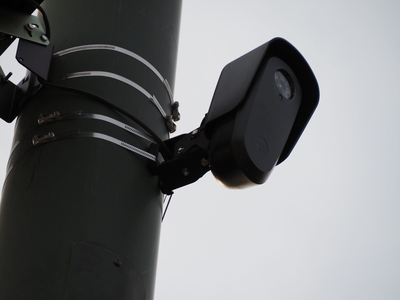
The cameras analyze the recordings and upload data to a national surveillance platform and stores the data in a way that’s accessible by law enforcement and Flock users everywhere, according to ACLU.
“These small, unassuming cameras allow police to potentially sit with unblinking eyes 24/7 on every street corner, in every parking lot, and in every neighborhood,” the ACLU said. “The data captured by Flock’s cameras can reveal very private details about a person’s life, including what meetings a person attends, what doctors’ offices and religious institutions they visit, who a person associates with, and even where they sleep at night.”
The devices have raised privacy concerns in other jurisdictions they’ve been used in.
In Houston, at least six Flock cameras were cut down last week after residents complained about the devices to county commissioners. The Los Angeles Police Department announced Saturday it would not renew its contact with Flock, citing concerns over privacy.
In Minnesota, Flock cameras reportedly wrongly flagged a car’s plates as stolen, leading police to pull a man over.
Farrell addressed the privacy concerns, saying that city officials had asked the company a lot of questions.
“When it comes to invasion of privacy, nobody wants to live in a surveillance state,” the mayor said. “Least of all me. Nobody wants to be tracked. So we asked a lot of questions, and it was very important to us that any solution to protect the public also meant that we were able to protect people’s civil liberties.”
The mayor said the city’s first priority is to keep people safe and to protect constitutional rights. He said the city should give the police the “lawful tools” they’re asking for to do their job.
“Let me be really, really abundantly clear: Your police department is asking for these tools to protect you, all the citizens in this city,” he said. “This is what they’re asking for to help keep you safe, and I trust them to do it responsibly.”
Council members who opposed the measure said they support the police department but do not trust the Flock company itself.
Councilwoman Tia “Fix” Rumbaugh, was one of the no votes on the resolutions. She told West Virginia Watch Monday she has concerns with some parts of the 100-plus-page contract for the devices. The agreement stipulates that Flock would have “irrevocable control of customer data to improve their services indefinitely,” she said. Other municipalities have been able to negotiate with the company about some of the problem areas of the contract, she said.
Council voted down a proposal to table the Flock contracts indefinitely and another that would have postponed the vote for two weeks so that council members could further review the contract.
The five-year contract for the devices will cost Huntington $394,785 the first year and $438,220 per year thereafter, according to a resolution. The city will pay another $77,560 for two years for professional services with Flock.
A spokesman for the city of Huntington said Tuesday the city plans to have the devices installed and running “sometime in the next few months.”

Charleston, WV