Energy leaders tell New Mexico lawmakers large users like data centers could help modernize grid
Jul 14, 2026 | 11:00 am ET
Description
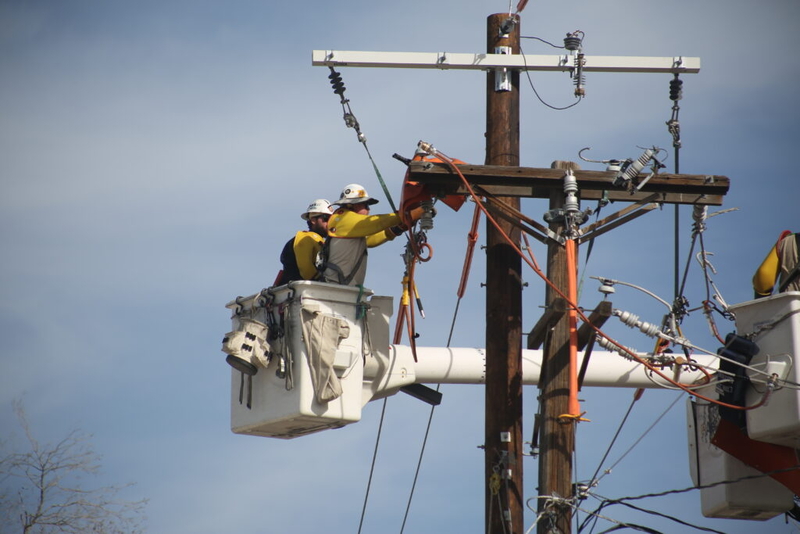
Workers repair power lines in Albuquerque on Feb. 25, 2026. (Danielle Prokop/Source NM)
Leaders in New Mexico’s energy industry told state lawmakers Monday that attracting data centers and other big energy users could be a key step toward modernizing the state’s outdated grid and meeting its ambitious renewable energy goals.
Laurie Williams, PNM’s senior vice president of integrated planning and transmission development, told lawmakers on the interim Water and Natural Resources Committee that big energy users, specifically data centers, could bring jobs to the area and help pay for the grid modernization they need to operate.
Those investments could alleviate some of the costs associated with the state Energy Transition Act, which established goals for utilities to use 50% renewable energy by 2030; 80% by 2040 and 100% by 2045, by spreading the cost among several big users rather than among residential ratepayers, Williams told lawmakers.
“Growth is positive for New Mexico, but it must occur in a way that protects existing customers,” she said, before appearing to reference ongoing discussions about a state-level data center moratorium. “I know we have folks or things afoot right now where people want to prohibit large loads from coming to New Mexico. The thing I would say about that is not prohibitions; let’s put appropriate protections in. We want protections for water, protections for costs.”
Williams said that PNM intends to file a so-called large-load tariff — a term that refers to increased fees for large energy users — which would include minimum revenue requirements, exit fees and other measures to shield residential ratepayers from increased costs, with the state Public Regulation Commission later this year.
She also recommended that lawmakers consider state-level renewable tax credits as federal ones expire; partial funding of geothermal energy mining explorations; and replicating the federal Transmission Facilitation Program, which acts as “anchor funding” for major transmission line projects.
Almost immediately, Williams met resistance from some lawmakers on the committee.
Rep. Micaela Lara Cadena (D-Mesilla), who’s long been an outspoken critic of the Project Jupiter data center under construction in southern New Mexico and is one of the Democrats planning to introduce a large-scale data center moratorium in next year’s legislative session, told Williams she took issue with the request to consider protections over prohibitions.
“Specifically what’s happening in here and why myself and others are in conversation about a data center moratorium is because we don’t have those protections in place,” Lara Cadena said at Monday’s hearing, before recalling that Williams asked lawmakers for protections rather than prohibitions. “Without protections first, are we supposed to trust the industry first to do it themselves?”
Democrat Deb Haaland and Republican Gregg Hull, the two nominees running to replace Gov. Michelle Lujan Grisham in the Nov. 3 election, recently took differing stances on the moratorium when asked by Source NM. Haaland said she supports putting “guardrails” on the developments while Hull said he opposes a moratorium but wants to see “real accountability” for water use and energy impact.
Citing Project Jupiter, Lara Cadena said she is concerned about what she believes is a “loophole” in a 2025 law that appears to let microgrids — developments that generate their own power — skirt the Energy Transition Act’s tiered renewable energy goals. Project Jupiter’s developers have proposed building a fuel cell-powered microgrid, which documents show would emit as many greenhouse gases as Albuquerque and Las Cruces combined.
How could such a development help the state meet its renewable energy goals, she asked Williams.
Williams responded by saying she agreed that the law created a microgrid loophole and that she is focusing on large-load users that will tie into the electric grid — not ones that seek to build their own sources of power.
“That is where you’re going to get the socialized cost benefits,” she said.
Santa Fe, NM