Northeast Missouri state Senate race tests GOP appetite for confrontation
Jul 14, 2026 | 11:00 am ET
Description
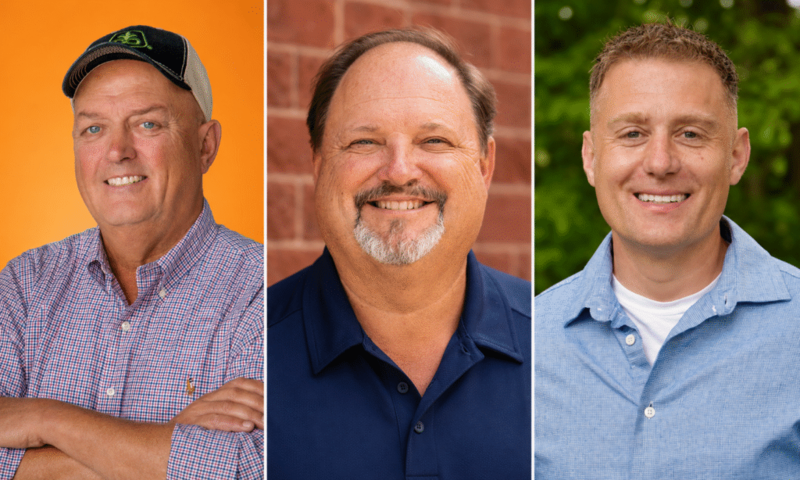
Republican candidates for Missouri Senate District 18, from left, are Greg Sharpe, Ed Lewis and Dusty Blue (photos submitted).
Two entire states — Connecticut and Rhode Island — could fit within the boundaries of northeast Missouri’s 18th state Senate District, almost 7,400 square miles where 14 counties have lost population almost continually for more than a century
On Aug. 4, Republican primary voters there will all but choose their next state senator. The two Democrats in the race have raised less than $5,000 combined, making the GOP contest between state Reps. Ed Lewis of Moberly and Greg Sharpe of Ewing and political newcomer Dusty Blue of Mexico the decisive vote in a district that hasn’t elected a Democrat since 2006.
The seat is open because Republican state Sen. Cindy O’Laughlin of Shelbina — the first woman elected majority leader and president pro tem of the Missouri Senate — is barred from running again by term limits. And she is not leaving quietly. O’Laughlin has endorsed Lewis, compares Blue to her chief antagonist in the Senate and a political action committee attacking Blue’s criminal record received $75,000 this year from a PAC aligned with her.
Blue says the attacks prove he’s winning.
“The special interests and the consulting class funding the attacks against me are scared,” he said, “and they should be.”
Whoever wins will inherit a district asking for more economic development, worried about how state budget cuts will hit schools and communities, and increasingly divided over the solar farms and data centers spreading across its farmland.
All three candidates have invested their own money into the race. Blue started with $100,000 in May 2025, with Sharpe putting up $115,000 and Lewis loaning his campaign $50,000.
Lewis spent 32 years as a science teacher in public schools and won election to the Missouri House in 2020. Sharpe is a farmer and feed dealer who won his seat in 2018. Blue is a U.S. Army veteran who owns a roofing company, who in his only previous election came in fourth in 2023 in an eight-way race for the Mexico Board of Education.
The Democrats running are farmer John Leykamp and veteran Nick Miller, who both live in Audrain County.
O’Laughlin is backing Lewis, the Missouri Farm Bureau is backing Sharpe and Blue is trying to corral voters discontented with any guidance from current politicians or lobbying groups.
A PAC aligned with Lewis, Rural Missouri Values, has raised $218,000, including $70,000 from NEMO Leadership PAC, the committee aligned with O’Laughlin, and $100,000 from Republican megadonor Rex Sinquefield.
To O’Laughlin, Blue is stamped from the mold of former state Sen. Bill Eigel of St. Charles. Their feud came to a head in January 2024 when O’Laughlin said she would vote to expel Eigel for the aggressive tactics he and his allies employed to challenge Senate leadership.
“It was horrific to hear those words come out of a Republican’s mouth, to expel another Republican,” Blue said in an interview with The Independent.
Blue only wants attention, O’Laughlin said in an interview with the Independent, not achievement.
“He follows in the path of some of the people that we’ve had in the past who will go to the public and say, ‘we really want to get this done for you, we know it’s really important’,” she said. “Then they come to the Senate and create so much dissension and chaos that you can’t get it done.”
Lewis wants voters to see him as the accomplished legislator with influence on major education issues as well as the sponsor of two major GOP priorities on this year’s ballots — Amendment 4, which changes how majorities are tallied for constitutional amendments proposed by initiative; and Amendment 3, which would allow Missouri to ban almost all abortions.
“Politics is not a lone sport, politics is a team effort,” he said. “You don’t get anything done by yourself.”
Sharpe focuses his appeal on building the district’s economy and his opposition to Amendment 5, which would eliminate the state income tax and allow lawmakers to expand and increase the sales tax to replace the revenue.
Sharpe was one of three Republicans who voted against the tax overhaul proposal on the August ballot called Amendment 5 every time it was before the House for a roll call.
“It is a tax shift that moves the burden onto working families who keep Missouri’s agricultural economy running,” Sharpe said in a news release after the vote.
Blue said he’s running to push the state Senate sharply to the right and to make Senate debate available via video livestream.
One goal, he said, is to ban all abortions except when a pregnant woman’s life is in danger. Amendment 3 on the November ballot, sponsored by Lewis, doesn’t go far enough, Blue said.
Missouri should not allow abortions for cases where a woman becomes pregnant as a result of rape or incest, Blue said.
“Unfortunately, there are cases, very, very nominal, very minimal cases in which a woman (becomes pregnant as a result of) rape or incest in this country,” he said. “It happens, and it’s a terrible act. I don’t believe countering that with another terrible act is the correct direction.”
District needs
Since 1980, the counties that make up the 18th District have lost almost 12,600 residents. Only two counties, Adair and Ralls, have added population.
Corn and soybeans are the main cash crops, with cattle grazing in hilly areas. The largest employer in most counties is likely to be a school district.
Modern concerns — solar power installations spreading across farmland and data center construction — are taking a place alongside traditional issues like roads, education and jobs.
Knox County, with about 3,750 people, has the district’s smallest population. It has also had the largest population loss since 1980, 32%.
The county needs a state senator who can bring support for economic development efforts, said Doug Kerr, chairman of the Knox County Republican Party.
“We want somebody that’s going to go down there with conservative values, but at the same time is willing to work with others to get something done,” he said.
In Adair County, the second-largest in population, debate over solar farms and data centers is creating tension between opponents who worry about electric costs and land use and people who champion private property rights, said Jason Soseman, the county GOP chairman.
Soseman said he drives past a solar farm and wind power installations every day.
“They’re ugly as sin,” he said. “But I’m a land rights guy, so my personal opinion is that as much as I don’t like them, people have the right to do what they want on their land.”
O’Laughlin proposed a moratorium on new solar farms during this year’s legislative session but the measure did not pass.
Now it is too late, Soseman said.
But Sharpe said it is not too late to regulate how land is used for solar farms. The Legislature just has to find the will to do it, he said.
“Some type of regulation on solar setbacks and some kind of uniform valuation and taxation are issues that we should pass and we didn’t and still haven’t,” Sharpe said.
Regulations that require funding for decommissioning solar installations at the end of their useful life are essential, Lewis said.
“Right now it’s the wild wild west where every county can do what they want or not do anything, and just allow these solar companies to come in, buy up land,” Lewis said.
Ballot issues
With no big statewide candidate primaries, the major ad spending for the Aug. 4 primary will be on two ballot issues — Amendments 4 and 5. The biggest differences between the candidates revolve around those two proposals, with Lewis backing both, Sharpe supporting Amendment 4 and opposing Amendment 5 and Blue opposing both.
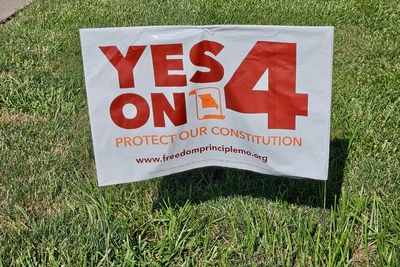
Amendment 4 would change how majorities are counted for constitutional amendments proposed by initiative petition. Instead of the current statewide majority, initiative measures would need a majority in all eight of Missouri’s congressional districts.
As few as 5.3% of voters could defeat a measure that is overwhelmingly popular in other parts of the state.
The threshold for passing constitutional amendments proposed by lawmakers would remain a majority of all votes cast.
Over six years in the Legislature, Lewis proposed various ways to make it harder for citizen initiatives to amend the constitution.
Part of Lewis’s summer has been spent traveling to promote Amendment 4, which he sponsored.
“I’m definitely pushing Amendment 4, trying to get out and educate people about what it does and what it doesn’t do,” Lewis said.
Amendment 4 protects rural voices from being overwhelmed by votes in urban areas, Sharpe said.
“I don’t consider this the best one, but it’s probably as good as we could get passed at the moment,” Sharpe said. “This will make it virtually impossible to pass an issue petition, to get eight out of the eight congressional districts to approve it.”
The money now spent on signature-gathering will be shifted to lobbying lawmakers to put special-interest measures on the ballot, Blue said.
“They’re fundamentally stripping the people’s right away to amend or repeal the Constitution, but while maintaining the same 50% plus one vote with the legislature,” Blue said. “I think that’s unbalanced.”
Amendment 5 would require lawmakers to set revenue triggers to eliminate the state income tax and give them a five-year window to expand the sales tax base or increase the tax rate to generate replacement revenue.
Republican voters are split on Amendment 5, Kerr said.
“There is concern about what will be taxed, and how,” he said.
Retirees who pay little income tax will feel the burden of extra sales tax, said Soseman, who agreed that Republican voters in his county are split on the amendment.
“There’s parts of it that are a little tough for some of our folks to swallow, especially the elderly that rely more on services and usually don’t have income, per se, anymore,” Soseman said.
Lewis supported Amendment 5 in the House and still does.
“Reducing the income tax is a big enough, lofty enough, goal that we will take the chance and let the general legislature pursue this, and I think that’s what this vote’s about,” Lewis said.
The proposal will damage Missouri’s economy, Sharpe said. Illinois taxes gasoline with sales tax in addition to imposing a per-gallon tax, he noted, which Missouri does not. Amendment 5 would allow sales tax on fuel purchases and allow the money to be used for non-road purposes.
Fuel purchases are just one example of Missouri’s price advantages over surrounding states, he said.
“The economy around the edges of the state will be severely hurt,” he said.
Blue opposes Amendment 5, he said, because it gives lawmakers far too much power. It allows tax changes that are intended to replace revenue from income tax without requiring a statewide vote on the new tax, he said.
“I’m against Amendment 5 because they want to again ask us to hand over the power to them to raise taxes on us by suspending the Hancock Amendment for five years,” Blue said.
Legislative style
O’Laughlin’s path to leadership included an early alliance with Eigel and a group that called itself the Conservative Caucus. She quit the group after a year and watched as it engaged in battles with Senate Republican leadership over a three-year span.
Lengthy filibusters frayed relationships, resulting in lost committee seats, name-calling and, in one instance, an argument outside the chamber that nearly became physical.
The Conservative Caucus disbanded for a year before being reborn as the Missouri chapter of the Freedom Caucus, with similar goals and tactics.
The disruptions didn’t produce results, Kerr said. He doesn’t want a senator who jams up the process over disagreements over how to accomplish common goals.
“It’s gotten to the point where compromise seems to be a dirty word, and that’s a shame,” Kerr said.
O’Laughlin promised to shake up Jefferson City and Sosemsan said he voted for her in the 2018 primary. He’s disappointed, he said.
“There’s a large number of people who are tired of politicians throughout this district,” Soseman said. “She’s lost a lot of her luster to the voters. It’s unfortunate.”
O’Laughlin said she hasn’t changed. She did, however, learn that demanding that things be done isn’t effective.
“The reality is you can work hard to get something done, but on the Senate side, of course, you have to have 17 other people to get something done,” O’Laughlin said.
Lewis has sponsored major bills on education and child trafficking that have become law. He’s a member of the School Funding Modernization Task Force established by Gov. Mike Kehoe that will issue a report later this year.
Blue, Lewis said, will learn the same lessons O’Laughlin learned if he is elected.
“People that want to just throw stones, just want to filibuster, just want to obstruct, just want to throw sand in the gears, those type of people don’t get anything done,” Lewis said.
Blue said he’s not running with the intent to disrupt the process. The goal, he said, is to push conservative legislation faster and back campaign rhetoric with action.
Blue’s personal criminal record is being used by opponents through a website called Real Dusty Blue that says he has a “troubling past” of harassment, threats and “mistreating women.” The website was put online by a political action committee called Let’s Go Brandon PAC, which received a $75,000 contribution this year from NEMO Leadership PAC.
The site points to court records, all 12 to 21 years old, of convictions for charges of violating orders of protection and trespassing that included a 15-day jail sentence in 2005.
In a video posted June 14 to his campaign social media, Blue responded to what he called a “whisper campaign” against him.
“I have never laid my hands on a woman and I never will,” Blue said.
In an interview, Blue said he’s matured since the incidents that got him arrested but continues to defend his actions as right at the time.
“We all have made mistakes,” Blue said. “When it comes to the instance of me chasing the guy into his house, you know, I said on the video I would do it again. I was protecting my family.”
Blue’s past should disqualify him from public office, O’Laughlin said.
“If you’ve been arrested eight times, I think that’s the number, there’s something fundamentally wrong in that person’s character,” she said.
Sharpe doesn’t have the list of accomplishments Lewis can show voters but he has proposed measures that have become law, including measures creating a ports and waterways trust fund and increasing the financial and other limits on what defines a family farm.
He’s not going to be a disruptor, Sharpe said.
“I’m looking forward to being in the Senate and certain things being addressed that need to be addressed,” Sharpe said.
As she’s departing office, O’Laughlin said she has been asking people what they think of politics generally. They are not happy, she said.
“Politics is a convoluted process,” O’Laughlin said. “It’s such a negative environment a lot of the time that people just check out, they get tired of it, and that’s the unfortunate part about it.”
Jefferson City, MO