Huntington hospital to offer new liver cancer treatment
Jul 14, 2026 | 6:00 am ET
Description
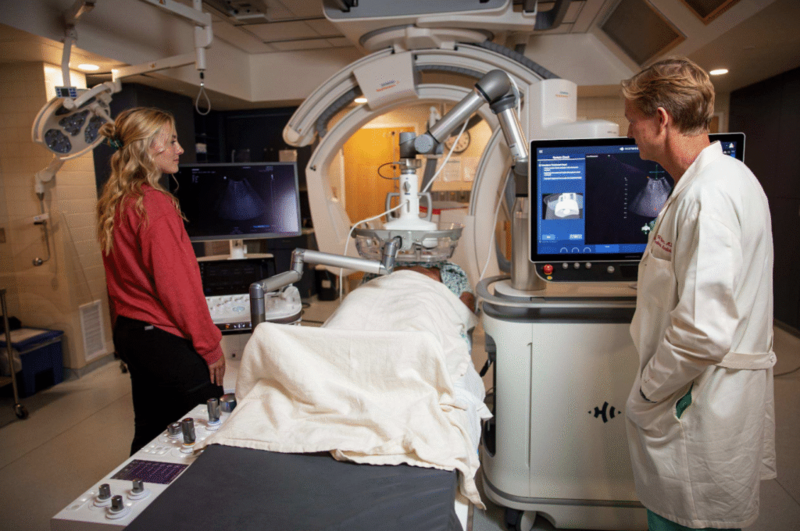
Interventional radiologist Dr. Paul Blom of Radiology, Inc. (right) discusses Cabell Huntington Hospital's new histotripsy system with a sonography student during a demonstration of the innovative, noninvasive liver tumor treatment technology. (Photo courtesy of Marshall Health Network)
Liver cancer patients in West Virginia will have a new option for treatment at a Huntington hospital. Marshall Health is the first health care system in the state to offer histotripsy, a treatment for liver tumors.
The new system is housed at Cabell Huntington Hospital in Huntington. It’s a $1.3 million gift from the Cabell Huntington Hospital Auxiliary, an organization that raises funds for patient care and equipment at the facility.
“Bringing histotripsy to our region reflects Marshall Health Network’s commitment to ensuring patients have access to the latest proven advances in cancer care,” Tim Martin, president of CHH, said in a news release. “As the first hospital in West Virginia to offer this technology and among the first 100 in the nation, we continue to lead the way in bringing innovative, evidence-based treatments to the patients and communities we serve.”
According to Johns Hopkins Medicine, histotripsy uses high-pitched ultrasound waves to target tumorous tissue in the liver. The sound waves are synchronized to make tiny bubbles within the tissue that break it apart.
The U.S. Food and Drug Administration approved the system for treating liver tumors in October 2023, and Histosonics, the company that makes it, is working toward approval for treating tumors in other organs.
Nancy Godby, director of radiology at Cabell-Huntington, said histotripsy is another tool for cancer treatment patients that meet certain criteria.
“It is a non-invasive procedure that can be the first step in treatment of liver (cancer), and it does not prevent them from moving on to other treatments either,” Godby said. “So, if they have this first, they still would be a candidate for cryoablation or for Y90 radiation treatment.”
The treatment requires pre-approval from insurance companies, as do other procedures, she said.
West Virginia reported about 210 new liver cancer cases per year between 2015 and 2019, according to the state Department of Health. Men in West Virginia are about twice as likely as women to develop and die from liver cancer, the health department said. Incidence of liver cancer doubled in West Virginia between 2000 and 2019.
About 42,000 people in the United States will be diagnosed with liver or bile duct cancer in 2026, according to the American Cancer Society.
Godby said the histotripsy system is onsite now and the hospital is working to get its first patients established with the treatment.
“Patients have to have a pre-screening ultrasound procedure that the interventional radiologist or whoever is going to do the actual histotripsy procedure is involved in to look at the particular lesion, mark it on images, be sure it fits the criteria for treatment, that it’s within the depth of treatment pathway before they move on then and schedule them for the actual procedure.”
She said the new treatment is “groundbreaking” for patients.
“As you can imagine, patients that have liver cancer, they’re looking for whatever options are available, and this is certainly less stressful on the patient,” she said. She added that the treatment requires general anesthesia but does not require an incision.
“It is a sound wave to break up that lesion or that tumor, and then the body just reabsorbs that and it goes away,” she said. “If it works, it’s fantastic. If it doesn’t work for that patient, then there’s still other options available.”

Charleston, WV