The more researchers look, the more contaminants they find in New Hampshire’s loons
Jul 14, 2026 | 5:00 am ET
Description
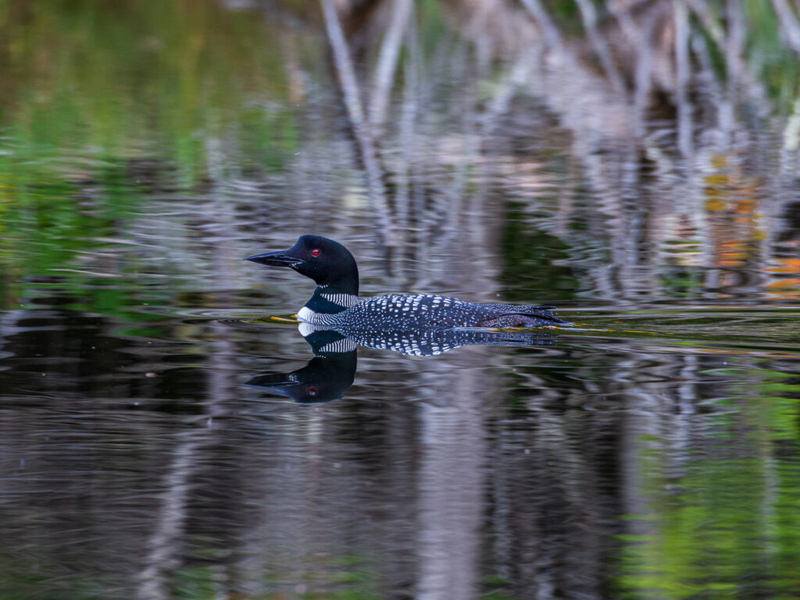
A common loon swims in The Nature Conservancy’s Lime Pond Preserve in Columbia. (Photo by Jeff Lougee/Courtesy of The Nature Conservancy)
In 2023, researchers found unprecedented levels of dangerous chemicals in eggs laid by New Hampshire loons.
Since then, ongoing testing has affirmed the sheer scope of pollution that New Hampshire wildlife and ecosystems must contend with, Loon Preservation Committee biologist Tiffany Grade said this month. As scientists press on with the research, they are striving to uncover more about what the levels mean for loons and their ecosystem at large and to trace some of the pollutants to their source.
“What’s been surprising to us in the course of this work is, you know, just how many lakes we find, and where we find them, with these elevated levels of contaminants,” Grade said. “… The more eggs we test, the more we get concerned about both the health of loons throughout the state as well as the health of our aquatic ecosystems.”
Eggs tell the story
Much of the research conducted by the Loon Preservation Committee to understand the prevalence of toxins in New Hampshire’s loons has relied on samples from nonviable eggs, Grade said, meaning eggs that failed to hatch and were subsequently abandoned.
Committee biologists who track loon nests throughout the summer watch the abandoned eggs, following a “very strict protocol” to ensure an egg really has been abandoned before they retrieve it for testing, Grade said. Abandoned eggs are then measured and samples are sent to laboratories to be tested for various contaminants.
Eggs are a preferred data source for a project like this, Grade said, because they are a reliable proxy for the pollutant burden carried by a loon mother.
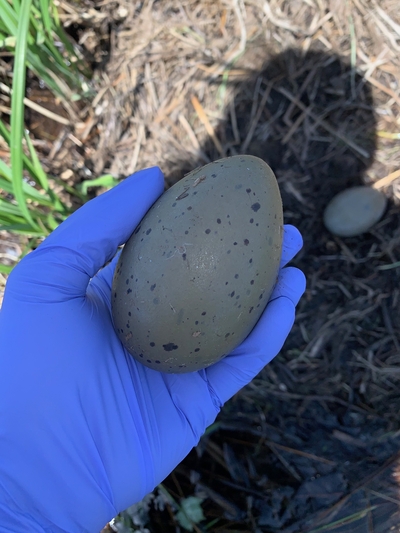
For that purpose, Grade said, they are in some ways more reliable than even a blood draw, which yields information mostly about a loon’s most recent meal. An egg, on the other hand, is fortified with the nutrients that a mother loon consumed in the four to six weeks prior to laying her egg. Because the birds are typically hunting in the neighborhood of their nest during that period, Grade said, eggs allow researchers to access a weekslong snapshot of contamination in that area.
Pollution from many angles
For decades, the Loon Preservation Committee has studied another form of pollution deadly to loons: lead fishing tackle. The heavy metal poisons birds who consume it, usually by preying upon a fish that has swallowed tackle or by mistaking lead sinkers for small stones, which they swallow as a digestive aid, according to the U.S. Fish and Wildlife Service.
The Loon Preservation Committee conducts necropsies on loons to determine their cause of death. To this day, lead tackle remains the leading cause of adult loon death in New Hampshire, according to the committee, which has led efforts to protect the state’s loons from the threat.
A major focal point of that effort is Squam Lake, where loons experienced a precipitous population decline in the mid-2000s, according to the committee’s records.
The committee links that trend to the rise in fishing activity on the lake during that period, according to their website. Conservation and advocacy have helped, but lead remains a significant problem for loons today, said Grade, who also holds the title of Squam Lake Project biologist for the Loon Preservation Committee.
Contaminants have added to that pressure on the birds. All the eggs tested by the committee — including those sourced from Squam Lake — have tested positive for at least some chemicals of concern, she said.
“We’re seeing them in 100% of the eggs that we test,” she said.
Eggs sourced from Squam Lake in the years following the period of sharpest decline, which occurred between 2004 and 2005, showed contaminants, including PFAS chemicals, at levels two to nine times those sourced from other lakes during the same period, according to the committee.
Lead tackle pollution and chemical pollution operate in very different ways, Grade said.
One of the hallmarks of lead poisoning in loons is its rapid effects. Ingesting a lead sinker will, in most cases, spell death for a loon within a matter of weeks. Meanwhile, toxins found in trace amounts in the environment, like PFAS “forever chemicals,” the now-banned pesticide DDT, and others, tend to wreak their brand of havoc more gradually, Grade said.
Once introduced to the environment, the chemicals make their way into a lake’s water and sediment. From there, they are taken up by plankton, which are eaten by small aquatic animals like crayfish; then, in turn, the pollutants find their way to larger fish and, eventually, loons, which eat a variety of fish, frogs, and invertebrates like crayfish and snails. The process by which the chemicals become more concentrated along the way is known as biomagnification.
The toxins then remain in a loon’s body, building up in a second process called bioaccumulation.
Thus, loons’ place high on the lacustrine food chain, and their long lives (scientists aren’t entirely sure how long loons can live, Grade said, but current hypotheses put their life span between 20 and 30 years) make them especially susceptible to the effects of the toxins. Over the course of their lives, the birds may accrue significant doses of toxins that are present in the environment even at low levels, Grade said.
These features make loons especially susceptible to pollutants, functioning as an indicator species for the overall health of a watershed.
Potential impacts
The Loon Preservation Committee’s 2023 analysis of 144 eggs from lakes throughout the state revealed significant concentrations of a range of PFAS chemicals. The most prevalent among them was the chemical PFOS.
Levels varied between water bodies. Lake Winnipesaukee showed particularly elevated levels of PFAS chemicals compared to other lakes evaluated in the study.
The other contaminants that the committee has discovered in eggs from a range of water bodies include PCBs, or polychlorinated biphenyls, a man-made industrial chemical; the pesticide DDT; dioxins and furans, byproducts of industrial and incineration processes that can be carcinogenic; BDE, a chemical used in firefighting; and others.
Some of the levels discovered were above those known to cause health impacts in other types of birds, Grade said. For example, about 26% of eggs in the 2023 study showed levels of PFOS that were higher than those known to impact other bird species. Of the eggs collected from Lake Winnipesaukee, 15 out of 16 were above that level.
Yet conservationists are still trying to understand the effects of those chemicals in loons.
Is contamination with high levels of PFAS, pesticides, or other chemicals harming loon populations? Could the high levels of chemicals observed in the eggs have contributed to the fact that they failed to develop? At the moment, there isn’t enough data to answer those questions, Grade said. That’s where she and her team are now focusing their efforts.
Grade and her colleagues at the Loon Preservation Committee have more research forthcoming about the extent of contaminants present in New Hampshire’s loons, she said. The next step will involve a deeper analysis of PFAS contamination of loon eggs, including studying the potential link between the level of “forever chemicals” present in the eggs laid by a loon pair and their reproductive success.
Another area of concern is what the elevated levels indicated by the eggs mean for other wildlife, for the ecosystem, and for the humans who live and play near contaminated water bodies, Grade said.
They also recommended that the state attempt to trace some of that pollution to its origin, especially on Winnipesaukee, where eggs with some of the highest concentrations of certain PFAS chemicals were laid.
It’s clear that contamination has entered the lake from myriad sources, Grade said. But the researchers have their eye on a site on the lake’s Northeast shore. Department of Environmental Services groundwater testing has indicated significant PFAS contamination near the site of the former Pak 2000 packaging plant, which is now federally listed as a Superfund site. More testing would be required, Grade said, to identify any possible source with more certainty.
The Loon Preservation Committee also recommended instituting a PFAS testing program for fish from lakes with elevated levels of PFAS, including Winnipesaukee. The New Hampshire Department of Fish and Game is currently investigating PFAS contamination of freshwater fish throughout the state, according to their website.
Though they face mounting threats, loon populations in New Hampshire are persisting in a slow recovery from their mid-2000s lows, Grade said.
Last summer, the Loon Preservation Committee counted 862 loons on the state’s lakes, up from 844 in 2024.
“We are continuing that slow but steady increase,” Grade said.
But she cautioned that the birds aren’t out of the woods yet — and factors like pollution are hindering their recovery.
Other complications, including increased human disturbance, habitat loss, and climate change are adding to the pressure on the birds, she said. Researchers in New England are watching avian malaria, for example, a mosquito-transmitted disease that seems to be expanding northward with climate change.
“The fact of the matter is that loons are facing increasing challenges,” Grade said. “You know, they’re dealing with this chemical cocktail … they’re just dealing with so much.”
Concord, NH