ACLU asks federal court to block Prop. 314’s border-crossing crime days before it takes effect
Jul 13, 2026 | 10:40 am ET
Description
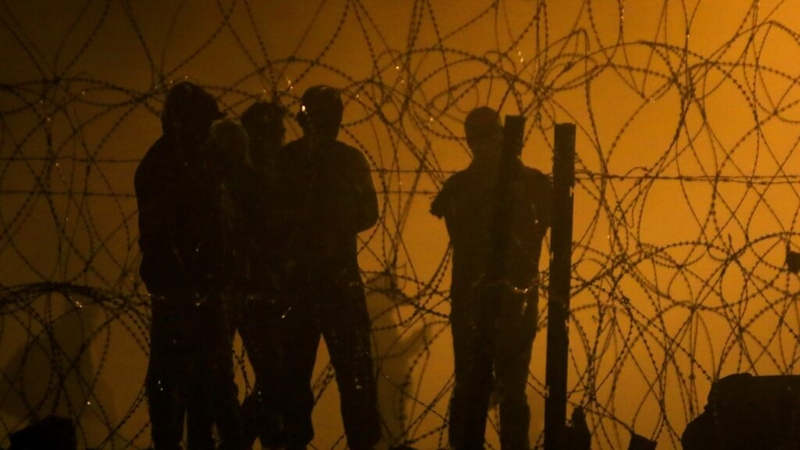
Migrants wait throughout the night on May 10, 2023, in a dust storm at Gate 42, on land between the Rio Grande and the border wall, hoping they will be processed by immigration authorities before the expiration of Title 42. Photo by Corrie Boudreaux | Source NM
An Arizona law that would empower local police officers and state judges to arrest and deport people who cross the state’s southern border without authorization is set to go into effect in just four days. An immigrant rights legal group is suing to prevent that from happening.
In 2024, 61% of voters cast their ballots in favor of Proposition 314, called the “Secure the Border Act.” The ballot measure enshrined multiple new criminal penalties in state law, including one to punish people who submit fraudulent documentation to apply for jobs or public benefits and another to incarcerate people convicted of selling fentanyl that later causes someone else’s death.
The most controversial part of Prop. 314 places Arizona at the helm of immigration enforcement by making it a state crime for anyone to enter the state without authorization anywhere but at an official port of entry. Immigrants convicted of violating the law would be punished with a class 1 misdemeanor, which carries with it up to 6 months in jail. Repeat offenders could face a class 6 felony and up to two years in prison.
Republican lawmakers, cognizant of the legal quandary the provision raised in light of previous U.S. Supreme Court rulings declaring that immigration enforcement is solely under the purview of the federal government, froze it until either the Supreme Court ruled that states have the right to take up immigration enforcement or until 60 days after a similar law in Texas went into effect. On May 15, a federal appeals court revived the Texas law, SB4, which had been mired in years of litigation, setting the stage for Arizona’s law to be implemented as soon as next week.
The national and Arizona chapter of the American Civil Liberties Union on July 9 filed a lawsuit on behalf of the Florence Immigrant and Refugee Rights Project, arguing that the section of the Arizona law that gives state officials the authority to prosecute and deport immigrants should be struck down because it conflicts with federal law.
Kate Huddleston, an attorney with the ACLU’s Immigrants’ Rights Project, called the provision “unlawful and inhumane,” and pointed out that Arizona’s attempts to wade into immigration enforcement have already been slapped down once before.
“Regulation of immigration into the United States is an exclusively federal power that cannot be usurped by Arizona or any other state,” she said. “The Supreme Court reaffirmed this basic principle in response to an unconstitutional Arizona law 14 years ago.”
The state’s infamous “show me your papers” law, SB1070, led to a landmark ruling from the U.S. Supreme Court in 2012, with the justices voiding three of the law’s four provisions and declaring that the states don’t have the power to criminalize immigration violations.
Much like Prop. 314, SB1070 punished unauthorized immigrants with state crimes. One of the law’s nullified provisions penalized unauthorized immigrants who worked or sought work in the state with a misdemeanor and another punished noncitizens with a misdemeanor for failing to carry federal alien-registration paperwork.
In its lawsuit challenging Prop. 314, attorneys for the ACLU argued that the law essentially creates an entirely new immigration enforcement framework that puts Arizona’s authority over the federal government’s, in direct violation of the U.S. Constitution’s Supremacy Clause, which upholds federal laws over state laws.
“(It) is patently illegal. A state cannot replace Congress’ immigration scheme with its own,” reads the brief.
Attorneys noted that the law creates an enforcement process that is entirely separate from the federal one, which leaves immigrants with little recourse for relief and threatens to conflict with federal decisions.
While federal law allows immigrants in removal proceedings to apply for asylum or other forms of protection, the Arizona law doesn’t. And Arizona’s unilateral bid to punish anyone who crosses the border without authorization anywhere but at an official port of entry is also much harsher than what currently occurs. Many immigrants who cross the border between ports of entry are still eligible for protective statuses like asylum.
Under Prop. 314, only immigrants who have already been granted asylum or have another form of federally recognized lawful presence in the country would be able to contest a state-issued deportation order. But that doesn’t include immigrants who are currently shielded from deportation because of their parole status.
And even if a federal court is mulling an asylum application or other petition at the time that state-level charges are brought against an immigrant in Arizona, they could still be deported. Nothing in the Arizona law advises state judges to pause removal proceedings until their federal counterparts have issued a decision.
Attorneys with the ACLU warned that the contested provision in the Arizona law, called “Section 5,” undermines the federal government, enshrines constitutional rights violations and upends decades of congressional agreement.
“Section 5 jettisons this system, wresting control from the federal government and depriving individuals subjected to Section 5 of the federal rights and due process that Congress ensured that they have, including the rights to contest removal and seek asylum,” reads the lawsuit.
The immigrant rights groups are seeking an order that freezes the provision from being enforced while litigation continues as well as pushing for it to be found unlawful, which would permanently block it from ever being enforced.
The Florence Project, which provides pro bono legal aid to immigrants held in detention centers in the southern part of the state, said that allowing the law to be implemented even temporarily would be devastating. Attorneys would be forced to travel across the state and risk missing legal appearances, because immigrants arrested under the law don’t have to be transported to federal detention centers.
Roxana Avila-Cimpeanu, the group’s deputy director, warned that Prop. 314 threatens to undermine the due process rights of thousands of people, including migrant children and others who would otherwise be eligible for protection from deportation under federal law.
“If it goes into effect, countless members of our communities, including vulnerable youth and individuals with mental health concerns, could end up jailed throughout Arizona on state immigration charges, intentionally isolated from expert legal support and potentially deported without ever having a fair day in court,” she said.
Tara DeGeorge, the legal director of the state chapter of the ACLU, added that even citizens would be at risk of unlawful detention. The law directs law enforcement officers to make an arrest if they witness an unlawful border crossing, view video evidence of one or have “constitutionally sufficient indicia of probable cause,” which critics have said leave too much up to a police officer’s personal discretion. The law also includes a civil immunity clause that would shield law enforcement officers from any lawsuits that arise from enforcing it.
“Section 5 of Proposition 314 is a permission slip for local and state law enforcement to engage in blatantly unconstitutional acts like racial profiling, unlawful arrests and illegal detentions,” DeGeorge said. “Arizona’s communities should not have to pay the price for this unconstitutional experiment.”
Phoenix, AZ