The odds are against independents running for office in RI. 21 candidates filed to run anyway.
Jul 13, 2026 | 5:45 am ET

Description
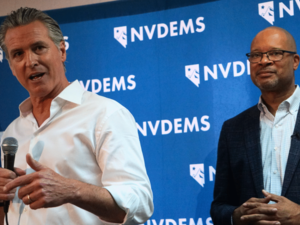
Left to right are independent candidates Ken Block who is running for governor; Brittany Kubicek, running for House District 5; Rep. Jon Brien, running for reelection to House District 49; Allan Fung, running for House District 15; and Brian Coogan, running for Senate District 14. (Courtesy photos)
When Rep. Jon Brien of Woonsocket refers to Rhode Island’s independent caucus, he’s talking about himself — the lone nonpartisan in the 113-person state legislature.
But Brien’s party of one could expand after November general elections — in the legislative chambers, and perhaps even the executive branch. Eleven independent candidates, including Brien, have declared candidacies for the legislature, while another 10 are seeking state general office seats, nine of whom are campaigning for governor.
Signature collection deadline trims governor’s race down to five candidates, initial data shows
It’s not the most independent contenders in recent state elections — there were 39 independent legislative candidates who filed in 2022, 21 of whom made the ballot after meeting nomination paper signature requirements. The Rhode Island Department of State is expected to finish certifying signatures and confirming ballot placement for candidates to local, state and federal offices by Friday, July 17.
But could voter frustration with the status quo provide an opening for independents to put their stamp on state politics?
Yes, independent gubernatorial candidate Ken Block says.
“In this moment in Rhode Island, being an independent candidate is a serious advantage,” said Block, a 60-year-old software engineer who lives in Barrington. “It’s not a disadvantage.”
He continued, “I have started introducing myself to voters as the independent candidate because reactions are so favorable.”
Part of Block’s path to victory is circumstantial. Polls show Gov. Dan McKee remains widely unpopular with voters. Block’s prior campaigns along with his outspoken criticism of McKee’s handling of the Washington Bridge has helped familiarize his name to voters.
A June 30 survey by the University of New Hampshire shows strong support for Block among prospective general election voters, especially if McKee beats Democratic challenger Helena Buonanno Foulkes in the Democratic primary. The survey showed Block and McKee each receiving 27% of the vote in a general election with an unnamed Republican candidate. If matched up against Foulkes, Block trailed 19% to 38%, but 20% of voters were still undecided.
In his first gubernatorial bid in 2010, Block received 6.5% of the vote as the Moderate Party candidate in the election which ultimately put independent Lincoln Chafee in the governor’s seat. Block lost the 2014 Republican gubernatorial primary to Allan Fung by 10 percentage points.
Now, Block sees a sea change starting.
“People are beyond frustrated,” Block said. “They don’t want ideology at this point, they want things fixed.”
Former GOP golden child goes purple
Look no further than Allan Fung.
The former Cranston mayor, who also ran twice for governor and in 2022 for the open seat representing Rhode Island’s 2nd Congressional District was once one of the state GOP’s biggest success stories.
But after feuding with Cranston’s current Republican Mayor Ken Hopkins, Fung left the state Republican party and is running as an independent candidate for Cranston’s House District 15. The seat is currently held by Republican Chris Paplauskas, a staffer for Hopkins who won his first term in the House in 2024 by 26 votes against Democrat Maria Bucci, following a recount. Fung’s wife, Barbara Ann Fenton-Fung, represented the district for two terms, from 2020 to 2024, before stepping down to run against Hopkins in the Cranston Republican mayoral primary.
Brien denounced Fung’s decision to run as an independent candidate as a political strategy rather than one rooted in ideology — a “convenient” way to avoid a primary, he said.
“Ridiculous,” Fung said in response.
Fung acknowledges being dissatisfied with Cranston’s Republican leadership. But he said his views remain rooted in fiscal conservatism and quality-of-life issues.
“My loyalty is to the people I represent, not a political party,” said Fung, 56, an attorney with Warwick firm Lepizzera and Laprocina.
Like Block, Fung said voters have embraced his change in party.
“They want someone who is independent in thought, independent in representing their policies,” Fung said. “I think you might see a lot more disaffiliated people who are voting for third-party candidates.”
In this moment in Rhode Island, being an independent candidate is a serious advantage. It’s not a disadvantage.
John Marion, executive director for Common Cause Rhode Island, is unconvinced that the two-party system is on its way out.
“We’ve seen this movie before,” Marion said.
It’s true that voters aren’t happy with the political status quo. But elections still heavily favor a two-party system that makes it very difficult for independent candidates to win office, said Adam Myers, associate professor of political science at Providence College.
“Even though voters hate political parties, they still rely on party labels a lot for voting,” Myers said. “Having that R or D next to your name carries a certain cache that gives you at least a base level of support.”
Independent in name only
Although 52% of current registered voters are unaffiliated, there are few examples of independent candidates winning office.
Chafee remains the state’s first and only independent governor, though he was previously a Republican, and has since run unsuccessfully for president as both a Democrat and a Libertarian. The last independent state legislator before Brien, Blake Filippi, of New Shoreham changed to the Republican Party after his first term in office, and served as House minority leader from 2018 until he chose not to seek reelection in 2022.
In a strong Democratic state with few serious GOP challengers, Myers sees a strategy for conservative candidates to run as independents rather than Republicans. The same logic is evident in other one-party states, such as Nebraska, where Democrats are rallying behind independent U.S. Senate challenger Dan Osborn.
“In states that are overwhelmingly Democratic or Republican, the out party sort of understands that its brand is so toxic it has no chance of winning,” Myers said.
Yet, progressive candidates are still running as Democrats in state and local races, rather than independents, suggesting the two-party system remains the dominant structure in Rhode Island, Myers said.
The Rhode Island Working Families Party endorsed four legislative challengers who are running as Democrats.
“Our goal here is governing power, not just to run campaigns to make a statement or make a specific political point,” Anusha Venkataraman, state director for the progressive organizing group said. “Independents can’t build the coalition of legislators needed to achieve and hold governing power to deliver the wins that working people need.”
Rhode Island doesn’t allow fusion voting, which lets multiple parties endorse the same candidate. In Connecticut, New York and other states where fusion voting is permitted, candidates can be listed on the ballot twice, as both a Democrat and the Working Families Party-backed option.
The Rhode Island chapter may endorse more candidates this election cycle, but it’s unlikely the state steering committee will look to independents, Venkataraman said.
“It would have to be a pretty high bar and specific set of circumstances,” she said.
Outside the lines
One prospect could be Brittany Kubicek, an independent candidate for Providence’s House District 5 whose entire campaign centers on helping workers.
“Why would I be in a party with people I have nothing in common with?” said Kubicek, a 32-year-old mechanical engineer and U.S. Navy veteran.
She identifies as a Democratic Socialist, and has been endorsed by the local chapter of the Democratic Socialists of America (DSA). Rhode Island does not formally recognize the DSA as a political party, which means Kubicek is considered an independent for ballot purposes.
Having the local DSA’s support comes with volunteers to collect signatures and canvas on Kubicek’s behalf. But there’s no financial boost, and Kubicek faces incumbent Democratic Rep. Anthony DeSimone in the general election. DeSimone is a two-term representative whose father, John DeSimone, was the former seatholder and House majority leader.
Also facing an uphill battle against a powerful incumbent is state Senate candidate Brian Coogan, who is running as an independent against Senate President Valarie Lawson. Coogan served as a Democratic state representative from 2000 to 2004 and on the East Providence City Council from 2008 to 2010. Coogan also challenged Lawson in the 2024 Democratic primary, losing with 25% of votes to Lawson’s 75%. Trying again, now as an independent, Coogan said he feels liberated.
“If I ran as a Republican or a Democrat, they can tell you what to do,” said Coogan, 56, a tow truck company owner. “This way, I am not beholden to anybody. I can speak freely, tell it like it is.”
Coogan has also been endorsed by The League of RI Businesses, a conservative-leaning business group rooted in Second Amendment protections.
The League is backing 25 state legislative candidates, a mix of incumbents and challengers, Republicans, Democrats and independents, including Brien. The League has set up 40 individual political action committees — one statewide and for each city and town — to maximize financial impact for its chosen candidates.
Neither Brien nor Coogan have received any money from The League’s PACs yet, they said. They didn’t need it.
Brien feels his name already carries weight with local voters, regardless of party affiliation. The son of a former Democratic state representative and Woonsocket City Council president, Brien followed in his father’s footsteps, serving as a Democratic state representative from 2007 to 2012, and on the Woonsocket City Council from 2016 to 2020.
The nonpartisan council race prompted Brien to disaffiliate from the Democratic Party, which he viewed as moving too far left.
“It was an easy choice for me,” he said. “My father would not recognize today’s Democratic party at all.”
Brien, 60, a criminal defense lawyer, welcomed the prospect of more independents on Smith Hill — with some exceptions, Kubicek being one of them.
“The independent caucus does not welcome socialism,” Brien said.
Providence, RI