Three Republican candidates in AL-01 face fears of low turnout in August special primary
Jul 13, 2026 | 6:01 am ET
Description
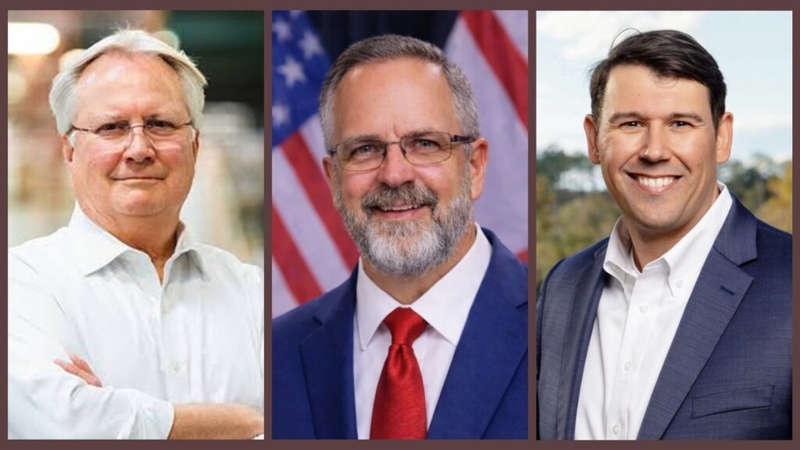
Republican voters in Alabama's 1st Congressional District will choose between (left to right) former U.S. Rep. Jerry Carl, John Mills and Austin Sidwell for the party's nomination in a special primary election on Aug. 11. The winner will face Democratic nominee Clyde Jones in November. (photos courtesy of candidates; graphic by Anna Barrett/Alabama Reflector)
In a redrawn district in South Alabama, Republican voters will choose between three candidates for the party’s nomination in an August special primary election.
Voters will choose between former U.S. Rep. Jerry Carl, R-Mobile; John Mills, a Navy veteran, and Austin Sidwell, who works at his family’s private security company. Alabama’s 1st Congressional District covers all of Mobile, Baldwin and Escambia counties, and all but the northeast corner of Covington County.
The winner of the primary will face Clyde Jones, the only Democratic candidate to run for the seat.
U.S. Rep. Barry Moore, R-Enterprise, who currently represents the district, won the Republican nomination for U.S. Senate in June, and is seeking to succeed U.S. Sen. Tommy Tuberville, who is the party’s nominee for governor. Due to redistricting, Moore likely would not have qualified to run for re-election in the seat.
Following a special session of the Legislature, Gov. Kay Ivey in May called a special election for the 1st, 2nd, 6th and 7th congressional districts after a U.S. Supreme Court order allowed the state to use a 2023 Legislature-passed congressional map, instead of a court-ordered one. The 2023 map was previously struck down as racially discriminatory, and the court-ordered map, used in 2024, led to the election of two Black representatives – a first in Alabama’s history.
Before the 2023 map was put into place this spring, there were seven Republicans running in the district, including Carl, Mills and Sidwell. The 81,205 votes cast in the May 19 primary were voided due to the special election, but Carl and state Rep. Rhett Marques, R-Enterprise, would have advanced to a runoff, according to election results.
Marques qualified in Alabama’s 2nd Congressional District for the special primary, where Republican voters will have a choice between six candidates.
The candidate who gets the most votes in the special primary will be the Republican nominee. Legislation passed during the special session did not include a special primary runoff election.
The candidates
Carl, 68, said in a phone interview Thursday that he enjoyed being in Congress, and wanted to return. Carl was elected to represent the district in 2020, but lost the Republican nomination to Moore in 2024, according to election results.
“I had sold all my businesses and was anticipating finishing out my working career in Congress,” he said. “I wanted to go back in. I did a great job when I was in there, and I plan on doing a great job when I get back in there.”
Should Carl return to Capitol Hill, he hopes to be on the House Committee on Appropriations and the House Committee on Natural Resources. He wants to turn an underwater petrified forest off the Alabama coast into a national park to prevent companies from harvesting the timber.
“We don’t need to lose that forest. That’s just natural resources that we need to protect,” he said.
He said voters should choose him because the candidate that wins in November will only have two years left in President Donald Trump’s administration, and it would be risky to send somebody new.
“Donald Trump is going to need some people that understand Washington that can get some stuff done, and I’m that person. I spent four years up there,” he said. “I understand how the system works. Don’t necessarily agree with it. Don’t necessarily even like it, but do understand it.”
Mills, 63, said in a phone interview Friday that he decided to run because he did not like any of the candidates trying to replace Moore in the first primary.
“I saw some career politicians. I am not a politician. I would never want to be one. I’m a patriot, and in my opinion, there’s a huge difference between a politician and a patriot,” Mills said. “A patriot is for the people. He stands behind their oath of office for the Constitution, and a politician works for bureaucrats and party bosses, and doesn’t work for – in my opinion, my humble opinion – does not work for the people.”
He currently lives in Newton, Alabama, which is in Alabama’s 2nd Congressional District under the new map, but has a “place set up” in Seminole. Mills ran in a 10-candidate field for Florida’s 1st Congressional District, which covers the panhandle, in a 2025 special election.
“My oath still stands today to defend our Constitution, and that’s what I do. So I always try to educate folks on our Constitution. I call myself a constitutional conservative,” he said. “I believe our rights come from God, not government, and it’s the government’s responsibility to protect our God-given rights.”
Should Mills be elected to the 120th Congress, he promised to ensure election integrity, border security and “stop reckless spending.”
“If we don’t own our elections, then what do we have? We have nothing. We’re going to lose our republic if we don’t keep control of our elections,” he said.
Sidwell, 36, said he is running for office to make the country better for his three children, the oldest of whom is 15.
“I think that with the rising debt and you know the war and things going on right now, I just wanted to step up and hopefully offer them a better future,” Sidwell said.
He said he wants to encourage his peers to be accountable to their constituents; control government spending and address funding issues with Social Security. A June report from the Social Security Board of Trustees found that benefits will be reduced by about 25% by 2032.
“That’s not a problem for future generations, or my generation, or my kids. It’s a problem for my parents, who are coming into the age of Social Security here in the next few years, and it’s going to affect millions and millions of people,” he said. “It’s something that Congress has to address.”
Sidwell encourages voters to choose the candidate that does not align with the establishment.
“I’m a Republican. I’m a conservative. Ultimately, I’ll support any president that’s there because I was a military guy, I understand the chain of command, and he’s the Commander in Chief,” he said. “At the end of the day, what are we doing for the next generation?”
Concerns of low voter turnout
Each candidate said the biggest part of their campaign is informing voters that there is something to vote for on Aug. 11. About 23% of Alabama voters cast a ballot in the May 19 primary, with only 10% voting in the June 16 primary runoff.
Republican candidates are expecting 5-10% turnout in the Aug. 11 special primary.
“In an off-cycle presidential year where you don’t have the president at the top of the ballot, people just don’t vote. They don’t pay attention to it,” Sidwell said. “We can’t survive in this country with 5% turnout, 10% turnout.
Carl said he has been spending more money on educating voters that there’s an election than campaigning.
“It’s the one thing as Americans I think should be a responsibility that we have to do. I don’t think it should be optional,” he said. “We’re allowing 7% of the people to determine who’s going to represent us in Washington. That’s not a good show, because I promise you more than 7% are going to call with problems and issues.”
Mills said the process has confused voters, and they will be lucky if turnout is as high as 5%.
“They’re saying we’re lucky if we get 5% [turnout] on the special, and it’s because there’s election fatigue, and they don’t know what’s going on. They don’t understand,” he said. “They don’t even know what district they’re in. They’re frustrated.”
Campaign finances
Campaign finance reporting is not up to date on the Federal Election Commission’s website. The latest numbers show fundraising and expenditures through April 29, which was before the special election was called.
Through April 29, Carl had raised nearly $760,000 and spent $556,000, according to the FEC website. Sidwell had raised $175,000 and spent $156,000; and Mills had raised about $14,000 and spent about $15,000, according to the website.
Montgomery