Third-party candidates know the odds, but they won’t give up the fight
Jul 11, 2026 | 5:01 am ET
Description
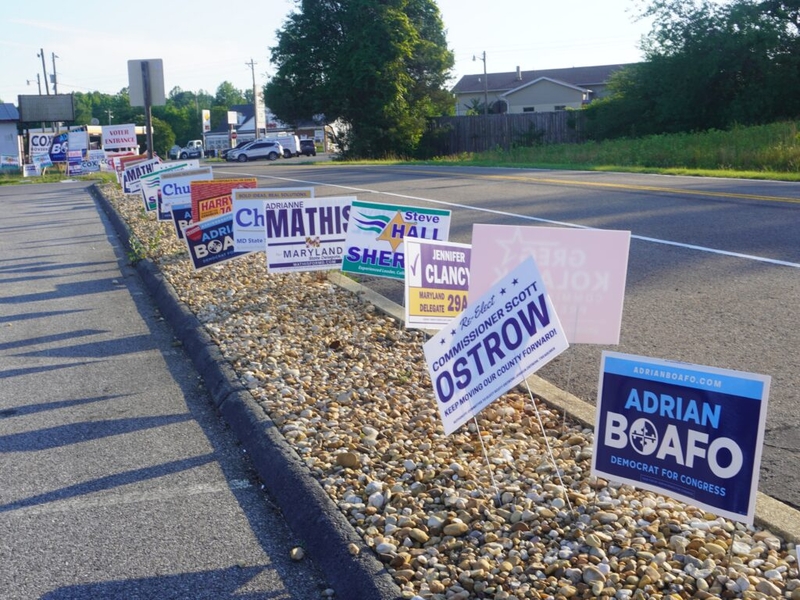
Campaign signs line the street near Mechanicsville Volunteer Fire Department before the June primary -- when Democratic and Republicans candidates were nominated. Third-party candidates cannot run in Maryland's primaries, just one of the many challenges they face. (Photo by William J. Ford/Maryland Matters)
Green Party gubernatorial hopeful Andy Ellis knows there’s almost no chance Gov. Wes Moore, a popular Democrat, loses his reelection bid in heavily Democratic Maryland. And that, in Ellis’ eyes, is a good thing for his campaign.
“If there’s no chance that Wes Moore loses, and the polls confirm that, I think there’s a lot of disappointed Democrats who supported Wes Moore in 2022 who will likely end up being willing to vote for us this year,” he said.
Conversely, if Republican Dan Cox — who lost to Moore in 2022 by a 32-64 margin — somehow makes their 2026 rematch closer, having a Green Party ticket in the governor’s race could force Moore to change his policies to appeal to disaffected Democrats who lean toward the Green platform.
“I like either of those possibilities for us,” Ellis said.
For third-party candidates — typically outnumbered, outspent, frozen out of primaries and debates, and looked on with suspicion by voters worried about wasting a vote — it’s often not about winning, but about making the incremental gains that allow them to stay on the ballot, to grow and be heard by voters disenchanted by the major parties.
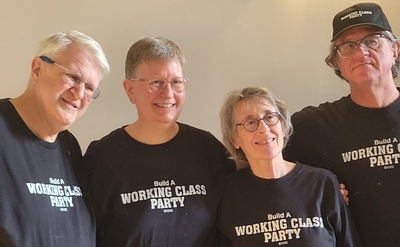
Cathy Permut, the Working Class Party’s nominee for lieutenant governor in Maryland, said she’s met people while campaigning who seem eager for alternatives.
“There’s plenty of people who like it when we say we don’t think the big parties have much interest in us – working people, people struggling to pay our bills,” Permut said.

But frustration with the two parties might not be enough for voters to throw in their lot with a third party, said David Karol, associate professor of government and politics at the University of Maryland.
“Most people find there to be a significant difference between the parties on the issues that they care about, even if they say they don’t.” he said. “As long as we can differentiate the parties on issues that voters care about, there isn’t really an opening for third parties.”
Karol pointed to hot issues in the past, like slavery or Prohibition, that the major parties ignored, creating an opening for third parties. “They need an opening like that, where there is a large group of voters that feel like neither party is doing anything for them on their issue,” he said.
Ellis said data centers might fit the bill in 2026, after seeing them mobilize voters and swing local elections in Frederick, Charles and Calvert counties.
“I think what unites all three of those counties is that the people felt like their politicians were serving the corporations before they were serving the people,” said Ellis, whose campaign calls for a statewide ban on data centers. “That issue encapsulates all the reasons people are mad at existing politicians: money in politics and the lack of transparency in government.”
Working Class gubernatorial nominee Cathy White said working people haven’t had a party that represents their interests in decades, and, “for a long time, the Democrats have not even paid workers lip service.”
“We’ve tried the Democrats, and we’ve tried the Republicans, and where are you now? Neither party has gotten you to where you would like to be,” she said.
Often, voters don’t even get that choice: As of June, 68% of Maryland elections this year were uncontested, just under the national average, according to Ballotpedia. Green Party Co-Chair Brian Bittner said changing that is one of the central pillars of third parties like his.
“It’s not because we’re a dictatorship, it’s because the areas are so gerrymandered and established,” he said of the statistic. “I want everyone to be able to vote without obstruction, but I also think if there’s only one candidate on the ballot, what’s the point?”
But it can still be an uphill battle for third parties.
“Our political system does not favor more than two parties,” Karol said. “It’s kind of a vicious cycle for them [third parties].”
Part of that challenge is just staying on the ballot. Political parties in Maryland have to win at least 1% of the vote in the race for the highest office in a general election to participate in the next election. If they don’t, they must submit 10,000 valid voter signatures to regain ballot access.
The Green Party skipped that hurdle when its 2024 presidential nominee, Jill Stein, won 1.1% of the Maryland vote that year. With no presidential in Maryland in 2024, the Working Class Party had to collect signatures to qualify for the ballot this year.
Libertarians had a presidential candidate in 2024, but Chase Oliver only won 0.5% of the vote in Maryland. So they were forced to gather signatures, a push that is still ongoing, said Libertarian Chairman Kyle O’Donnell. He said they have collected about 10,500 so far, but likely need more because many end up invalid due to things like voters changing addresses after they signed.
“All of our volunteer effort is currently allocated to collecting petition signatures,” he said. “Time is of the essence and we try to complete this as fast as we can.”
Once they reach that goal, there are other hurdles. Third parties are not part of the state-run primaries, as Democrats and Republicans are. That privilege is reserved for the parties of the first- and second-place candidates for governor in the previous election. The rest hold conventions or run their own primaries.
Ellis said small parties and unaffiliated voters should be able to participate.
“The two parties get primaries in the state of Maryland that are paid for by taxpayers,” Ellis said. “Not only does that allow them to select the candidates, that also allows them to nominate their party officers, you know. That’s taxpayer-subsidized party building for the two parties.”
Cox tops Hale in GOP primary, heads to rematch with Moore for governor
The Working Class Party held its convention in April, nominating White and Permut, while the Green opened their primary Wednesday in an election that runs through July 22. The Green Party’s annual assembly is Saturday.
O’Donnell said more than any change to the party threshold, he’d want to see third-party candidates on the debate stage for president and governor.
“It’s a shame that with the deck already stacked in favor of the two-party system that third-party candidates get zero time in the debate,” he said. “Andy Ellis should be up on the debate stage with Moore and Cox. A Libertarian candidate should too, even if it’s a long shot.”
Maryland Public Television, which orchestrates the gubernatorial debate, requires candidates to poll at least 10% of the vote to take the stage, a benchmark third parties in the state have yet to even near.
“There is little benefit to Maryland voters in including candidates who garner negligible support from the electorate,” said Tom Williams, senior managing director of communications for MPT. He noted that the station has broadcast interviews of third-party candidates in the past on its program, “State Circle.”
“Should a third-party candidate mount a campaign that demonstrates significant voter interest and polling strength, MPT will include them in the debate,” he said.
After all that, third-party candidates have to contend with voters who worry about supporting a spoiler or throwing their vote away.
“I’m not sure that it’s throwing away your vote to vote for a third party any more than it is to vote for a presidential or gubernatorial candidate who’s going to win by 30 points,” said Ellis.
But neither the Green nor Working Class parties shy away from their long history of Election Day defeats.
“We know it’s not the most likely thing that a third-party candidate would win,” Permut said. “But by giving a vote, you’re actually saying something to the large parties. You’re reminding them there are voters out there who are fed up to the back teeth with all their political promises that they never carry out.”
That was echoed by Ellis.
“For some people that’s a protest vote, for some people that’s voting their values, for some people that’s power in order to have leverage over existing politicians. And for some people, it is something else,” Ellis said. “My role is to provide it to voters and explain how they have that power and how they can use it.”
Annapolis, MD