Young lawmakers talk online child safety and AI policy at annual bipartisan summit
Jul 10, 2026 | 5:22 pm ET
Description
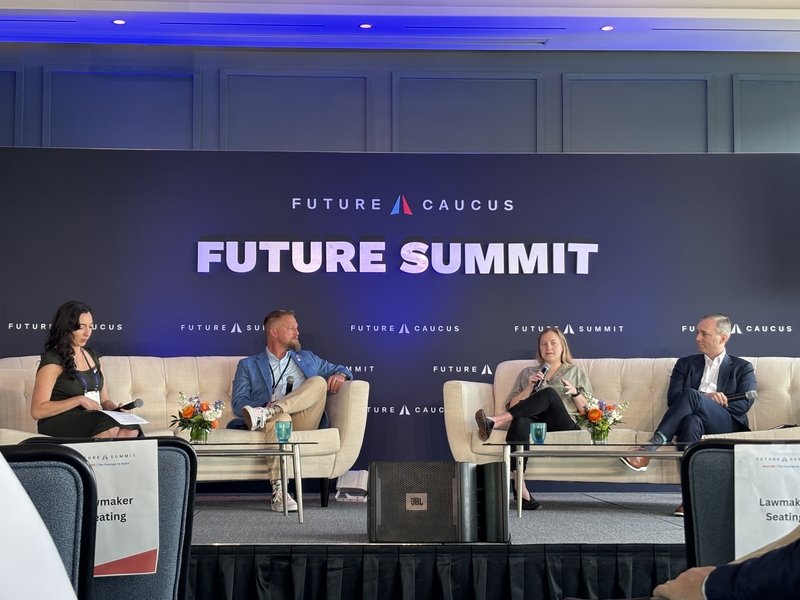
A panel discussed kids' online safety and artificial intelligence during a conference of Gen Z and millenial lawmakers Friday July 10, 2026. Pictured, from left, are moderator Diana Haber-Daws, South Carolina State Rep. Brandon Guffey, Ohio state Rep. Christine Cockley and Project Liberty President Tomicah Tilleman. (Photo by Amelia Twyman/States Newsroom)
WASHINGTON — Young Democratic and Republican state lawmakers from across the country found common ground Friday on the need to regulate artificial intelligence and kids’ online safety.
Legislators at an annual conference hosted by Future Caucus, an organization that aims to strengthen bipartisan dialogue among Gen Z and millennial leaders, engaged in tech-related policy discussions and agreed states should impose some guardrails on online activity, especially for kids.
South Carolina state Rep. Brandon Guffey urged lawmakers to pursue policy that would hold Big Tech companies accountable for exposing kids to harmful online content. He said he champions “guardrails” over device bans because “we cannot keep kids (offline) right now.”
“I don’t want to take away anybody’s rights to be free,” the Republican said. “But at the end of the day, we have a responsibility to protect the next generation.”
Guffey wrote Gavin’s Law, an act passed in 2023 that made “sextortion,” or the use of explicit content for blackmail, a felony in the state. The law was named after his 17-year-old son Gavin Guffey, who lost his life in 2022 due to online sextortion, and whose story Guffey shared with the roomful of quiet, attentive legislators.
Tomicah Tilleman, president of the organization Project Liberty that works to shape and advance AI policy, also warned state lawmakers of the addictive nature of the technology, a feature he said comes at the cost of users’ personal data for tech companies’ financial gain.
“Take a hard look at the structures that have led us to where we are, and start thinking at a very first-principles level about how we can build something better,” Tilleman said.
State Rep. Christine Cockley, a Democrat from Ohio, highlighted the growing issue of young people turning to AI chatbots for suicide assistance.
She is working to pass a bill alongside a Republican colleague that would require AI developers to build their models using mental health frameworks because she said she is “sick of hearing” stories about chatbots helping children write suicide notes and encouraging self-harm.
“The biggest thing I’ve learned is that we have to listen to the people with the lived experience to create good, sound policy,” Cockley said.
What to do about AI?
AI was a dominant theme throughout the rest of the morning.
State Reps. Monique Priestley, a Vermont Democrat, and Joe Hogan, a Republican from Pennsylvania, talked about the speed and scale of AI’s growth into almost every sector of society and weighed the pros and cons of managing the technology at the state level versus federal level.
Hogan said he believes states can succeed in protecting children and consumers from chatbots, but he thinks a “national framework” is more effective when it comes to developing the actual AI models.
On the other hand, Priestley said states should lead on the issue because it would help them address harms that only happen in certain areas, she said.
Plus, she added, it would protect states’ rights to self-govern.
Though the panelists expressed a handful of different views on questions related to AI policy, they agreed that the technology requires government regulation.
“It is the one bipartisan issue where we can come together and experiment,” Priestley said. “We are the laboratories of democracy, and when we are scared into not being those laboratories, then I think all of America is let down by that.”
Bipartisan look to the future
Future Caucus has convened summits of young lawmakers since 2017, with the goal of strengthening bipartisanship.
This year’s Future Summit, as the meeting is called, focused on the country’s 250th birthday with the title “Next 250 — The Courage to Build.”
Organizers invited Gen Z and millennial lawmakers to look back on the history of American politics, share their visions for the country’s future and work together to build a plan for that next chapter.
Aside from Friday’s internet safety and AI sessions held, state legislators sat in on discussions led by their peers throughout the week on topics such as passing bipartisan legislation, bridging the gap between elected officials and public constituents and empowering female leadership.
“There is joy in this community that surprises people, and it comes from discovering that politics doesn’t have to be a zero-sum game,” Future Caucus president and CEO Layla Zaidane said in a speech Thursday. “Solving problems (with people) who think differently from you is not only possible, but it is deeply fulfilling.”
All States Newsroom content is free to republish. Read our republishing policy for more information.