SCOTUS rulings show NJ’s ‘sensitive places’ gun law should fall, gun owners say
Jul 10, 2026 | 7:02 am ET
Description
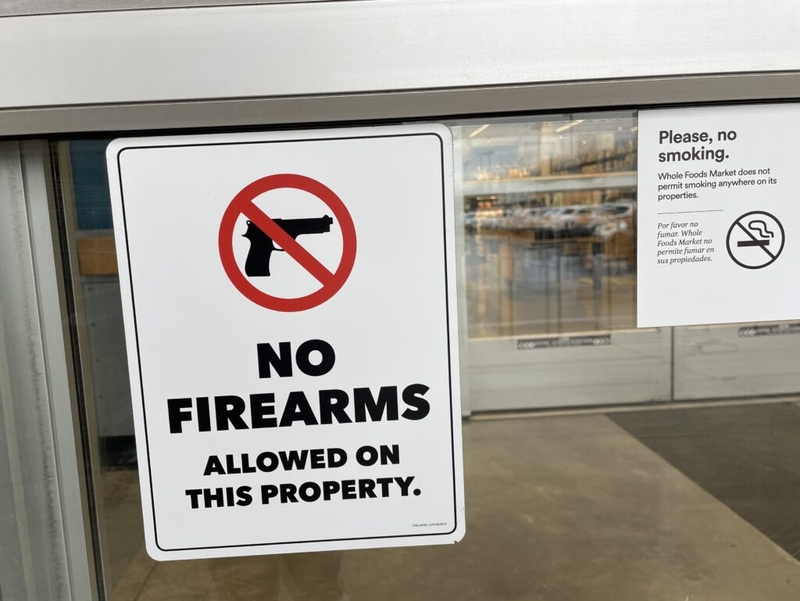
A sign warns shoppers at the Whole Foods Market in Princeton not to bring guns inside the store. (Photo by Dana DiFilippo/New Jersey Monitor)
Gun-rights advocates again are urging federal judges to strike down New Jersey’s ban on guns in sensitive places, saying two U.S. Supreme Court rulings last month overturning similar restrictions in Hawaii and Texas prove the law here is unconstitutional and cannot stand.
In those decisions, the nation’s top court said government cannot ban guns on private property open to the public (places like gas stations and grocery stores), nor disarm pot smokers and other users of illegal drugs.
Those rulings are fatal to New Jersey’s contested 2022 law, which also prohibits guns on private property open to the public and similarly presumes all substance-users are dangerous by barring guns at places where alcohol is served, the gun owners argued in briefs filed Wednesday.
Attorney David D. Jensen, who represents the Second Amendment Foundation and the Firearms Policy Coalition, argued that the rulings show the justices “flatly rejected creative efforts to legislate around the requirements of Bruen.” Bruen is the court’s 2022 decision that upheld a constitutional right to carry guns and struck down hurdles that states like New Jersey established that allowed gun owners to carry outside their home or business only if they could prove a need.
In the Hawaii case, the justices even specifically cite New Jersey’s law as problematic, Jensen noted.
While the Supreme Court didn’t directly address the constitutionality of more than 20 other places New Jersey deems sensitive, its “framing makes clear that they should be treated with extreme skepticism. After all, even if most New Jerseyans, like ‘most Hawaiians might prefer that no one carry firearms in public places, a majority’s opposition to a constitutional right is not a permissible basis for restricting it,” he wrote, citing the Hawaii ruling.
New Jersey Attorney General Jen Davenport, though, countered that the law here is rooted in historical traditions that existed at the time the Second Amendment was written, as Bruen requires.
“A wealth of diverse history proves States can regulate firearms in places where particularly dense crowds gather to engage in democratic governance, recreation, and transportation; where vulnerable people like children congregate; or where firearms mix dangerously with alcohol,” Davenport wrote.
The Supreme Court also has said attorneys don’t have to identify a “dead ringer” or “historical twin” in American traditions for a law or restriction to pass constitutional muster, she added.
“Because historical evidence is not a ‘straightjacket,’ freezing our laws in ‘amber,’ courts must identify traditions at a level of generality sufficient to ensure modern legislatures could address ‘circumstances beyond those the Founders specifically anticipated,’” she wrote.
Judges on the Third Circuit Court of Appeals had solicited the state’s and gun owners’ opinions on what impact they think the Hawaii and Texas rulings have on New Jersey’s law, as the full bench mulls whether to affirm or reverse a three-judge panel’s September decision rejecting the gun owners’ challenge.
The full bench heard arguments in the case in February in Philadelphia but had delayed its decision in anticipation of the Supreme Court rulings. It’s unclear how long that decision now could take.

Trenton, NJ