Judge blocks Arizona elections rule barring ‘intimidating’ and ‘harassing’ clothing
Jul 09, 2026 | 9:13 pm ET
Description
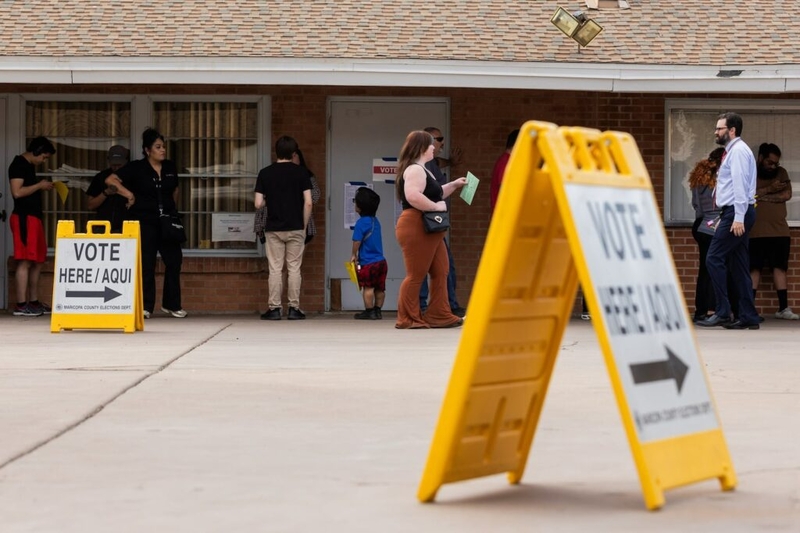
Maricopa County voters wait in line to vote during the November 2024 presidential election. Many longtime residents will receive a notice in the mail soon asking them to prove their citizenship to continue voting a full ballot. (Photo by Courtney Pedroza/Votebeat)
A federal judge on Tuesday blocked a provision in Arizona’s elections rulebook that prohibits people at polling places from “wearing clothing, uniforms or official-looking apparel intended to deter, intimidate, or harass voters.”
Judge Michael Liburdi’s ruling came fewer than two weeks before the Grand Canyon State’s July 21 primary election, with early voting already underway.
The temporary block of the intimidating apparel provision of Arizona’s Elections Procedures Manual was a win for the Pima County Republican Party and The Oversight Project, which is representing the party in a lawsuit challenging multiple provisions of the EPM.
The elections rulebook, which is revised every two years, was written by Democratic Secretary of State Adrian Fontes and approved by Gov. Katie Hobbs and Attorney General Kris Mayes, also Democrats.
The Oversight Project asked the court in May to block multiple provisions of the EPM, arguing that they were unconstitutional. Fontes and Mayes countered that the challenged provisions merely explain existing state law, without expanding upon it.
Liburdi handed wins and losses to both parties when he opted to block poll workers from enforcing the intimidating apparel provision, but did not do the same for a provision banning audible electioneering outside the 75-foot perimeter of polling places, if it can be heard at the polling place door.
He also chose not to block a provision allowing elections officials to kick political party election observers out of polling places if they raise “repeated frivolous voter challenges to poll workers without any good faith basis.”
In his order, the judge noted the conflict in this case between the right to political speech and the government’s authority to maintain order at polling places.
Liburdi agreed with the Oversight Project that the apparel rule was overly vague because it asks the election worker to discern both whether the clothing is intimidating and if the person is wearing it with an intent to harass.
“Intent of that kind is not observable,” he wrote. “An election official cannot read it from the garment, and the manual offers no standard for inferring it from anything else.”
He wrote that blocking the rule was necessary to prevent discrimination based on election officials’ discretion and the chilling of protected speech.
“Because the provision makes the lawfulness of a voter’s attire depend on a poll worker’s unguided assessment of the voter’s intent, it fails to give fair notice and invites discriminatory enforcement,” he wrote.
Although Fontes and Mayes argued that blocking any of the provisions would confuse poll workers and voters amid primary election voting, Liburdi disagreed that the block on the apparel rule would do so.
“Enjoining its enforcement changes no ballot, deadline, precinct, or voting procedure,” he wrote. “It requires officials only to refrain from applying a clause the Court has found likely unconstitutional, which imposes no administrative hardship and disturbs no longstanding procedure.”
Regarding the provision about audible politicking more than 75 feet away from polling sites, Liburdi disagreed with Fontes and Mayes that the EPM rule didn’t go any further than state law, but he also concluded that the Oversight Project failed to make a case that the rule is unconstitutional.
“Plaintiffs have not shown the audibility provision is likely unconstitutional, there is no constitutional violation for an injunction to prevent, and the public’s interest lies in the orderly administration of the election under the rules already in place, particularly now that early voting has begun,” the judge wrote.
And Liburdi found that the Oversight Project and the Pima County Republican Party did not have legal grounds to challenge the repeated frivolous voter challenge provision because the party doesn’t train its poll workers to make frivolous voter challenges.
“Today’s ruling affirms that the overwhelming majority of those common-sense protections are lawful and appropriate,” Fontes wrote in a Thursday statement. “That is good news for Arizona voters and for the dedicated election officials who work to administer elections fairly, securely, and professionally.”
The Oversight Project also counted the ruling as a win.
“Today, the Oversight Project secured an outstanding election integrity victory in our Arizona litigation against unconstitutional provisions of Secretary of State Fontes’ Election Procedures Manual,” spokesman Marshall Yates said in a statement to the Mirror. “A federal court agreed to block Arizona election officials from enforcing a vague ‘Apparel Rule’ designed to dissuade law enforcement and military voters from voting in person.”
***UPDATE: This story has been updated with a comment from the Oversight Project.
Phoenix, AZ