Sheep Creek mine update calls for 2,200 helicopter flights in first season
Jul 08, 2026 | 6:38 pm ET
Description
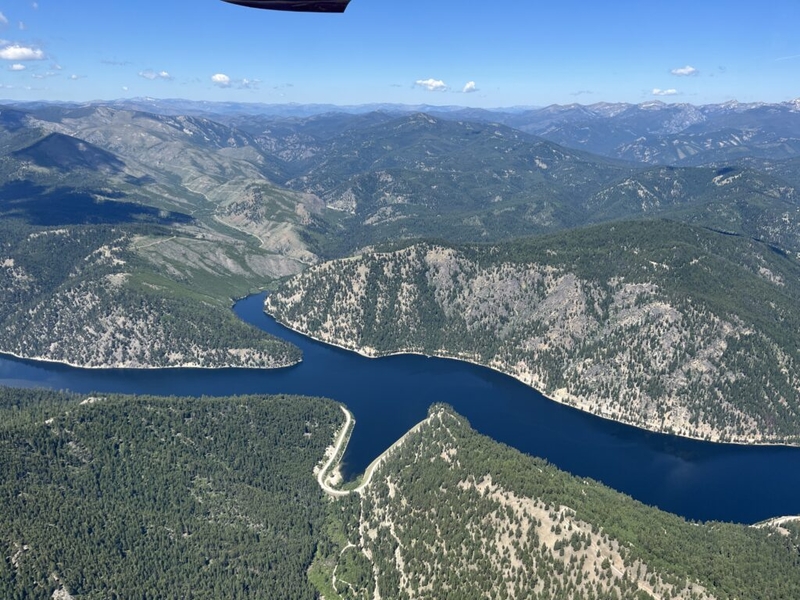
Painted Rocks Reservoir delivers 32,000 acre feet of water annually to the Bitterroot Valley and its economies, or 10 billion gallons, according to the Bitterroot Water Partnership. (Keila Szpaller/The Daily Montanan/Aerial support provided by LightHawk)
STEVENSVILLE — From the sky, the Painted Rocks Reservoir stretches long and blue, and it looks immense under the timbered mountains around it.
Alex Ocañas, with the Bitterroot Water Partnership, wants to put that vastness in perspective in light of a mine that could pollute a valley dependent on its waters.
The reservoir is one square mile, but Ocañas said it would be dwarfed by the mining claims should a project move forward.
“Just imagine that the claims span 11 times the size of Painted Rocks,” Ocañas said.
U.S. Critical Materials wants to mine at the headwaters of the Bitterroot River, and it has resubmitted an exploration proposal to the U.S. Forest Service.
CEO Scott Osterman said the project is a pathway to economic development for the Darby area and security for the country given China’s hold on “rare earth” minerals.
“Our day to day life, as well as our national defense, depend on rare earths,” Osterman said.
He and other U.S. Critical Materials officials have yet to convince many Bitterroot Valley residents, and the project is drawing interest and questions beyond the valley.

Ocañas said elected representatives, business owners, and Confederated Salish and Kootenai Tribes representatives recently took flight tours of the area to gain an understanding of the landscape and potential impacts of a mine.
This week, Bitterroot Water Partnership guided additional parties, including Commissioner of Securities and Insurance James Brown, a member of the state Land Board, and other business and conservation group members on flights to the headwaters.
Brown said he wanted to understand firsthand how the project might affect state lands downstream.
He said he came away believing the permitting process needs to take a hard look at environmental impacts and impacts to the community.
“All of us have a responsibility to make decisions future generations will thank us for making,” Brown said.
Revised proposal still controversial
Last week, the Bitterroot National Forest released an updated proposal from U.S. Critical Materials.
The company describes its mission as reducing U.S. reliance on foreign imports.
The project is being proposed as a mine exploration at four locations to confirm and evaluate the presence of “rare earth” minerals, gallium, samarium, scandium, neodymium, and praseodymium.
“The exploration project involves bulk sampling and surface drilling for rare earth elements classified as ‘critical risk’ by the United States Government,” the proposal says.
The project has been met with stiff opposition in the Bitterroot Valley across the political spectrum, including concerns truck traffic will bring expensive wear and tear on roads taxpayers fund.
The revised proposal mentions trucks, but it says the project “will be primarily serviced by helicopter from R&R Connor Aviation.”
Osterman said the change to helicopters would cost more money, but it is in response to community concerns. The proposal cites as many as 2,200 flights in one season, with 1,900 of those “internal hops,” or inside the project area.
The first season is described in the proposal as July through November 2026, but a federal permitting timetable for the project does not have a set start date.
The proposal calls for drilling for core samples, and blasting explosives for rock samples, 3,000 short tons of bulk material in both seasons total for testing.
Osterman said helicopters will fly the material in “super sacks,” heavy woven fabric, to staging areas, one to three different areas off site on private land.
He declined to disclose those locations and whether they were close to Darby.
“Some might be, some might not be,” Osterman said. “We know some places, but we also have other options. It really just depends on the logistics of the best way to move the material with the least amount of effort.”
A helicopter operations plan filed with the proposal counts as many as 35,000 pounds of bulk material transported off site each day “during active bulk sampling periods.”
The plan says material will go by helicopter to an “interim staging area,” then be loaded onto a heavy-duty pickup and gooseneck trailer and taken to a lab for testing.
It says up to two outbound truck trips are expected per day. Osterman said rail might also be possible.
“The integrated use of helicopter and ground transportation is intended to minimize overall disturbance within the project area while maintaining safe and efficient project operations,” the proposal says.
View of the Bitterroot, West Fork
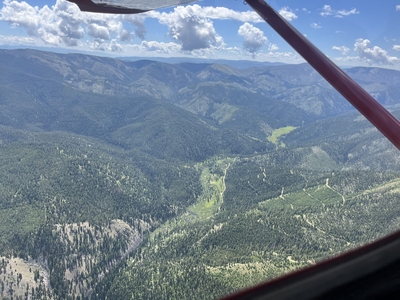
The proposal sets boundaries on paper, but the vantage from the sky shows the breadth of the landscape and the way water weaves through it all.
“To see where that mine is going to be located in relation to the headwaters — that’s pretty eye-opening,” Brown said. “That’s the best way to put it.”
LightHawk, a nonprofit dedicated to conservation through flight, donated the flights, and volunteer pilot and Northern Rockies program manager Chris Boyer said the tours allow people to “see for themselves.”
“There’s an inherent objectivity to the aerial view which prevents a selective presentation of the evidence — you get to see it all,” Boyer said in an email.
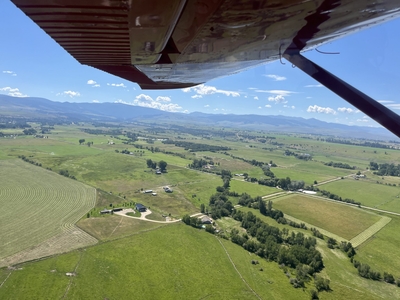
Before and during flight Tuesday, Ocañas pointed to evidence of the thriving economies in the valley, ranchers baling hay, traditional agriculture, fishing on the Bitterroot River, businesses downtown Hamilton.
“You can see exactly how water flows from Sheep Creek into this beautiful, healthy West Fork headwaters habitat, into the West Fork proper, filling Painted Rocks Dam, continuing on,” Ocañas said.
The valley bottoms were still green, the Bitterroot River curled back and forth through them, and snow still topped some of the mountains.
Painted Rocks delivers 32,000 acre feet of water annually to the valley and its economies, or 10 billion gallons, Ocañas said.
Among the recipients are 1,400 farms and ranches, she said, with farmers and ranchers working cooperatively with other users to figure out how to share the resource.
Tourism is an $80 million industry in the Bitterroot, and its river is among the top five most fished rivers in Montana, she said.
Tony Hudson, with Save the American West and on a tour Tuesday, said those economies can’t support a mine given the geography of the landscape, evident from a plane.
“All of this drainage exits through a 100-yard-wide canyon, so every spring, every snowmelt, every event that involves water is basically a potential flood disaster,” Hudson said.
“And it’s at the very entrance of their mining claims.”
Concerns about mine proposal
Before the tour, Lisa Ronald, with American Rivers, outlined some of the new and ongoing concerns about the possible mine and about U.S. Critical Materials.
Ronald said the company has taken a small step in the right direction in being responsive to community concerns, but not enough.
“They have incredible room for growth in communicating with and engaging the community,” Ronald said. “I think that’s a concern that we’ve heard repeatedly.”
She said worries about water quality exist even for the exploration project, much less a mine itself, because water can be affected anytime chemicals are being used and stored.
The proposal lists hazardous substances to be kept on site, including blasting products, lime for water treatment, diesel, gasoline and equipment maintenance products (oils, grease, antifreeze).
She said the proposal still doesn’t address how the project will handle fire traffic, such as potential closures and detours, or the impacts to recreation from persistent helicopter flights.
Ronald said the company also is promoting new mining techniques, but without evidence they’ve done it successfully elsewhere.
“The community really needs to feel like they’re not using the Bitterroot as a test tube,” Ronald said.
Proposal goal to have ‘limited to zero discharge,’ Osterman says
Last week, U.S. Critical Materials announced it was opening an office in Darby as part of its effort to be open with the public.
In a phone call this week, Osterman said an office manager would be hired and work there, as would a summer intern, a geophysicist.
The company’s chief geologist will mostly work in the field but have an office there when he’s not at the project site or traveling, Osterman said.
“We are working to do this the right way, and we believe there is an opportunity for there to be economic development and value for the Darby area,” Osterman said.
Osterman said the exploration will produce “no major waste,” and he said the lack of carbonatite material on site means nothing there will create acid rock drainage.
“An educated, informed geologist would know that,” Osterman said. “We’re going to do it right. Environmental stewardship is what this is all about, as well as national security and creating jobs.”
The proposal says up to 8,500 gallons of water per day may be needed, and Osterman said the source is commercial.
On its website, the company says the project will not use water from Sheep Creek, and will rely primarily on “natural mine inflow, potential groundwater wells, and trucked water if necessary.”
Osterman said China recently cut off 56 companies from receiving export of any rare earths, the United States needs to create “mineral sovereignty,” and the project at Sheep Creek can help.
At a public meeting in December 2025, community members raised environmental concerns, but Osterman disputed the area was “pristine” at the time.
This week, he said at least five other mines operate next to “Blue Ribbon” trout streams in Montana alone, pointing to Sibanye-Stillwater, Golden Sunlight, Hecla, U.S. Antimony and Black Butte.
“It can be done properly. We can’t look in the rearview mirror. We have to look forward if we ever get to that point,” Osterman said.
In an email, District Ranger Dan Pliley said timelines for the project are pending.
He said no start date has been determined, and other agency permitting and reclamation bonding must be in place first.
“There may be a public comment period for the project depending on the appropriate level of environmental analysis, which has yet to be determined,” Pliley said.
Helena, MT