More than a hundred protest new Medicaid rules at Capitol
Jul 08, 2026 | 7:26 pm ET
Description
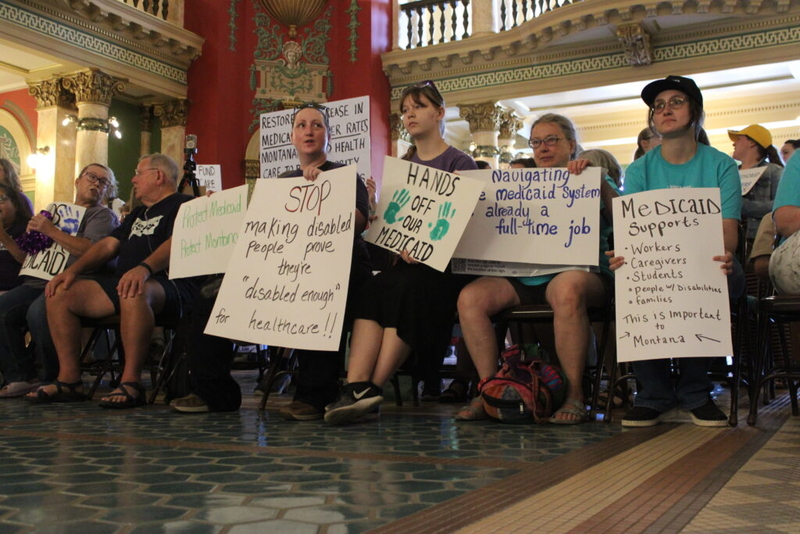
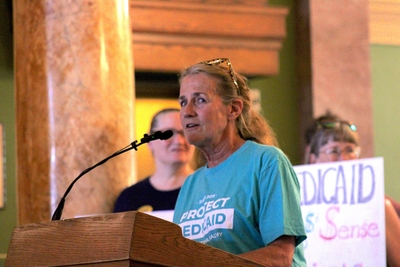
Advocates for Medicaid gathered at the Montana Capitol to protest new Medicaid rules. Some attendees are pictured prior to the event on Wednesday, July 8, in Helena, MT. (Jordan Hansen / Daily Montanan)
HELENA — More than 100 people from across the state gathered in the Montana Capitol rotunda on Wednesday to protest cuts to Medicaid as well as new work requirements to access the health insurance program.
Catalyst Montana, an advocacy-focused nonprofit, hosted the gathering, which included speeches from healthcare professionals, politicians and others impacted by the changes.
The federal Medicaid changes stem from H.R. 1, the budget reconciliation bill, which President Donald Trump has called the “One Big Beautiful Bill Act.”
This includes new federal Medicaid work requirements — 80 hours per month — to get the benefit unless a person meets the criteria for an exemption. The bill also shortened certification periods from annually to every six months.
Montana implemented the federal requirements six months early, on July 1. The Montana Department of Public Health and Human Services has said it is “fully prepared for this transition.”
Not everyone is convinced that’s true.
Rep. Mary Caferro, a Helena Democrat, asked why Montana DPHHS moved forward with the switch early, calling it an “unnecessary policy” that was pushed forward before the agency was ready or required to do so.
As recently as June 22, state DPHHS still hadn’t hired or fully trained staff on reviewing Medicaid applications and access to claims data, according to the Montana Free Press.
Those work requirements are causing frustration for some Montanans, especially the more complex documentation process.
Brine Quimby, 30, said he was on Medicaid as a child. His parents died, he said, and he was an emancipated minor, so he had to figure out much of the system himself. Quimby is disabled and does work — he is involved with the Missoula SPACECAT Network, the Community Living Task Force and helps moderate the Missoula Mutual Aid Community Facebook page — it’s just not always paid or recorded, which makes it difficult to prove to the state or fully get counted hours.
“They’ll see working without money not being actual work,” Quimby said. “I face barriers now.”
He’s frustrated because he’s advocated for Medicaid and educates others about it, but he’s still experiencing problems with the system. Quimby said he didn’t turn in one form correctly and has not had success following up with health services to address the issue.
“When I’m in the Access to Care work group, I’m the only one who doesn’t have access to healthcare, and I’m making a tool kit that is for providers and for patients to help with policy initiatives and health equity and all this stuff,” Quimby said. “I feel like I’m in a simulation, like a ‘Black Mirror’ episode.”
The issue is not just limited to those who need help, it’s the people giving them the care as well.
Melody Rice, 64, is a mental health professional based in Butte and said that two-thirds of her clients are on Medicaid. Her therapy techniques include art, which she used to help treat people with mental illnesses such as Post Traumatic Stress Disorder.
She can’t turn down someone in crisis, she said, adding that it becomes pro-bono work for her. Montana also recently nixed a planned 3% increase in Medicaid reimbursements that have had some legislators frustrated and providers with more hassle and less money.
Nick Sunshine, an in-home care provider, said he was “deeply concerned” about the changes.
“People who are still eligible for Medicaid can lose their health treatment, not because they’re no longer qualified, but because of paperwork, work requirements, or administrative delays, and the impact doesn’t stop with my clients,” Sunshine said. “When my clients don’t get services, I don’t work hours, but the biggest problem for me is that people who need care suddenly don’t have someone showing up on their doorstep.”
Helena, MT