Judge’s ruling pauses ethics probe, lets Shekarchi’s Supreme Court seat pursuit play out in court
Jul 07, 2026 | 5:05 pm ET

Description
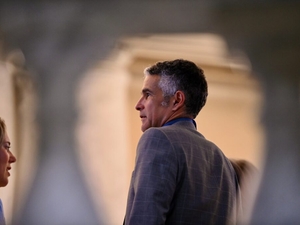
pause the Rhode Island Ethics Commission's investigation into his Supreme Court application while his lawsuit moves forward. (Photo by Christopher Shea/Rhode Island Current)
A Superior Court judge has temporarily halted the Rhode Island Ethics Commission’s investigation into former House Speaker K. Joseph Shekarchi’s application for a vacancy on the Supreme Court pending a hearing later this month.
Justice Richard A. Licht on July 2 granted Shekarchi’s motion to stay the probe in a consent order in Shekarchi’s lawsuit against the Ethics Commission. Shekarchi’s complaint, filed June 25, seeks to permanently end the probe into whether his bid to become a justice on the high court violates the state’s “revolving door” rule, which bars sitting lawmakers from taking on another state job.
The pause was first reported by the Boston Globe Tuesday afternoon.
Licht’s order also pauses the clock on the Ethics Commission’s investigation. State law gives the commission 180 days to complete its inquiry.
The halt will remain in place pending further judicial order. Licht, who sought and received an Ethics Commission advisory opinion before joining the Superior Court in 2014, is set to hear oral arguments at 1 p.m. on July 20 in Kent County Superior Court, court records show.
Jason Grammitt, executive director for the Rhode Island Ethics Commission, did not immediately respond to a request for comment. Shekarchi said he has no comment until the judicial process is complete.
Shekarchi, a Warwick Democrat, stepped down as House speaker on May 7, three days after applying to the bench. That same day, Roger Williams University School of Law Professor Michael Yelnosky filed his complaint arguing that the leap from one branch of government directly to another would violate the revolving door rule written into state law in 1992.
The law prohibits sitting legislators from seeking or accepting employment with any state government agency for at least one year after leaving elected office. But it exempts lawmakers who seek or accept election to a constitutional office.
Shekarchi has repeatedly insisted his application is eligible under the law. The Ethics Commission similarly agrees that the judiciary is a constitutional branch of government, but argues the exemption applies only to candidates for general office: governor, lieutenant governor, treasurer, secretary of state, and attorney general.
Which is why the Ethics Commission rejected Shearchi’s attempts to toss its investigation during its June 23 meeting. Shekarchi’s lawyer quickly brought the matter to court two days later, asking for an emergency hearing ahead of the July 28 Judicial Nominating Commission meeting when five finalists, including the former House speaker, will be interviewed to fill the vacancy created by the March retirement of Justice Maureen McKenna Goldberg.
John Marion, executive director for Common Cause Rhode Island said he expects Licht to issue a ruling by the time the Judicial Nominating Commission conducts interviews for the lifetime seat on the Supreme Court.
“The question will then be if one of the parties chooses to appeal it to the Supreme Court,” Marion said in an interview Tuesday.

Providence, RI