Kansas farmers suffer from tariffs and closing of Strait of Hormuz, ag experts say
Jul 07, 2026 | 3:49 pm ET
Description
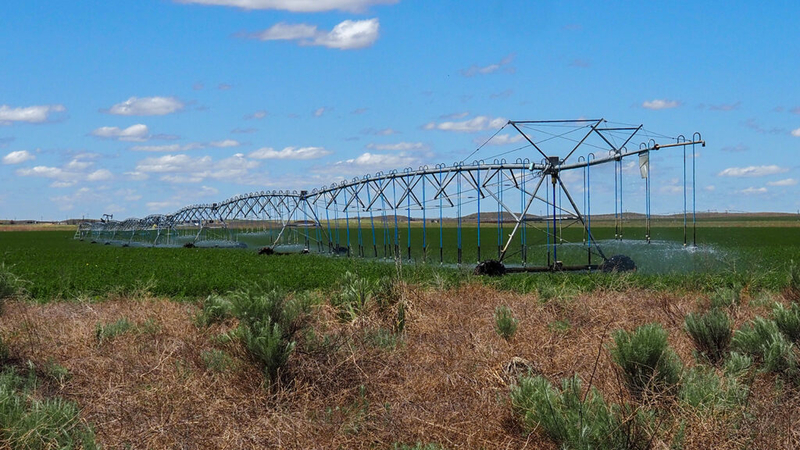
Trade tariffs and the Iran war have added challenges to costs for Kansas farmers, including increased costs of fertilizers, agriculture policy experts say. (Photo by Kevin Hardy/Stateline)
TOPEKA — Trade tariffs cost the United States about $15 billion in losses in the Chinese market alone, agriculture policy experts said Friday.
Sandro Steinbach and Shawn Arita, associate professors at North Dakota State University’s Agricultural Risk Policy Center, spoke about international policies affecting agriculture during an episode of Kansas State University’s podcast Clearing the Air.
Steinbach said the policy center studied market disruption in the United States and China relationship.
He said the higher cost of exporting products to foreign markets caused a “pretty strong” diversion in China away from U.S. products, causing losses of about $15 billion for the United States.
“Diversion means that exporters export products to other countries as well, so we have seen in certain markets significant diversion,” Steinbach said. “Those states that export a lot of product to China, they saw quite significant disruptions.”
In April 2026, Kansas exported $91.3 million of products to China, the third largest country behind Mexico and Canada, according to the Observatory of Economic Complexity, an economic data-gathering organization.
Steinbach said many corn shipments were diverted to Mexico and South America, creating large trade disruptions that were harmful for producers because the diversion depresses prices.
In assessing historical tariff effects, Steinbach said, changing access to China’s market caused disruption in the economy. In the past, the move has led to overall long economic losses and has “major implications for local economies.”
“That’s kind of the message out of the earlier episodes, actually, which really depressed global economic growth,” he said. “So it’s not just about U.S. implications, but also how the global economy is evolving. Obviously, we as exporters depend on foreign markets. If everyone is doing well globally, people get richer while they’re consuming more goods — just this classical mantra of economic growth leads to more demand for agricultural commodities.”
Decisions to isolate the United States from certain import or export markets have a cost and benefit, Steinbach said. The country’s gross domestic product — the value of finished goods produced in a country — is small compared to other countries, he said.
“While it may benefit certain groups by having closed borders and limiting access to the U.S. market, or the other way around, it might create unintended consequences, which can be large and can be harmful.”
Agriculture, for instance, needs the international market because the domestic market doesn’t see increased demand, Steinbach said.
“I think these fundamental factors should be always taken into account when we make dramatic decisions, or when we discuss dramatic policy shifts,” he said. “Actually, there are always winners and losers, and making sure that the losers are taken care of in a transition is really important. That applies to both opening markets and closing markets.”
‘Balanced trade’
The Trump administration’s overall strategy has been focused on a balanced trade strategy and addressing trade deficits, Arita said. Compared to trading partners, the United States has had low tariffs, he said.
Trump reset tariffs higher through the International Emergency Economic Powers Act, creating leverage for negotiation, Arita said.
“Reciprocity is a key part of tariff negotiations,” he said.
The Trump administration also has the goal of restoring the manufacturing sector, he said.
“In terms of restoring the manufacturing sector, that had left the ag sector to some degree more of collateral damage, in the sense where now we got hit by some of our other trading partners, like China,” Arita said. “We have a very aggressive trade policy, and interestingly enough, only China, and to a smaller degree, Canada, have actually retaliated against our ag sector this time around.”
Although some countries chose not to retaliate with tariffs, Arita said, there is a risk that if the United States is too aggressive, other trade partners will look outside the U.S. market.
“All these countries, if they do not see us as being very, very stable or a partner that they can easily negotiate with, then they’re going to negotiate amongst themselves,” he said. “On a global level, this is all good to have more trade agreements, but if you do have a situation in which a lot of countries are signing these pacts outside with the U.S. not being a part of it, the U.S. does get left behind.
“Whenever you’re very aggressive, there’s just risk,” Arita added.
Fertilizer prices
The uncertain future of the Strait of Hormuz, the waterway between the Persian Gulf and the Gulf of Oman that is important for transportation of oil and liquified natural gas, affects multiple aspects of the agricultural sector. That includes the price of gas and fertilizer.
It’s unclear how quickly fertilizer prices will rebound, Arita and Steinbach said. An agreement reached June 18 to reopen the strait is tenuous, as three ships were bombed in the strait this week. Still, Steinbach said, he is hopeful the agreement will provide some stability in the markets.
The policy center has run simulation models to understand different scenarios and how they will affect the U.S. agriculture’s input costs, Steinbach said. Many producers bought fertilizer last fall, so the immediate impacts have been small, he said.
That is likely to change next year, he said.
Steinbach said his department’s research found concern that fertilizer prices will stay elevated for a longer time than initially expected.
Arita said the war with Iran in the strait, which closed in February and then has been a “roller coaster” of being open and closed since then, has not raised fertilizer prices as much as previous conflicts have. Concerns often centered on urea fertilizer because about 30% comes through the Strait of Hormuz, he said.
But the market was more resilient than expected, Arita said. China is also a key supplier of urea, and the country stepped back into the market to address shortages, he said.
However, two fertilizers, referred to as MAP (monoammonium phosphate) and DAP (diammonium phosphate), have seen elevated prices, Arita said. They both contain sulfur, and about 40 to 50% of the world’s sulfur goes through the Strait of Hormuz, he said.
“We also have to keep in mind, before the Strait of Hormuz, supply conditions were already tight, for MAP, DAP, as well as the nitrogen fertilizer,” Arita said. “It just served to amplify that effect.”
It’s unclear how long it will take to normalize the fertilizer market because it isn’t certain how much damage was done to the fertilizer-related production infrastructure in Iran, he said.
“That could keep upward pressure moving forward well into 2027 and beyond in terms of overall prices,” Arita said.
Although prices have come down a small amount, they could easily rise up, especially as Brazil and India, two of the top fertilizer importers, move into the time periods when they increase imports.
“Anything can happen, and so the best we can do is just be prepared for uncertainty,” he said.
Andrew Ferguson, Federal Trade Commission chairman, announced at a Texas Farm Bureau event that the FTC is launching an investigation into fertilizer prices and market concentrations. The investigation will explore the “precipitous rise of fertilizer prices,” Ferguson said.
At the end of June, Trump signed a proclamation to suspended some tariffs affecting phosphate fertilizer imports to help lower fertilizer costs, a U.S. Department of Agriculture news release said.
The action is expected to lower phosphate fertilizer prices by 22%, the news release said.
Topeka, KS