Don’t fight Arkansas school vouchers by governing like Trump
Jul 05, 2026 | 6:00 am ET
Description
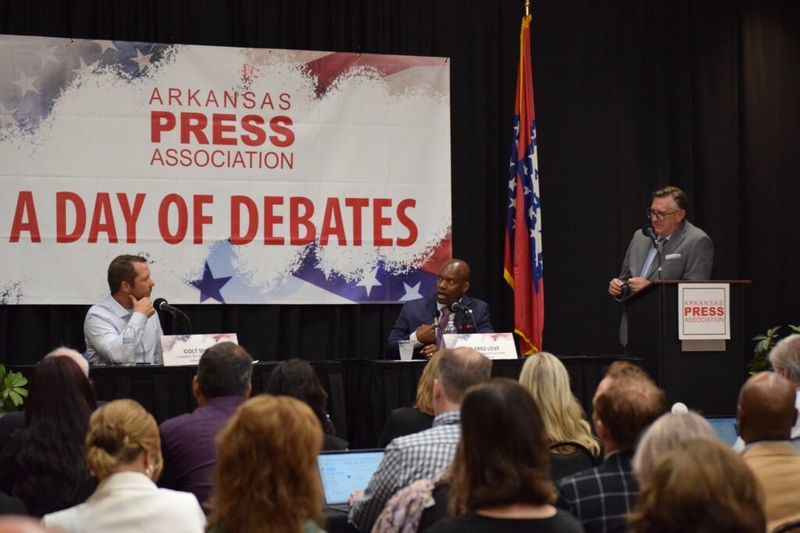
Libertarian candidate Colt Shelby (left) listens as Democratic state Sen. Fred Love (center) addresses a question from Natural State Media CEO Roby Brock (right) during a gubernatorial debate on June 26, 2026 in Eureka Springs. (Photo by Antoinette Grajeda/Arkansas Advocate)
Fred Love isn’t the first elected official promising to use his executive power to circumvent the legislative process.
The Democratic state senator is running for governor in Arkansas, where voters have three times backed a president who’s used executive orders to test and ignore the limits of his power.
That’s what makes Love’s vow to end Arkansas’ school voucher program on his first day in office so concerning.
Beyond promising to take an action that would most certainly be challenged in court as unconstitutional, he’s embracing a brand of governing that treats the law as an obstacle. It’s the wrong lesson for Democrats to take from President Donald Trump’s time in office.
Love proposed the order as he faced off against Libertarian nominee Colt Shelby in a governor’s race debate that Republican Gov. Sarah Huckabee Sanders skipped.
“As the executive of the state, my department of education will not administer (Educational Freedom Accounts),” Love said at the Arkansas Press Association debate. “But what we will do is we will reinvest that money into the public education system because that’s where the money should go in the first place.”
Going after the voucher program that was a key part of Sanders’ signature education law is no surprise.
Democrats have warned about the growing cost of the program using taxpayer funds to pay for private and homeschool education expenses, and the impact that its growth will have on the state’s public school system.
But they face long odds in fighting the voucher program politically, with Republicans holding a predominant majority in the Legislature and Sanders in a comfortable position for reelection. The vast majority of those legislators weren’t around during the reforms that were enacted in response to the decades-long Lake View school funding litigation.
And the legal landscape is just as challenging, with Republican-linked justices holding a 5-2 majority on the state Supreme Court.
There’s a temptation in politics to go tit for tat when the other side overreaches, or to warn of unilateral disarmament by eschewing tactics that your opponent has clearly used with impunity.
And Democrats can easily point to orders Sanders has signed since taking office that were gimmicky political statements or legally questionable. That includes her 2024 order directing schools to follow state law instead of Title IX’s protections for LGBTQ+ students proposed by the Biden administration. Those protections were eventually struck by a federal judge.
That approach to executive action shouldn’t be the norm, either in Little Rock or Washington.
Imagine a Republican governor using a similar approach to unilaterally end the state’s Medicaid expansion, despite the program being repeatedly reauthorized by state legislators.
Such a promise is also a politically risky move. The threat of an order ending vouchers gives Sanders and Republicans a new talking point: that Democrats don’t want to follow the law.
It also undermines the key argument from Democrats and some Republicans that Trump has thumbed his nose at the law and the Constitution. That argument is highlighted by the U.S. Supreme Court’s rulings rebuking Trump’s attempts to end birthright citizenship and impose far-reaching tariffs by order rather than through the legislative process.
Opponents of Arkansas’ school vouchers face a difficult path forward in trying to end or even just scale back the program. Their frustration is compounded by the state’s efforts to restrict voters’ ability to use the initiative process to change the law.
Frustration doesn’t warrant bypassing the legislative process. The governor, just like the president, wasn’t meant to be a one-person Legislature. That principle should apply no matter which party is in the office.
Little Rock