Arrest warrant for AG Liz Murrill quashed by Louisiana Supreme Court
Jul 04, 2026 | 1:31 pm ET
Description
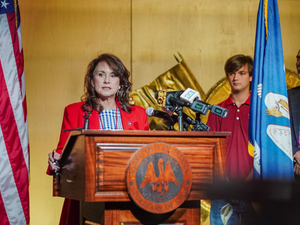
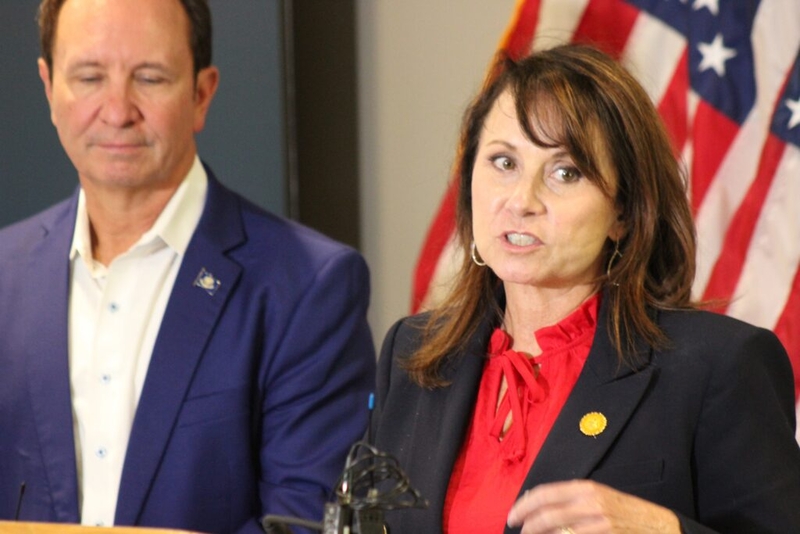
A Louisiana Senate committee blocked legislation backed by Attorney General Liz Murrill that could have moved thousands of cases from juvenile to adult court. (Wes Muller/Louisiana Illuminator)
An arrest warrant for Attorney General Liz Murrill for intimidation and malfeasance charges has been recalled at the direction of the Louisiana Supreme Court in an order issued late Friday night.
The court’s clarifying order followed one it issued earlier in the day that stayed a 16-count indictment against Murrill from a special prosecutor in Orleans Parish. The charges, handed up Thursday, are related to a letter she sent in May to seven elected officials in New Orleans that said Gov. Jeff Landry could remove them from office for disobeying a new state law that consolidated the two local clerk of court offices into one.
Murrill asked the justices to intervene late Thursday, and they granted the stay order early Friday. Murrill made another emergency request to the Supreme Court later Friday after she said special prosecutor Laurie White refused to withdraw her arrest warrant, which set a $400,000 bond for Murrill. Online court records show the warrant was pulled Saturday morning.
“The lawfare continues!” Murrill said in a statement Friday. “On the eve of celebrating 250 years of freedom and independence, the special prosecutor in New Orleans refuses to remove the active warrant for the arrest of the Attorney General, even though the Louisiana Supreme Court has stayed the indictment.”
The attorney general was never taken into custody while the legal showdown unfolded. The stay calls off an arraignment scheduled for Wednesday and allows Murrill to seek to have the charges against her dismissed.
“There is considerable support for the view that the Attorney General is likely to succeed on the merits of a motion to quash this indictment on either a legal basis or due to apparent procedural irregularities,” the stay order reads.
Associate Justices Jay McCallum, Jefferson Hughes, Piper Griffin, Cade Cole and Billy Burris concurred in issuing the stay, while Chief Justice John Weimer and Associate Justice John Guidry dissented. Griffin joined the dissent in the order that lifted the arrest warrant.
“Ironically, on the eve of this July 4th when our nation will commemorate the 250th anniversary of the Declaration of Independence, this court is once again called upon to provide exceptions to the normal process pursuant to another feigned emergency by one party,” Weimer wrote in his dissent on recalling the arrest warrant.
In the stay order, the Supreme Court sided with Murrill’s view that the grand jury proceedings that led up to her indictment took place under questionable circumstances.
“By all public accounts the Orleans Parish Criminal District Court violated express provisions of state law requiring that grand jury returns occur in the public eye, ‘in open court,’ the order reads. ”Numerous media outlets have stated that reporters were handcuffed and removed from these otherwise public proceedings.”
One journalist and an attorney for the television station where he works were briefly handcuffed and removed from the court, news outlets reported. White told reporters afterward they were displaced in order to protect the anonymity of grand jury members who were in the courthouse at the time.
The dispute has dramatically intensified a political showdown between the state’s Republican leadership and Democratic elected officials in New Orleans. It originated with a legislative proposal to pare down the city’s judiciary branch, which has separate courts and clerks for civil and criminal cases in contrast with the state’s other 41 judicial districts.
Another measure from the state lawmaker, Sen. Jay Morris, R-West Monroe, sought to remove elected several judges from both Orleans courts, though it was ultimately amended to remove just three from the criminal bench.
Judge Leon Roche, who was slated for removal in Morris’ bill before it was amended, appointed White as a special prosecutor to investigate Murrill’s letter, sent to Mayor Helena Moreno, District Attorney Jason Williams, five New Orleans City Council members and retired Judge Calvin Johnson.
The attorney general told the mayor and council members the governor could use the state’s usurper law to replace them after the council voted to name Johnson interim court clerk and call a special election to find a permanent leader of the consolidated clerk’s office. Murrill argued, and the Louisiana Supreme Court agreed, that the new law to combine the two offices put Civil Clerk of Court Chelsea Richard Napoleon in charge of both. Johnson could have been imprisoned if he sought to carry out the clerk’s duties, Murrill wrote in her letter.
The new clerk consolidation law also prevented Calvin Duncan, who had been elected to the criminal court clerk’s post in November, from assuming office in May. Duncan won resoundingly in his first bid for elected office after having served nearly three decades at Angola State Penitentiary for a 1981 murder he didn’t commit. He was released after pleading guilty to a lesser charge in 2011 and cleared of any wrongdoing in 2021.
After his release from prison, Duncan obtained a law degree and campaigned to run the office he said had placed numerous obstacles in the path to freedom for himself and other wrongfully prosecuted people.
In her stay request to the Louisiana Supreme Court, Murrill pointed out her office is currently defending White, a former Orleans Parish Criminal Court judge, in a sexual harassment case. The prevailing justices agreed this relationship presents a conflict of interest, and it resulted in White violating the secrecy of the grand jury process because she called the attorney general’s office to discuss the pending indictment against Murrill.
This is a developing story.
Baton Rouge, LA