SC now requires American-made steel for roads, bridges and other public projects
Jul 04, 2026 | 10:00 am ET
Description
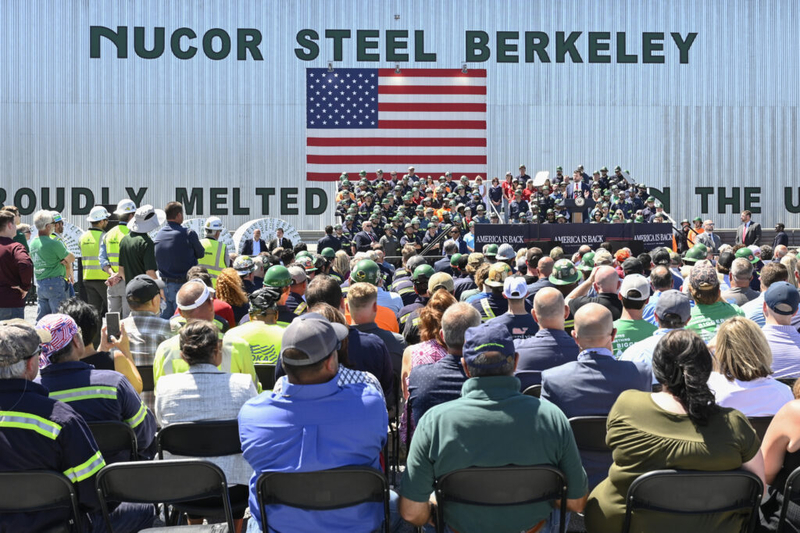
Gov. Henry McMaster signed a law June 30, 3036, requiring state and local officials to build taxpayer-funded projects using U.S.-made steel and iron. The photo is at Nucor Steel Berkeley, in Huger, South Carolina, on Thursday May 1, 2025, when Vice President JD Vance gave a speech about the "golden age" of manufacturing. (Photo by Mark Susko/Special to the SC Daily Gazette)
COLUMBIA — Nearly all taxpayer-funded construction projects must be built using U.S.-made steel and iron under a new law signed by Gov. Henry McMaster.
The law, pushed by South Carolina steel companies, passed through the General Assembly with almost no opposition. The House gave unanimous approval. Only two senators — one Republican and one Democrat — voted against the measure before the governor signed it June 30.
“We want to keep our steel industry strong,” said Sen. Larry Grooms, whose Berkeley County district is home to a Nucor steel mill.
South Carolina is where industry giant Nucor Corp. broke into steel in 1962, when it purchased Florence-based Vulcraft. Its first recycled steel mill, known in the industry as a mini mill, has been in operation in Darlington since 1969.
“We have a very healthy metal recycling industry in South Carolina, so we do make a lot of steel here,” said Grooms, R-Bonneau Beach.
While Charlotte-based Nucor, the largest steel manufacturer and recycler in North America, got its start in South Carolina, the lion’s share of the country’s production is based in Indiana, followed by Ohio, Texas and Pennsylvania.
No other state accounted for more than 4% of total domestic raw steel production, according to the U.S. Geological Survey.
And in the Southeast, South Carolina has three steel mills — two owned by Nucor in Darlington and Berkeley County and one owned by CMC in Cayce — compared to seven in Alabama.
South Carolina’s mills have a total production capacity of about 6 million tons. The majority of that comes from Nucor’s Berkeley mill. In 2022, the company invested $425 million to add a new 500,000 ton line to its existing 3.8 million ton plant. The line makes flat-rolled sheet metal, essential to the state’s growing automotive industry.
Vice President Vance touts ‘golden age’ of manufacturing in SC steel visit
The state chipped in $400,000, as well as income tax credits for the 50 new jobs associated with the investment.
A fourth South Carolina mill, the Liberty Steel Mill in Georgetown, closed for good in 2024 after nearly a decade of on-again-off-again operations.
At a hearing for the bill in January, industry officials blamed cheaply made steel from Turkey, India and China for the industry’s decline.
Still, Nucor employs some 2,500 South Carolinians at multiple locations across Berkeley, Darlington, Florence, Laurens, Lexington, and York counties, Devin Webster, a Nucor vice president in the state, told legislators. That includes manufacturing of custom metal buildings, steel foundations and rebar for construction projects.
The new law could end up costing taxpayers, however, as American-made steel has historically been the most expensive in the world. U.S. steel prices hover around $1,100 to $1,200 per ton.
Import taxes, known as tariffs, levied by the Trump administration on companies that import steel into the country has driven up costs, pushing foreign suppliers out of the U.S. market. That was on purpose.

For the first time in 26 years, the U.S. was the third largest steel producer in the world. Production jumped to 82 million tons in 2025, up about 3%, pushing the U.S. past Japan, behind only China and India.
But that also means the cost of steel overall has gone up.
While China is the world’s largest producer and exporter, it sends very little to the U.S. — less than 2% of total imports into the country, according to U.S. Census Bureau data and the International Trade Administration.
President Donald Trump passed a 25% tariff on Chinese steel during his first term, pricing the country out of the market. He’s since upped that to 50%.
Most steel coming into the country comes from Canada, followed by Brazil, Mexico, South Korea and Germany. Imports make up about a fifth of all steel used in the U.S.
The new law seeks to address the pricing issue by waiving the requirement if a government can’t get U.S.-made steel fast enough or if the use of American steel increases costs by more than 25% above initial estimates.
There are also exceptions in cases of emergency, such as a tornado damaging a firehouse, Grooms said. The requirement does not apply to state-funded affordable housing projects or those receiving state tax credits.
And a negligible amount of foreign steel and iron can be used incidentally in any project, which the law defines as not exceeding 0.1% of the project’s total steel and iron costs or $2,500, whichever is greater.
The federal government has had U.S. production requirements for federally funded road projects on the books since the 1980s. Congress has tightened those mandates over the years, including most recently in the Biden administration’s massive infrastructure law.
The legislation’s sponsor, Rep. Richie Yow, R-Chesterfield, said the new law takes those federal requirements and applies them to the state.
Texas passed similar legislation in 2017, and Florida did the same last year. Legislators in the major steel state of Ohio are considering the measure, Bill Paxton, a national lobbyist for the iron and steel industry told legislators in January.

Columbia