Francesca Hong bets Wisconsin will embrace Democratic Socialism statewide
Jul 03, 2026 | 4:45 am ET
Description
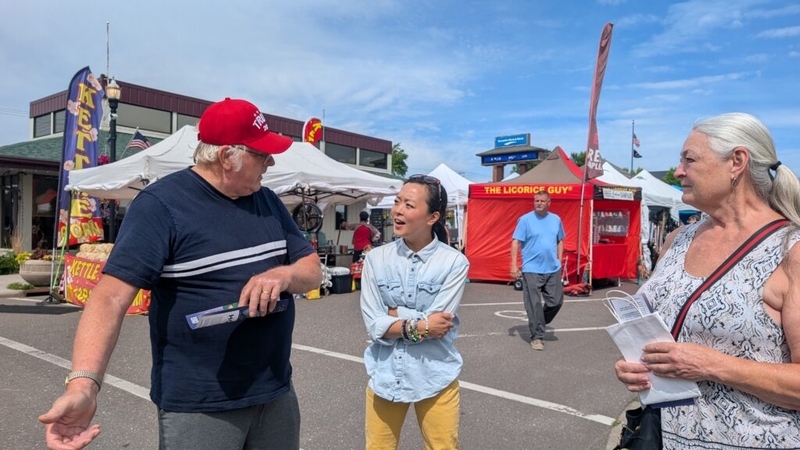
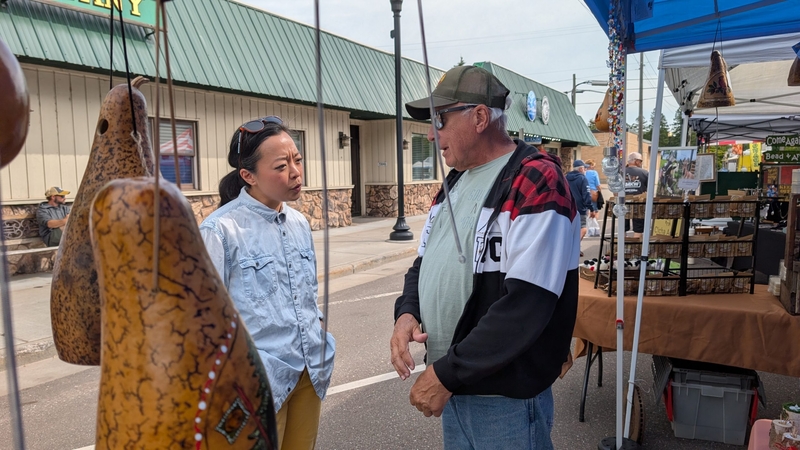
Robert Olson, who donned a ‘Trump 2028’ hat, and his wife speak with Hong. He told the Examiner he only wore the hat “to get the flakes going.” (Photo by Baylor Spears/Wisconsin Examiner)
Early on a Friday morning in June at the 76th annual Musky Fest in Hayward, Wisconsin, a sprawling conversation between state Rep. Francesca Hong (D-Madison), who is running for governor, and dried gourd vendor Pam Boesch ended with an exchange of pregnancy stories.
“I worked in the kitchen at the restaurant until about five hours before my water broke,” said Hong, who has worked as a dishwasher, executive chef and bartender.
Boesch laughed.
“I was bowling in a tournament right up till two days before I had the baby,” she said in response. “I bowled so good. I couldn’t cross that arm over for nothing,” she added, making a swinging motion with her arm. “That baby was keeping me straight.”
The exchange lasted a few moments before the two parted ways, and Boesch, a retiree who makes and sells decorative gourds with her husband in northern Wisconsin, is not likely to vote for Hong, but the moment represents part of how Hong, a two-term state lawmaker from one of the bluest cities in Wisconsin, is working to break out in a crowded Democratic primary.
Hong is betting that her working-class background and her pledge to build a government that works for people will connect with a broad swath of Wisconsinites and fuel a movement that crosses partisan lines in a closely divided battleground state.
Building on a national political movement
Hong, a single mom and self-proclaimed “outsider” known for her prodigious cussing and for her Democratic Socialist politics, is running in a fiveway primary for a spot on the November ticket in the race to succeed Gov. Tony Evers. The other candidates in the race are Lt. Gov. Sara Rodriguez, former Lt. Gov. Mandela Barnes, state Sen. Kelda Roys (D-Madison), Milwaukee County Executive David Crowley, and former head of Gov. Tony Evers’ Department of Administration Joel Brennan.

Hong, the first Asian American to be elected to the state Legislature, has represented a big section of deep blue Madison since 2020. She ran for office motivated by the COVID-19 pandemic and the urgent need for more relief for working Wisconsinites. At the time, Hong owned and operated the restaurant Morris Ramen in downtown Madison, which was closed in 2024 due to financial difficulties.
Her candidacy for the state’s top executive office comes at a moment when Democratic socialist and progressive candidates are winning races around the country, challenging establishment Democrats. Socialist New York City Mayor Zohran Mamdani won last year and, in June, three of his endorsed congressional candidates in New York won their primary races, two of them by defeating longtime incumbents. More recently, Melat Kiros, a 29-year-old Democratic socialist defeated a 15-term Democratic incumbent congresswoman in Colorado.
Hong’s run for statewide office in a state that President Donald Trump won twice, in 2016 and 2024, is a new test for the movement.
Hong has sought to connect with voters on the ground, while also tapping into a growing national progressive movement to bolster her campaign. Ever since she launched her longshot campaign for governor, momentum has been steadily growing behind her campaign.
In Marquette Law School polls, Hong has repeatedly polled at the top of the Democratic field, although more than 60% of voters still said they were still undecided. She came in second behind Lt. Gov. Rodriguez in a straw poll conducted by WisPolitics at the state Democratic Party convention, winning 138 votes, or 23.1%.
At a rally at Atwood Music Hall in Madison on the same weekend as the convention, Hong filled the room with excited supporters. Ro Khanna, the progressive Democratic congressman from California and Kat Abughazaleh, the former congressional candidate who made waves by running an upstart campaign as a young progressive in Chicago, both campaigned for her. Along with Khanna, Hong has the endorsement of progressive Minnesota U.S. Rep. Ilhan Omar.
At the Atwood Music Hall rally, Hong pitched herself there as following in the footsteps of Wisconsin’s progressive trailblazers former Gov. Gaylord Nelson, founder of Earth Day and the “father of environmentalism,” former Secretary of State Vel Phillips, the first Black statewide officeholder in Wisconsin who spent much of her career combating racial discrimination in housing and former governor and Sen. Robert “Fighting Bob” La Follette, leader of the progressive movement who helped pioneer progressive taxation and workers’ compensation.

Hong said all of these Wisconsin leaders were called “unreasonable” in their time, but today they are “thought of as visionaries.”
“Did you know that it is our state where environmentalism was born? It was our state where sewer socialism was born. It was our state where Social Security was born,” Hong said to the crowd. “Our progressive roots run deep. F*** Robin Vos and the Republicans, who’ve been trying to uproot our history,” she added, referring to the longtime Republican Assembly speaker who is retiring this year. “That time is over.”
Hong also noted at the rally, which was held immediately after the close of the Democratic state convention in Madison, that she has been repeatedly fielding a lot of the same questions.
“I got asked over and over again about, ‘We love your campaign. We love what you stand for. Your policies are amazing. It’s so thorough, but can you win?’” Hong said to shouts of “Yes!” from the crowd, “I wouldn’t be running if I didn’t think we could win.”
While she has growing support, Hong has had to navigate a number of controversies in recent months. She was sued for a $30,000 credit card debt, accumulated by her now-closed restaurant, although she said it was paid off by her parents shortly after Capital One Bank filed the lawsuit, according to the Capital Times. She has also taken to social media to answer criticism of her past statements that she supports policies to “defund the police.”
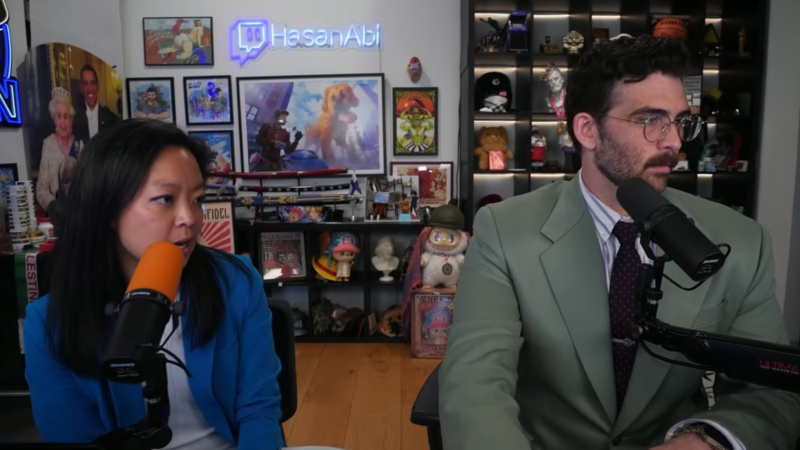
Another controversy popped up this week during livestreams Hong appeared on to raise money and bolster her candidacy nationally. Just ahead of a key fundraising deadline, Hong flew to California to speak with Hasan Piker, the left-wing Twitch streamer who has made controversial comments including saying that the U.S. “deserved 9/11,” which he later said was “inappropriate.” During the same week, she appeared on a show with streamer Michael Beyer, also known as Mike from PA, who has been criticized for saying that Jews are “demonic.”
Hong raised over $92,000 for her campaign during the appearances on Beyer and Piker’s streams. Piker also said during the stream that he would come to Wisconsin to campaign for Hong.
Hong’s campaign responded to the criticism in a lengthy statement, saying “antisemitism, Islamophobia, racism, transphobia, and all forms of dehumanization have no place in Wisconsin politics or in the movement we are building,” condemning all violence including the Hamas attack on Israelis on Oct. 7, and that she was unaware of the comments made by Beyer before going on.
However, the campaign also said the discussion was a distraction from the substance of the conversation on the live streams where she said she was trying to reach voters who have typically ignored and disengaged from politics.
“Appearing on a podcast or livestream is not an endorsement of every statement a host has ever made,” the campaign said. “Fran is willing to go anywhere and talk to anyone about her vision for a better, more compassionate world… If we refuse to show up, those voters will hear only from the right, from the conspiracy theorists, or from people who do not share our values.”
Hong’s Democratic primary opponent David Crowley, the Milwaukee County executive, said on X that he would not go on Piker’s broadcast if invited, as his statements are “beyond the pale.” Another opponent, Kelda Roys, also criticized the appearance, saying it “wasn’t about trying to persuade voters who disagree with you and having an honest conversation across differences; it was about raising money” and that it was “a deliberate choice about what you’re willing to tolerate when you’re seeking campaign cash.”
The livestreams did not include discussion of the controversial comments, but focused on Hong’s campaign, including her proposals for taxing the rich, funding public schools, implementing universal child care, paid family and medical leave and putting a moratorium on data center development.
Hong also promoted establishing a public grocery store, noting wryly that a similar policy is being implemented in “communist” Indiana. She proposed a public bank, which would be modeled after the country’s only such bank in North Dakota (a “famously a communist state” she joked), that would be used to give small businesses subsidized loans.
“If it is radical to have free child care and public grocery stores, I would say, let’s be radical, let’s embrace that,” Hong said on Piker’s stream. “That hasn’t been what we’ve done in the past, and look at where we are now using the same playbook and strategy. We’ve been incremental in the past, and it’s led to complacency.”
Reaching voters in Tom Tiffany’s district
Beyond Madison and national livestreams, Hong is taking her message to voters across the state.
During her day visiting a handful of towns north of Highway 29, in the heart of the 7th Congressional District currently represented by Republican gubernatorial candidate and U.S. Rep. Tom Tiffany, Hong spent the majority of the day meeting with Democrats and progressives. But she started the day at the 76th Musky Fest in Hayward, an annual celebration of the area’s deep fishing culture, where she spoke with Republicans and politically unaffiliated Wisconsinites.
Pam Boesch, a retiree, makes “thunder gourds” — percussive instruments made from dried gourds that make a sound like thunder when shaken — that she sells with her husband mostly at farmers’ markets. It’s a side gig for the couple who are on a fixed income and expressed concerns about rising property taxes. Boesch said she plans to vote for Tiffany, the presumptive Republican nominee for governor and said he had “blessed” her and her husband.
During the conversation, Hong learned that the retirees were friends with Rep. Chanz Green (R-Mason), her colleague in the Assembly, and Green had once referred them to Tiffany’s office, when they weren’t able to cash a check from Veterans Affairs. Tiffany helped them recover the money.
“[Tiffany] does care about people, and he’s very down to earth and very personable, too, and he makes a presence in this north country. That is important, just like she is,” Boesch said, referring to Hong.
While she appreciated the conversation and Hong’s visit to the Northwoods, Boesch questioned some of the ideas that Hong articulated, including taxing billionaires to pay for bolstered government services.
Hong has said that she wants to take the burden of school funding off property taxpayers by increasing state funding to two-thirds of the cost of public schools, but that it will be necessary to bring more revenue into the state by taxing rich individuals and megacorporations. She has said that she would also wants to legalize and tax cannabis to help pay for her policy priorities, as well as explore putting in place a small payroll tax and eliminating tax exemptions for data centers.
Boesch asked how many billionaires there are in Wisconsin to tax. According to In Business Madison, there are seven.
“Is that the answer? Taxing the millionaires and billionaires? Is that the whole answer to it? I don’t know,” Boesch said. “I think cutting spending is a good answer… We have to learn how to live within a budget. We shouldn’t have to look for another way to find more money so you can spend more money.”
Boesch added that she and her husband are low-income, but never borrow money. “I mean, living in a budget is something everyone has to do,” she said.
Hong then spotted Robert Olson, who donned a ‘Trump 2028’ hat. He told the Examiner he only wore the hat “to get the flakes going.”
The two spoke about patriotism and public schools. Olson said he was worried about the lack of training in the trades, including shop classes in the schools, while Hong said the state could get rid of Act 10, the Walker-era law that stripped collective bargaining rights from public employees including teachers, so they could get paid more. When his wife, Lolita, who is a town clerk and on the county Board of Supervisors, walked up, the conversation turned to shared revenue, the state’s system for funding local governments.
Olson said after that it’s not a “shoe-in” that he’ll vote for Tiffany. He described him as “OK” and not “breaking any records.” He said if there is a Democrat with better ideas, he’d be open to voting for them.
“She pays attention very close, and she’s got her mind on the issues,” Olson said of Hong. “And she never said what party she’s with, which to me is very important.”
Progressives and Democrats in the Northwoods
After spending the morning talking with skeptical Republicans and independents at Musky Fest, Hong faced a different audience: Democrats and progressives. In that safer forum she addressed, in her words, the “big scary S word.”
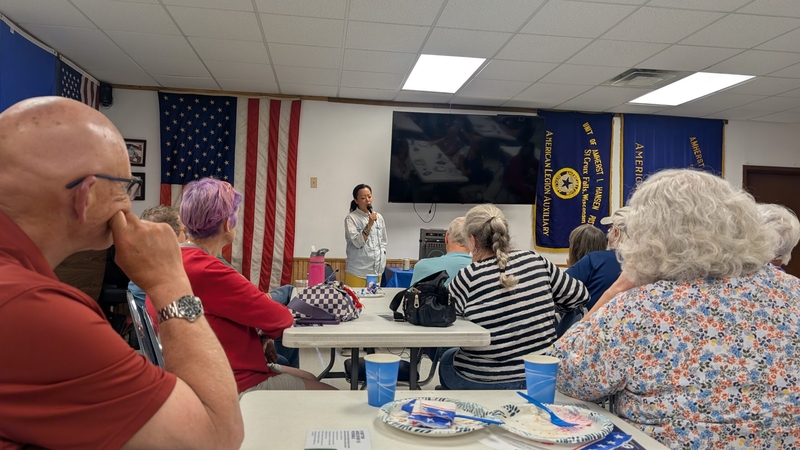
In Luck, Wisconsin, about an hour and a half south of Hayward, Hong told a small group of progressives and Democrats that she had “some really good conversations” with voters who wanted to talk about issues like public schools and property taxes.
“It turns out folks are pretty excited about taxing the rich, too,’ Hong said. “Wisconsin voters care more about solutions than labels.”
University of Wisconsin-Superior political scientist Alisa Von Hagel told the Examiner in a phone interview that while the Northwoods has trended more Republican over the past decade, the region also has deep roots in labor unions and progressive politics.
“It isn’t the progressive liberalism you would see in San Francisco… but a progressivism that has roots here in the northern Midwest,” Von Hagel said.
Von Hagel said there continues to be a strong Democratic base in the area and it’s important for candidates looking to make inroads in the area to show up.
“Thinking about campaign visits as purely reciprocal… getting as many votes as possible, [a visit] doesn’t have that transactional outcome, perhaps, for visitors coming to the area. However, it’s still symbolically important,” Von Hagel said.
Even so, Von Hagel said Hong’s biggest challenge may not be convincing voters about Democratic Socialism but simply introducing herself to them.
“Especially in a primary election, name recognition is the primary concern that most candidates who aren’t already an incumbent struggle with,” she said.
William Johnson, a former member of the Polk County Board of Supervisors and Frederic resident, told the Examiner that he supports Hong because she is more progressive than other Democratic candidates.
During the meeting at a coffee shop in Luck, Johnson asked Hong about how she plans to overcome name identification challenges across the state. He said some residents in their part of the state know more about Minnesota politics than Wisconsin and some have even claimed that former Minnesota Gov. Jesse Ventura was their governor.
Hong said that’s why she launched an aggressive social media campaign early. On social media Hong has sought to reach voters with frequent video posts, and has addressed controversies including her credit card debt. Her campaign has also hosted and attended over 300 in-person events since it launched in September.
During a Polk County Democratic Party meeting, Hong started by talking about public schools and wanting to end the state’s school voucher system, implementing a public option for healthcare and ensuring that the state’s natural resources aren’t “for sale” to data center and AI companies.
“We can do this, especially when we have a trifecta. We’ve got an opportunity this year to make sure that we flip the Legislature,” Hong said, referring to Democrats’ hopes of winning majorities in the state Assembly and Senate as well as the governor’s office.
As she took questions, the broader concern about the Democratic Socialist label came up.
“If you’re more left than center, I mean we live in a state that, let’s face it, we have a lot of Republicans in this state,” one attendee said, “what is your plan to win those people over if and when you win the primary election?”
Hong explained that she has embraced the label because it aligns with her values.
“Republicans have made it so that we think government has to be dysfunctional, but the policies that we’re running on make government a force of good,” Hong said. “That’s what it’s actually supposed to be… a social insurance space.”
Hong compared “mutual aid,” a term used in urban activist and progressive circles for pooling resources to help communities, to neighbors in rural Wisconsin helping their neighbors mow their lawns and plow driveways in the snow.

Von Hagel said she thought the message could be effective with people in the Northwoods, pointing to the tradition of community spaghetti dinners for people facing hardships.
“It’s one small example, but I think it’s a philosophy and a tradition that resonates with people who are from here and live here.” Von Hagel said.
Hong described on her conversations at Musky Fest. She said she didn’t know whether the people she spoke with there would vote for her, adding that if the guy wearing the Trump hat Googled her he might find things he dislikes.
But, she said, she hopes when he remembers the conversation he feels that “Democratic Socialism isn’t scary, that I’m someone that is an ordinary person trying to make it so that folks can live easier lives, be able to take care of themselves, their kids, aging parents, and help their neighbors.”
Madison, WI